How deep should a sideboard be? Eighteen inches, and why
The Wooden Stars is a participant in the Amazon Services LLC Associates Program. We may earn a commission when you buy through links on our site, at no extra cost to you.
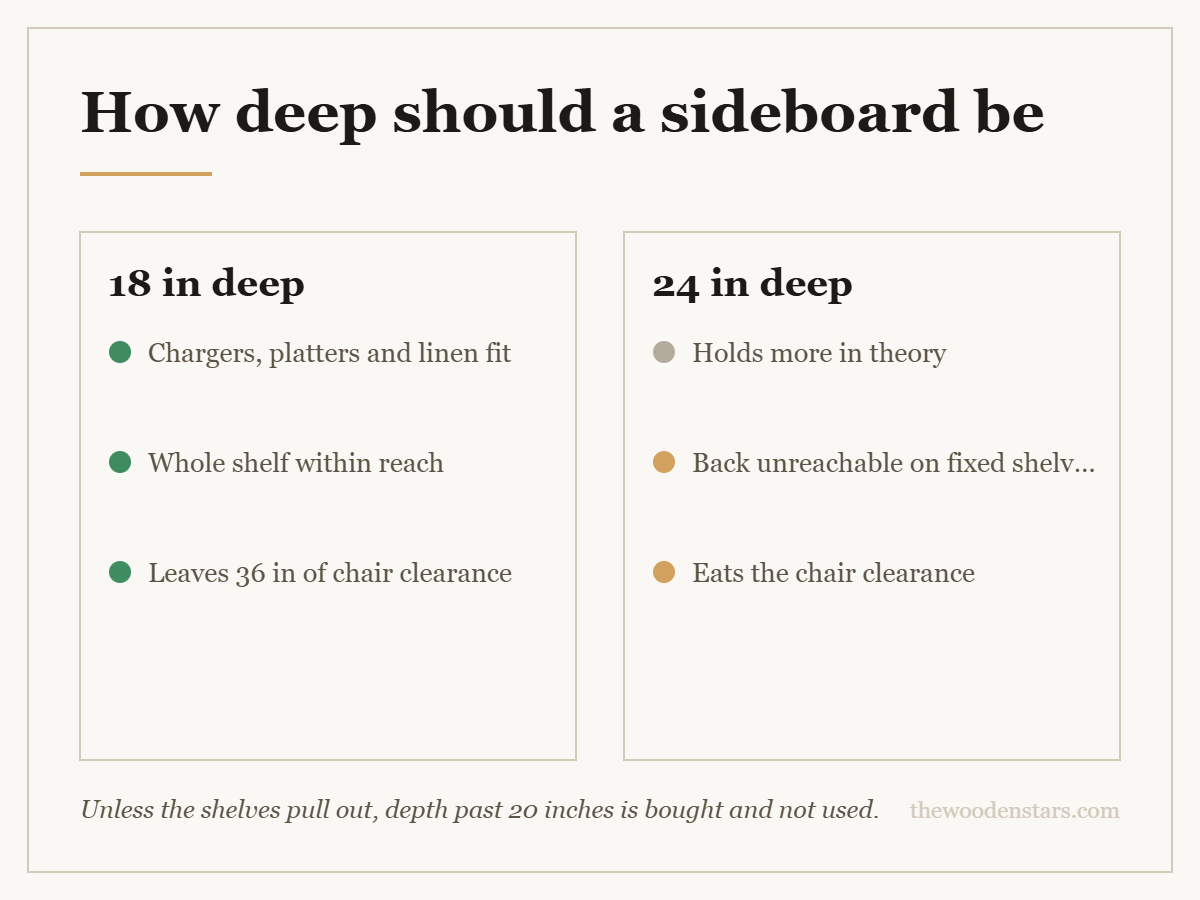
How deep should a sideboard be? Between 16 and 20 inches, and 18 is the figure that fits the most things people actually put in one.
Depth is the specification that decides whether a sideboard works, and it is the one buyers check last — usually after discovering that dinner plates do not fit.
Aim for 18 inches. That takes a 12-inch dinner plate stacked, a 13-inch charger, most serving platters on edge and a standard placemat box, with room for the door to close on the back panel. Below 16 inches the useful contents drop off sharply — that is console-table territory, good for keys and lamps, not tableware. Above 20 inches you gain little because you cannot reach the back of a deep shelf without unloading the front, and you start blocking a walkway. In a dining room allow 36 inches of clearance in front so chairs can pull out past it.
How deep should a sideboard be for what goes in it
Work from the contents, because that is what the depth is for.
- Dinner plates, 10 to 12 inches: need 14 inches of internal depth stacked flat.
- Chargers and large platters, 13 to 16 inches: need 17, or they go on edge.
- Placemat and napkin boxes: 14 to 16.
- Table linen folded: 16 to 18.
- Wine bottles lying down, 12 inches: 13.
- Serving bowls and tureens: 15 to 18.
Add about 1.5 inches for the door and the back panel, and 18 inches external covers nearly all of it. Sixteen covers plates and bottles but not chargers or linen.
| External depth | Internal | What it holds |
|---|---|---|
| 12 to 14 in | 10 to 12 in | Keys, lamps, small plates — a console |
| 16 in | 14 in | Dinner plates, bottles, most glassware |
| 18 in | 16 in | Chargers, platters, folded linen — the sweet spot |
| 20 in | 18 in | Large tureens, stacked serving ware |
| 24 in and over | 22 in | More than you can reach without unloading |
Why deeper stops helping
A shelf you cannot reach the back of is storage you use once a year, because getting to it means taking everything out of the front.
Comfortable reach into a cabinet at waist height is about 18 inches. Past that the back becomes a place things go to be forgotten — which is fine for Christmas platters and a waste of money for anything else.
Deep sideboards earn their depth only with pull-out shelves or drawers, which bring the back to you. If a listing offers 24 inches on fixed shelves, the extra six inches are decorative.
The room decides the maximum
Depth is also a circulation number, and this is where an 18-inch piece beats a 22-inch one regardless of what fits inside.
- Against a dining room wall: allow 36 inches between the sideboard front and the nearest chair back, so chairs pull out past it. In a 12-foot room with a 40-inch table, an 18-inch sideboard leaves that; a 24-inch one does not.
- In a hallway: keep the total obstruction under 30 inches, which usually means 14 to 16 inches deep — and at that depth you are buying a console, not a sideboard. See credenza against console table.
- Under a window: check the sill projection and the radiator, which often set the depth before you do.
Dining room clearances are in dining table width.
The other two numbers, while you are measuring
Height: 32 to 36 inches. Serving height, which is the point — it should be comfortable to put a dish down on without stooping. Under 30 it becomes a media unit; over 38 it is a highboy and you cannot see the top.
Length: 48 to 72 inches. The convention is that a sideboard reads correctly at roughly two-thirds to three-quarters of the wall it sits on, and it should not be longer than the dining table it serves.
The word itself is slippery — sideboard, credenza and buffet overlap heavily in listings. Sorted out in credenza against sideboard against buffet.
What to check inside, not just the depth
- Internal against external. Listings give external. Subtract 1.5 inches for the door and back before judging whether a plate fits.
- Adjustable shelves. Fixed shelves at the wrong pitch waste more capacity than two inches of depth ever gains — shelf pins and support sizes.
- Shelf thickness against span. A 48-inch shelf under 0.75 inches sags under stacked plates, which are heavy — how to fix a sagging shelf.
- A solid back panel, let into a groove rather than pinned on. It is what stops a long carcass racking.
- Drawer runners. Full-extension runners make a deep drawer usable; three-quarter runners hide the back four inches permanently.
Material terms are in what engineered wood actually is, and the storage versions in sideboards with storage and buffets with drawers.
Getting the depth to work
- Shelf pins and supports Adjustable shelving recovers more capacity than extra depth
- Full-extension drawer runners What makes the back of a deep drawer reachable
- Cabinet shelf liner Stops stacked plates sliding on a deep shelf
- Furniture anti-tip strap A tall, shallow sideboard tips more easily than a deep one
What to buy
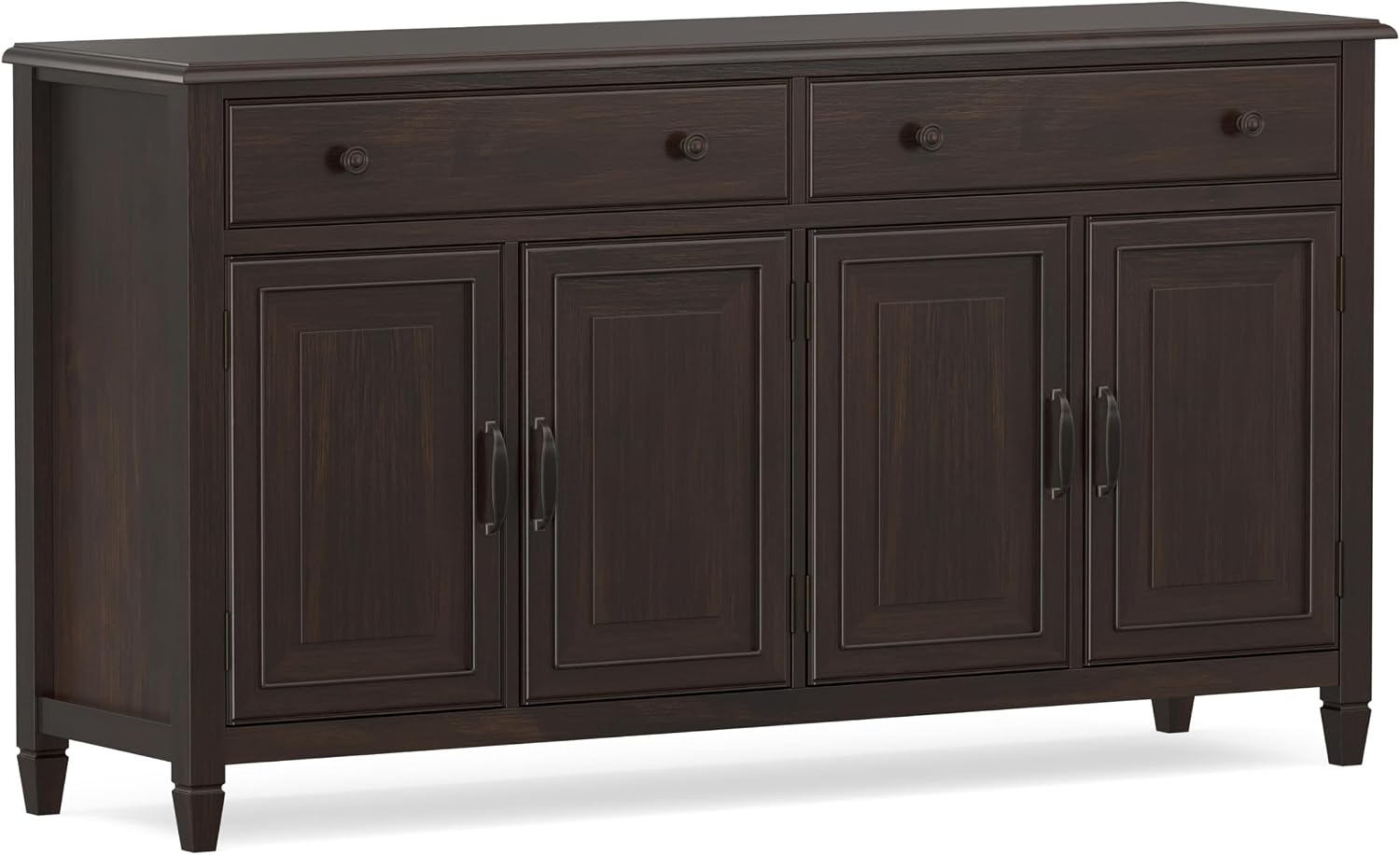

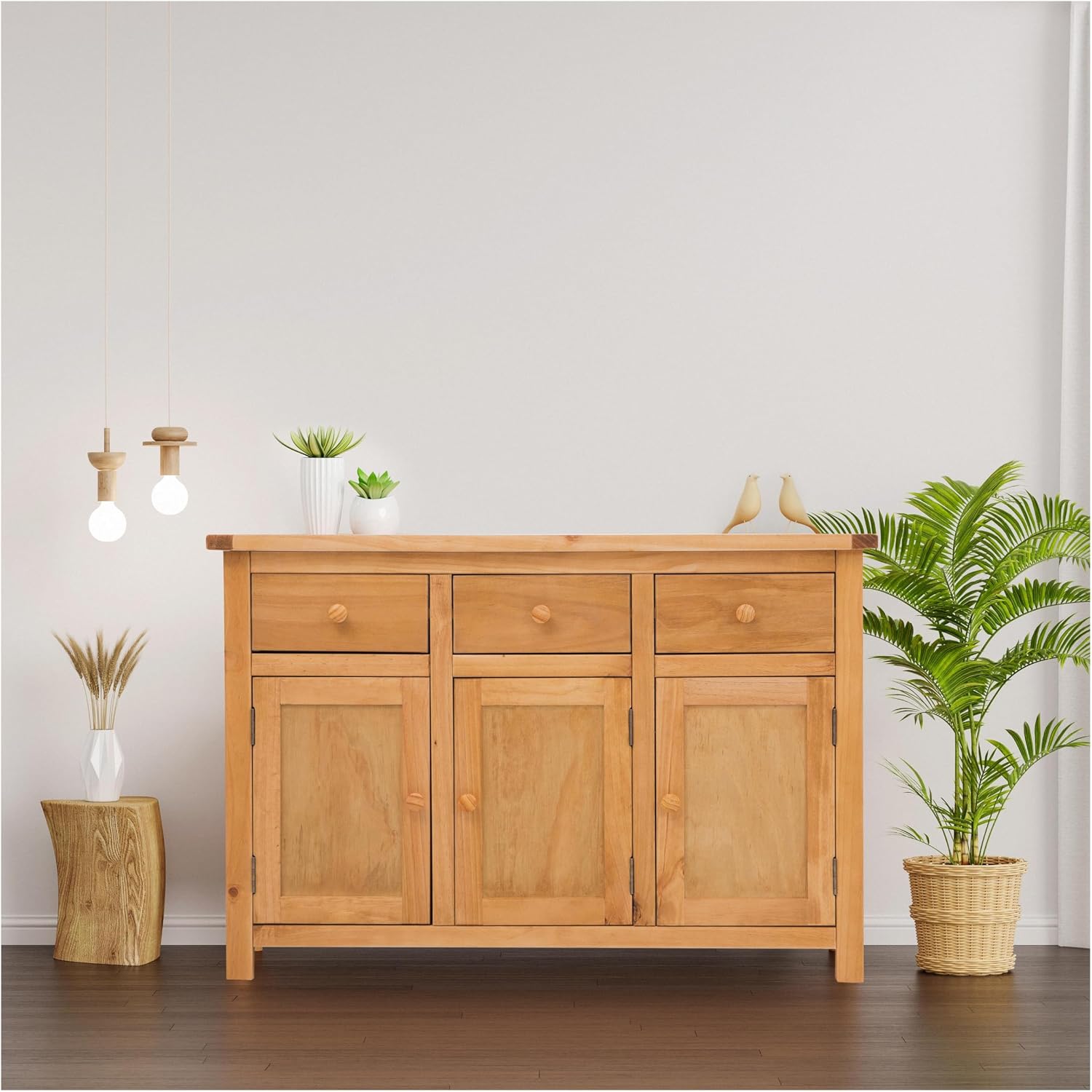

For the pieces themselves, see sideboards with storage, buffets with drawers and media consoles with storage. For the naming, credenza against sideboard against buffet and credenza against console table. For the top unit, buffet against hutch.
Questions we get asked
How deep should a sideboard be?
Sixteen to 20 inches, with 18 the figure that fits the most things people actually store — plates, chargers, platters and folded linen.
Is 16 inches deep enough?
For dinner plates and bottles, yes. Chargers, large platters and folded table linen want 18.
Why not buy a deeper one?
Comfortable reach into a waist-height cabinet is about 18 inches. Past that the back of a fixed shelf is unusable without unloading the front.
Is the listed depth internal or external?
External. Subtract about 1.5 inches for the door and back panel before checking whether a plate fits.
How much clearance does a sideboard need in a dining room?
Thirty-six inches between its front and the nearest chair back, so chairs can pull out past it.
What height should a sideboard be?
Thirty-two to 36 inches — serving height, so a dish can be set down without stooping.