Table Legs: Height, Thread and Fixing, in That Order
The Wooden Stars is a participant in the Amazon Services LLC Associates Program. We may earn a commission when you buy through links on our site, at no extra cost to you.
Most table legs sold online will not fit the table you already own, and the reason is almost never the leg. It is the thread, or the height, or the fact that the top has nothing to screw into.
Get those three right, in that order, and the style question sorts itself out. Get them in the wrong order and you buy a beautiful set of legs that arrive with an M10 stud for a table with a 5/16 inch insert.
Work in this order. Height first: finished table height minus the top thickness gives the leg length you need, and dining is 730–760 mm finished. Fixing second: a leg either screws into a threaded insert, bolts through a mounting plate, or is joined into an apron — and they are not interchangeable. Thread third, and only if the leg screws in: the two common ones are 5/16 inch-18 UNC and M8, they look identical, and they will not cross-fit. Measure an existing stud with a caliper before ordering anything.

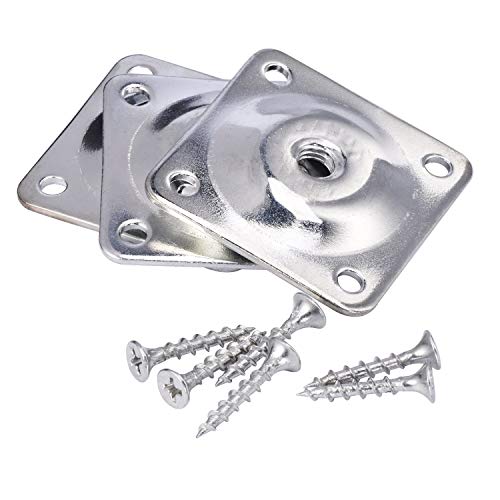
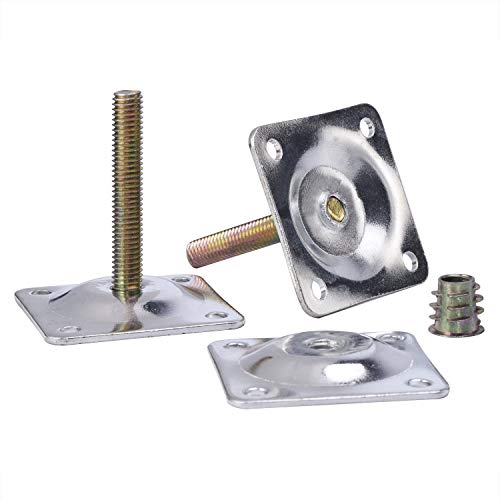
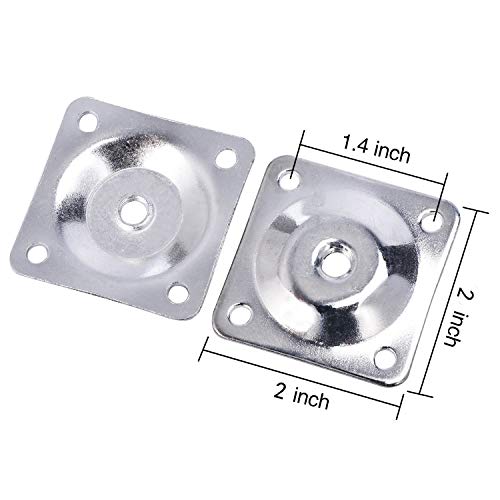
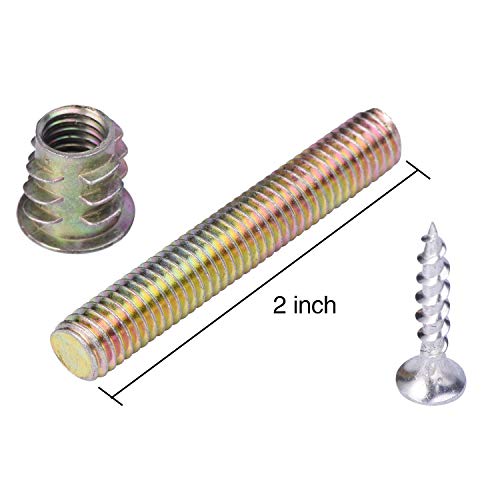
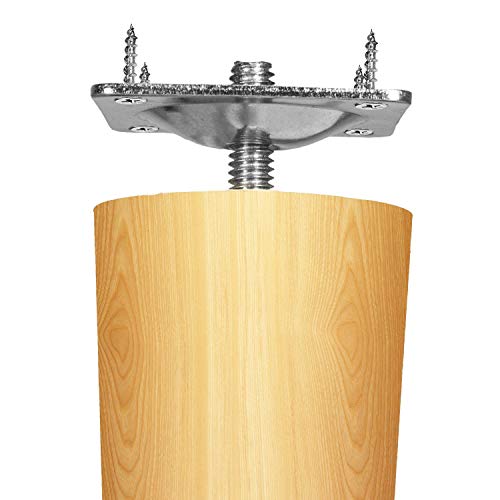
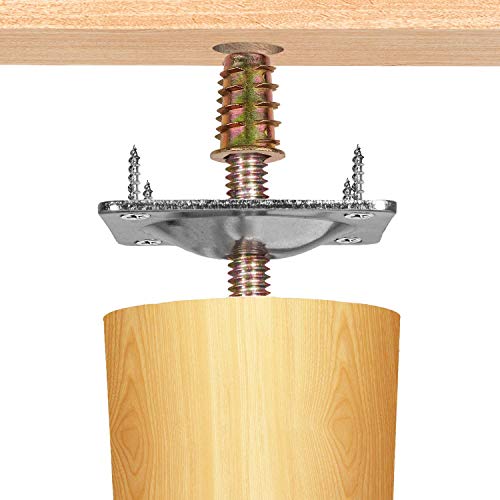
Prime Maricome 4PCS Leg Mounting Plates with Screws for Sofa Couches Tables Furniture Legs Brackets Hardware Attachment Plates Brackets M8 T-Plates


As an Amazon Associate we earn from qualifying purchases. Product prices and availability are accurate as of the date/time indicated.
Start here: the plate is what fails or holds, so start there. A good leg on a poor fixing wobbles; a plain leg on a proper plate does not.
Height: the number to settle first
Leg length is not table height. The top adds its own thickness, and any glide or levelling foot adds a few millimetres more.
| Table | Finished height | With a 25 mm top, leg length | With a 40 mm slab |
|---|---|---|---|
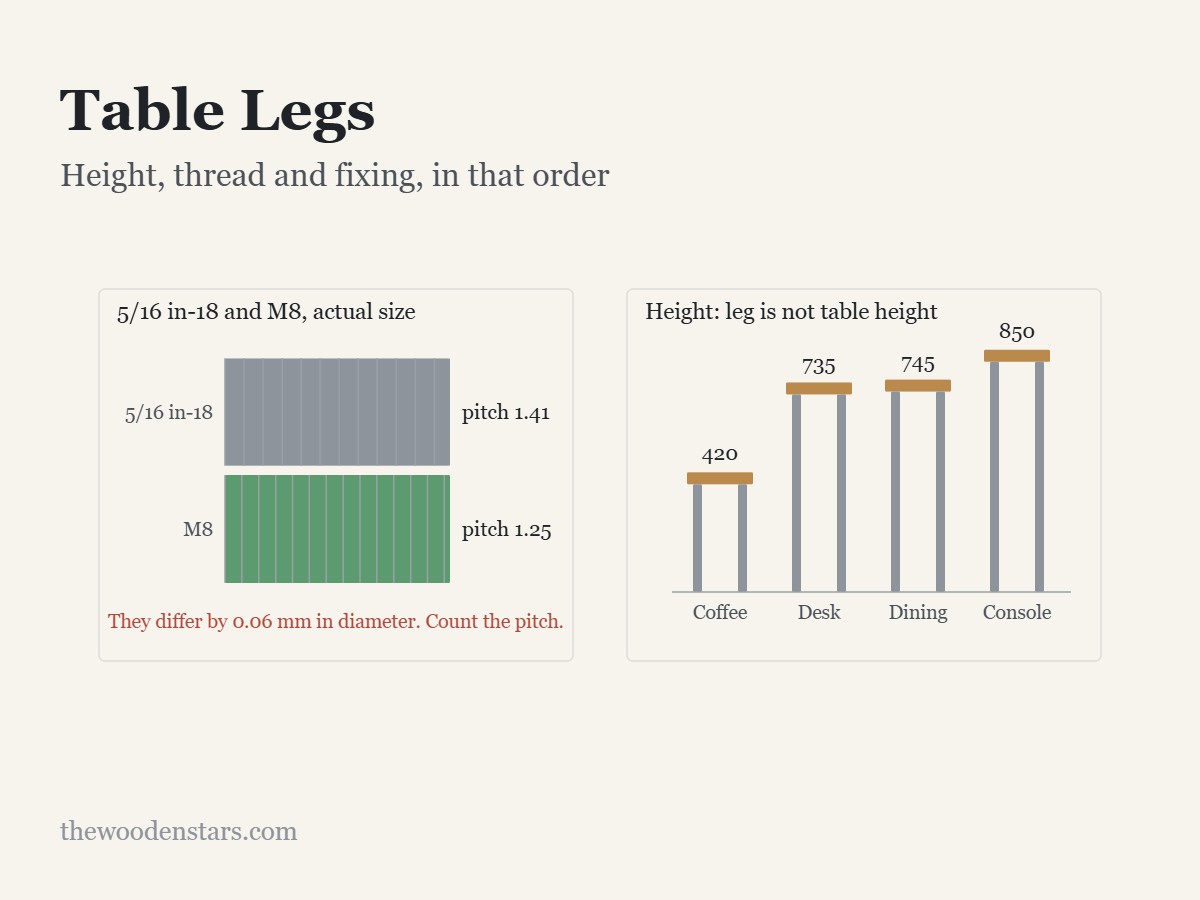
| Dining table | 730–760 mm | 705–735 mm | 690–720 mm |
| Desk | 720–750 mm | 695–725 mm | 680–710 mm |
| Console or hall table | 800–900 mm | 775–875 mm | 760–860 mm |
| Coffee table | 400–450 mm | 375–425 mm | 360–410 mm |
| Side or bedside table | 550–650 mm | 525–625 mm | 510–610 mm |
| Counter-height table | 900–920 mm | 875–895 mm | 860–880 mm |
Two checks that save a return. Leave at least 300 mm of knee clearance under a dining apron, measured from the floor to the underside of the apron rather than the top. And if the legs are angled outwards, the splay eats floor space at the ends — measure the footprint, not just the top.
Desks are a special case and are not simply low tables: keyboard and chair-arm clearance change the arithmetic, which is covered in our guide to wooden desk legs. Coffee tables are the other end of the range, and the low height changes how the leg is best attached — see metal coffee table legs.
Fixing: three systems, and they do not mix
Threaded insert and stud
A metal insert is driven into the underside of the top, and the leg has a matching stud. Quick to fit and to remove, which makes flat-packing and moving easy. The whole load passes through one thread, so the insert has to be seated in solid material — not into the edge of plywood, and not into MDF without a larger insert designed for it.
Mounting plate
A steel plate screws to the underside of the top with four to six screws, and the leg bolts or screws to the plate. Spreads the load over a much larger area than an insert, and it is the right answer for a thin top, a board top, or an angled leg. Hairpin legs are effectively plate-mounted legs with the plate built in.
Apron and rail joinery
The traditional method: the legs are joined to rails that run between them, and the top sits on the resulting frame. By far the strongest, because the frame resists racking rather than relying on the fixing at the top. This is what you have if your table has a wooden rail around the underside, and it is also why those tables rarely wobble.
| Fixing | Top thickness | Resists racking | Best for |
|---|---|---|---|
| Threaded insert, 5/16 in or M8 | 25 mm and up, solid | Poorly | Straight legs, flat-pack, quick swaps |
| Threaded insert in MDF, special | 18 mm and up | Poorly | Board tops, light duty only |
| Mounting plate, 4 screws | 18 mm and up | Moderately | Thin tops, angled legs, hairpins |
| Mounting plate, 6 screws or corner block | 25 mm and up | Well | Heavy tops, tables that get moved |
| Apron and rail | Any | Very well | Dining tables, anything that takes side load |
A wobble almost always means the fixing has loosened rather than the leg has failed, and the order to check it in is set out in our guide to a wobbly dining table.
Thread: two sizes that look the same
This is the single most common ordering mistake. The two threads in general circulation are 5/16 inch-18 UNC (7.94 mm diameter) and M8 (8 mm). They differ by six hundredths of a millimetre in diameter and, more importantly, in pitch — 18 threads per inch against 1.25 mm.
- You cannot force one into the other. It will start, bind after two turns and strip the insert.
- The pitch is the tell. Lay a rule along the thread and count: 18 threads in an inch is UNC, and a thread every 1.25 mm is M8.
- Country of origin is a hint, not proof. North American furniture leans to 5/16 in, European and Asian to M8, and plenty of both is sold everywhere.
- Heavier legs use M10 or 3/8 in. Same trap, one size up.
A digital caliper settles it in seconds and is the same tool that decides levelling feet and drawer slide clearances. It is the cheapest way to stop guessing.
The leg families, and what each is for
- Tapered. The default for a dining table or a sideboard. Straight or slightly splayed, plate or insert mounted, and quiet enough to suit almost anything.
- Turned. Shaped on a lathe, traditional in look, usually thicker and often supplied for apron joinery rather than plate mounting.
- Hairpin. Two steel rods welded to a plate. Light, cheap and fine at coffee-table height; at dining height a hairpin flexes noticeably, and it cannot be straightened once bent.
- Trestle and A-frame. Two end frames joined by a stretcher. Very stable and no leg at the corners, so more seats fit.
- Pedestal. One central column with a spread foot. Maximum legroom, but the top must be well braced or it will rock.
- Box or plinth. A closed panel each end. Modern, extremely rigid, heavy.
Chair legs behave differently from all of these, because a chair takes side load every time somebody sits down — which is why they fail at the joint rather than the leg, and why they get their own chair leg guide.
What to buy
- Leg mounting plates, M8 The fixing decides more than the leg does On Amazon →
- Hairpin legs, 16 in, 3 rod Right at coffee and side table height, not at dining height On Amazon →
- Figure 8 table top fasteners Lets a solid top move without splitting On Amazon →
- Felt pads Fit them while the legs are off On Amazon →
- Digital caliper Settles 5/16 in against M8 in seconds
What to buy


Fitting new legs so the table does not rock
- Work on the top upside down, on a flat floor. Not on carpet, and not on the old legs.
- Mark all four positions from the same two edges. Measuring from the nearest corner each time compounds every small error into a rock.
- Drill inserts square, with a stop. An insert going in at an angle puts the leg at an angle, and it is very visible.
- Tighten a plate’s screws in a cross pattern, the way wheel nuts go on, so the plate seats flat.
- Stand it up and check for rock before loading it. If one leg is short, fit a levelling glide rather than shortening the other three.
Questions we get asked
What thread do table legs use?
Either 5/16 inch-18 UNC or M8 for most legs, and M10 or 3/8 inch on heavier ones. They are visually indistinguishable and do not cross-fit. Measure the diameter and count the pitch on an existing stud before ordering, or buy the legs and the inserts together as a matched set.
How long should table legs be?
Finished height minus the top thickness, minus any glide. For a dining table with a 25 mm top that means roughly 705–735 mm of leg. Check knee clearance under the apron as well: below about 300 mm from the floor to the underside of the apron, a dining table stops being comfortable.
Can I put new legs on a table with an apron?
Usually yes, but not with inserts into the top — fix a corner block or a plate to the apron and mount to that. Screwing an insert into a thin top inside an apron frame is the one combination that tends to pull out, because the apron stops the top flexing and all the movement goes into the fixing.
Are hairpin legs strong enough for a dining table?
For a small table, with a light top, and accepting some flex, yes. For a full-size dining table, no — the rods are too slender at that length, and once one bends it stays bent. They are at their best at coffee-table and side-table height.
Do I need four legs, or is a pedestal better?
Four legs are simpler and stronger for the same money. A pedestal buys legroom and easier seating, at the cost of needing a well-braced top and a heavier base to stop it tipping when somebody leans on the edge.