Dining sets with storage — What the bench actually holds
The Wooden Stars is a participant in the Amazon Services LLC Associates Program. We may earn a commission when you buy through links on our site, at no extra cost to you.
A dining set with storage is usually a table, two benches and sometimes two chairs, where the benches lift or the table carries a shelf underneath. The selling photograph shows the lid open and a stack of neatly folded linen inside.
The useful question is not whether the storage exists. It is what that storage costs you in seat comfort, and whether the volume is a real cubic foot or a four-inch tray.
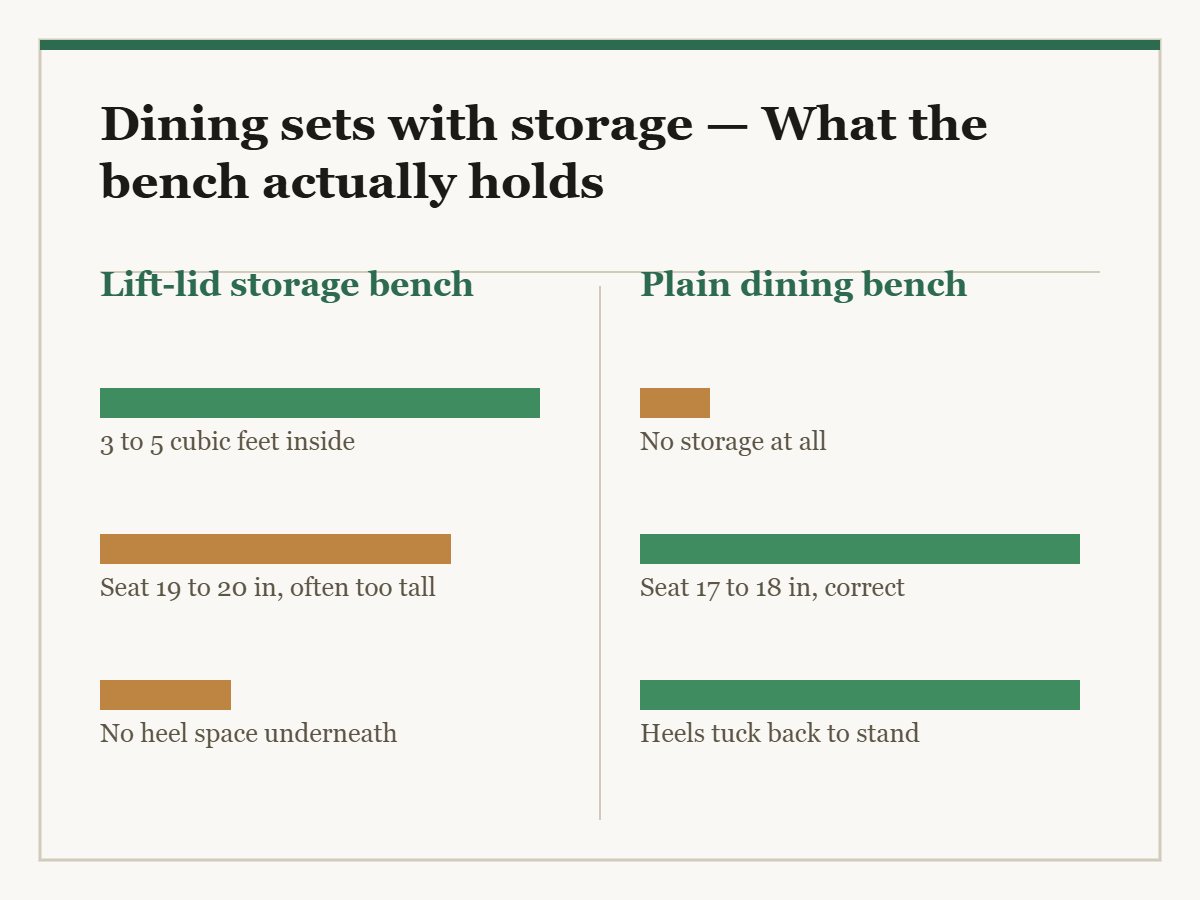
Storage in a dining set comes in three places and they are not equal. A lift-lid bench gives the most volume — typically 3 to 5 cubic feet — but adds a seat box that raises the seat and removes the space your heels sit under. A table shelf or trestle box holds the least but costs you nothing in comfort. A drawer in the apron is the shallowest, usually 2 to 3 inches deep, and is for placemats and nothing else. Check the seat height with the lid fitted — 17 to 19 inches is what you want, and storage benches routinely arrive at 19 to 20. And check how the lid is held open, because a lid with no stay closes on hands.
Where the storage actually is
Lift-lid benches
The whole seat is a box and the top hinges. This is where nearly all the advertised volume lives — 3 to 5 cubic feet in a 42 to 48 inch bench, which genuinely swallows table linen, board games or a folded high-chair.
Two costs. The box fills the space under the seat, so you cannot tuck your heels back when you stand, and the added floor makes the seat 1 to 2 inches taller than a plain bench of the same design.
A shelf or box under the table
A lower shelf between the trestles, or a shallow box hung under the top. Volume is small and the contents are visible, so it suits things you use at the table — trivets, a fruit bowl, place mats.
It takes nothing away from the seating, and it is the only kind of dining storage that does not change how the set feels to sit at.
Apron drawers
A drawer in the rail under the table top. Depth is limited by the apron itself, so 2 to 3 inches is normal and 4 is generous. Fine for cutlery and mats; not a place for anything with height.
The seat height problem, in numbers
A dining table sits at 29 to 30 inches. The gap you want between seat and table top is 10 to 12 inches, which puts the correct seat at 17 to 19 inches.
A plain bench lands at 17 to 18. Put a storage box under the same seat and the floor of that box, the box sides and the lid together add height — 19 to 20 inches is common, and at 20 you have 9 to 10 inches of leg gap and your thighs are against the apron.
This is the single measurement listings are least clear about. If a bench is sold with a table set, the seat height is usually stated for the set; if the bench is sold alone, measure it against the table you already own.
| Type | Usable volume | What it costs |
|---|---|---|
| Lift-lid bench | 3 to 5 cu ft | Seat 1 to 2 in taller, no heel space |
| Table lower shelf | 1 to 2 cu ft, open | Nothing, but contents are on show |
| Trestle box | 1 to 2 cu ft | A foot rail you may kick |
| Apron drawer | 2 to 3 in deep | Nothing, but it holds almost nothing |
| Chair with seat box | Under 1 cu ft each | Seat height and a heavier chair |
The lid, which is the part that fails
A bench lid is a wide panel on a long hinge, opened by someone standing over it and closed by gravity.
A friction stay or soft-close hinge holds the lid wherever you leave it. This is the feature worth paying for, and it is what separates a bench you will actually open from one you will not.
A plain butt hinge with no stay means the lid stands up only if the bench is against a wall, and drops the moment it is not. On a child’s bench that is a finger injury waiting to happen.
A lift-off lid — no hinge at all — is the cheapest and the most annoying, because it needs somewhere to go while the bench is open.
Whichever it is, the hinge screws land in the back rail of the box. That rail wants to be solid timber or plywood; the reasons are in what engineered wood actually is.
Measuring the room before the set
- 36 inches of clear floor on every side people use, measured from the table edge to the wall or the next obstruction. Benches need this as much as chairs, because you stand up sideways off a bench.
- The bench must clear the table apron. Push it in and the seat should slide under; if the apron hangs low, the bench parks proud and eats the walkway.
- Lid swing. A lift-lid bench pushed under the table cannot be opened. You pull it out first, so allow the bench length plus a step.
- Table width per person. Allow 24 inches of table edge each — a 60-inch bench seats three adults, not four. Sizing for larger gatherings is in what size dining table seats 8.
What the set is made of
A dining set takes spills, heat, and a bench that gets dragged rather than lifted.
A solid timber top sands and refinishes, which over ten years is the property that matters. Finishes and repair are in the best finish for a solid wood table top.
Veneer on a stable core stays flatter across a wide top and refinishes once. On a dining table that is a genuine advantage, not a compromise — a wide solid top can move at the joints, which is the failure covered in when a dining table top cracks at the seams.
Laminate over particleboard is common at the bottom of this category and cannot be repaired. On a storage bench it matters more than usual, because the box carries weight on screws driven into panel edges.
For the material vocabulary, see solid wood against engineered wood against veneer and solid wood dining tables.
Two things to check in the listing photographs
The inside of the bench. A finished interior with a clean base means the box is built as a box. Exposed staples and a loose bottom panel mean the base will sag under weight.
The underside of the table. Look for corner blocks or a proper apron where the legs meet. That joint is what stops a dining table racking, and it is the same joint discussed in how to fix a wobbly dining table.
After it arrives
- Soft-close lid stay Retrofits to a bench lid that has no stay and drops
- Levelling feet A bench with a box base shows every dip in the floor
- Felt pads Storage benches get dragged, not lifted, and they are heavy
- Hardwax oil Repairs a mark on a solid top in ten minutes
What to buy


If the room is tight, start with compact dining sets for small spaces and dining tables for small spaces. For storage that is not part of the seating, a sideboard holds far more and costs nothing in comfort. Bench comfort is easier to judge against how wide a dining table should be.
Questions we get asked
How much does a storage bench actually hold?
Three to five cubic feet in a 42 to 48 inch bench — enough for table linen, board games or a folded high-chair.
Does a storage bench sit too high?
Often. A plain bench lands at 17 to 18 inches; the same bench with a box under the seat is usually 19 to 20, which leaves only 9 to 10 inches of leg gap under a 29-inch table.
Can I open the bench while it is under the table?
No. You pull it out first, so allow the bench length plus a step of clear floor.
What should I look for on the lid?
A friction stay or soft-close hinge. Without one the lid drops as soon as the bench is away from a wall.
Is a drawer in the table apron worth having?
Only for flat things. The apron limits it to 2 to 3 inches deep, which suits mats and cutlery and nothing with height.
How much floor space does the set need?
Thirty-six inches clear on every side people use, measured from the table edge — the same as for chairs, because you stand up sideways off a bench.