Buffets with drawers — Flatware trays and the 36-inch rule
The Wooden Stars is a participant in the Amazon Services LLC Associates Program. We may earn a commission when you buy through links on our site, at no extra cost to you.
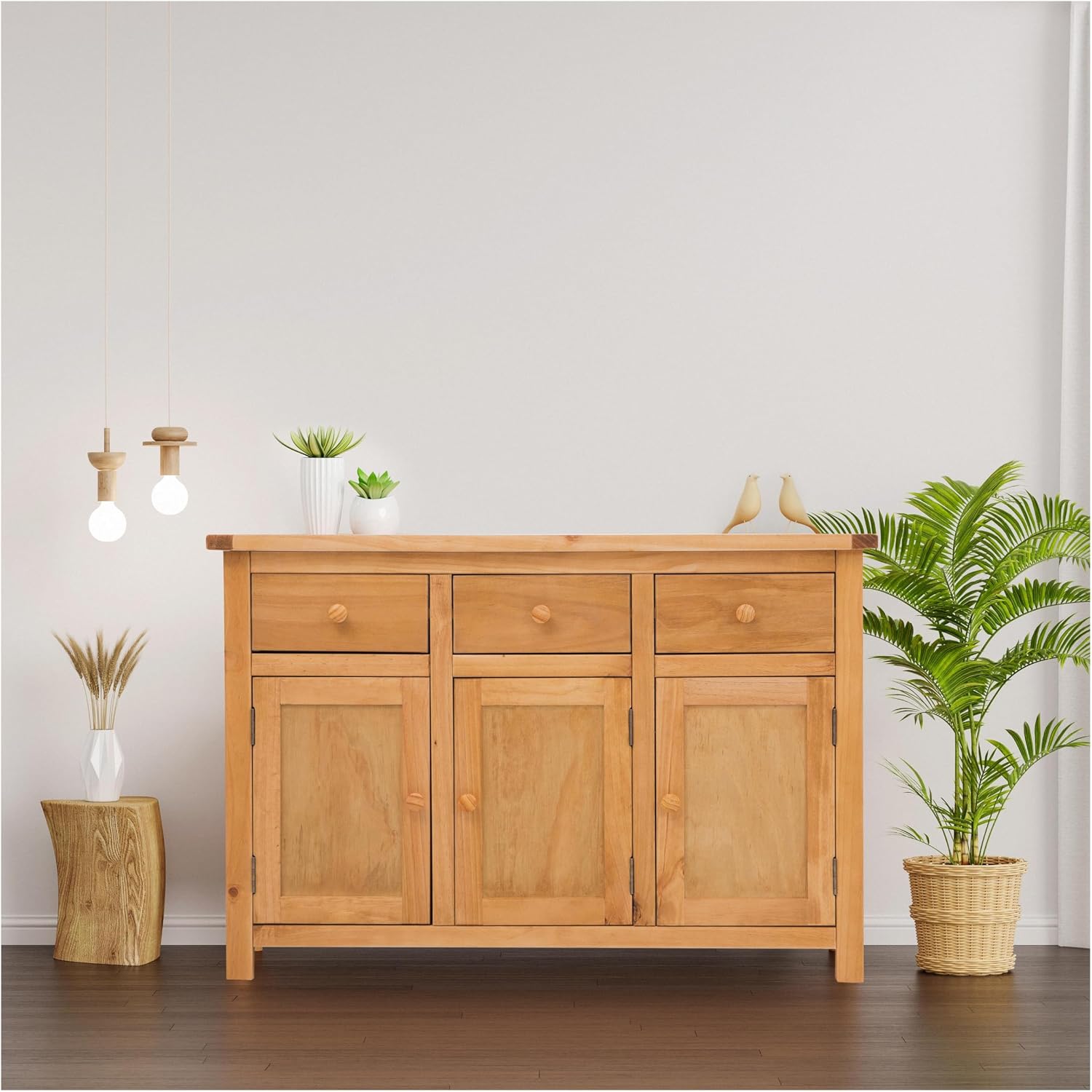
The drawers are the reason to buy a buffet rather than a plain cupboard. A run of shallow drawers along the top is where flatware, napkins, table linen and candles live, and it is the part of the piece you will open every single day.
Which makes it odd how little attention listings give them. The photographs show the drawers closed, the description gives a count, and nothing tells you the one number that decides whether your cutlery tray fits.
A buffet stands 34 to 38 inches tall — deliberately taller than a sideboard, so you can serve from it standing. The top drawers are 3 to 5 inches deep internally and 14 to 17 inches front to back, which is what decides whether a standard flatware tray fits: most trays are 13 to 15 inches deep and 2 inches tall. Below the drawers you get 8 to 14 cubic feet of cupboard. Check the runners — these drawers open daily and bottom-mounted rollers sag — and allow 36 inches of clear floor in front, because a drawer plus a person is more than a walkway.
Drawer dimensions, and the flatware tray test
The useful measurement is internal, and there are three of them.
- Depth front to back: 14 to 17 inches on a buffet 18 to 20 inches deep. A standard flatware tray is 13 to 15, so most fit — but a 16-inch tray in a 14-inch drawer does not, and you will not find that out until it arrives.
- Height inside: 3 to 5 inches. A cutlery tray is about 2, leaving room for serving spoons above it. Under 3 and the tray is the drawer.
- Width: whatever the bay is. Two drawers across a 60-inch buffet gives about 27 each, which takes a tray plus a stack of napkins.
If the listing gives only external dimensions, subtract about 1.5 inches from the depth and 1 from the height to get the inside.
Runners, because these drawers work harder than most
A buffet drawer gets opened at every meal, often one-handed, often while holding a plate.
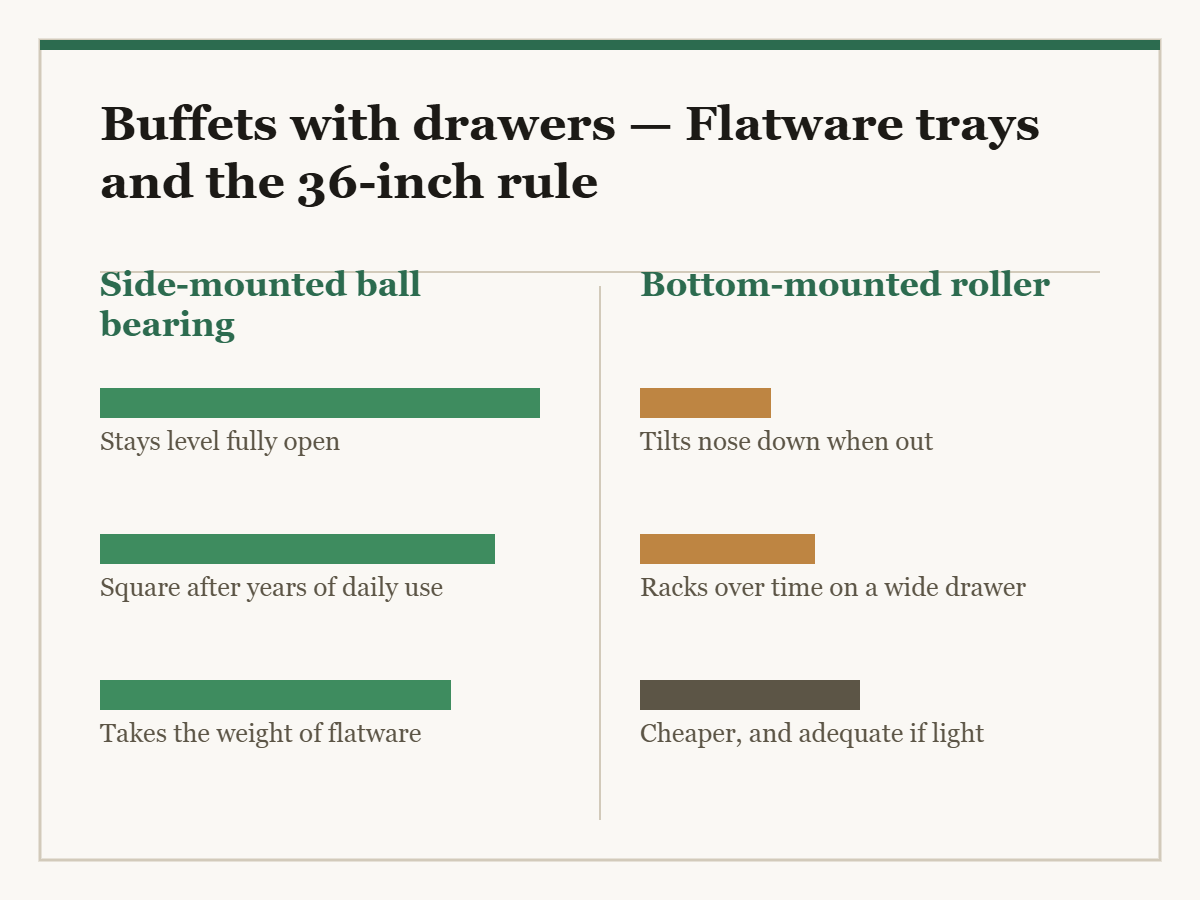
Side-mounted ball-bearing runners carry the load on both sides and stay square. They are what you want, they usually come with a soft-close option, and they are the difference between a drawer that still runs true in year five and one that does not.
Bottom-mounted roller runners are the norm lower down the market. They work, and a wide shallow drawer on them tilts nose-down as it comes out, which is exactly the motion that spills a tray of cutlery.
Timber-on-timber runners appear on traditional and reproduction pieces. They are fine and they want waxing once a year. If a drawer already drags, the causes in order are in when a drawer will not slide, and replacing metal runners is covered in how to measure drawer slides.
| Measure | Typical | What it means |
|---|---|---|
| Cabinet height | 34 to 38 in | Tall enough to serve from standing |
| Cabinet depth | 18 to 20 in | Drawers come out 14 to 17 in |
| Drawer inside depth | 14 to 17 in | Flatware trays are 13 to 15 |
| Drawer inside height | 3 to 5 in | A tray is 2, so 4 is comfortable |
| Cupboard volume below | 8 to 14 cu ft | Platters, tureens, table linen |
| Clear floor in front | 36 in | Drawer out plus a person standing |
Height, and why a buffet is taller than a sideboard
The names overlap, but the tendency is real: a buffet is built to serve from. At 36 to 38 inches the top is at counter height, so you can carve, plate up or lay out dishes without stooping.
A sideboard at 30 to 32 looks lighter in a room and is too low to work at comfortably. Neither is wrong; they are answers to different questions. The full comparison, including credenzas, is in credenza against sideboard against buffet.
Height has a consequence: a 38-inch cabinet only 18 inches deep, with heavy drawers at the top, is exactly the geometry that tips. Anchor it — see anti-tip kits for dressers.
The drawer box itself
The joint between the drawer front and the sides takes a lever every time someone pulls a full drawer by one corner.
Dovetailed corners — machine-cut is fine — do not come apart. Grooved and glued sides are the middle ground and last well. Stapled butt joints are what fails, and the symptom is a drawer that starts binding because the box is no longer square.
Look at the drawer bottom too. A panel sitting in a groove on all four sides stays put; a panel pinned underneath drops out eventually, usually under the weight of flatware.
Measuring the wall
- Leave 4 inches between the cabinet and anything at either end. A buffet wedged exactly into an alcove cannot be moved to clean behind it and shows every out-of-square wall.
- 36 inches of clear floor in front. A drawer out is 14 to 17 inches, plus a person. In a dining room this usually overlaps the chair pull-out zone, so check both at once.
- Check the skirting. A cabinet with a solid plinth sits proud of the wall by the depth of the skirting board unless it is scribed. A cabinet on legs does not care.
- Measure the route in. A 60-inch buffet is usually one rigid carcase, and doorways and stair turns are where they stop.
What it is made of
The top gets hot dishes set down on it mid-meal and gets wiped constantly.
Solid timber takes a water ring out with a light sand and a re-oil — the methods are in how to remove water rings from a wood table and the best finish for a solid wood table top.
Veneer on a stable core is often the better answer for long doors and a long top, both of which want to stay flat across six feet.
Laminate over particleboard cannot be repaired, and the drawer fronts are where the edge band lifts first because that is what hands touch. Terms are in solid wood against engineered wood against veneer.
Making the drawers work
- Flatware tray Measure the drawer inside first, trays run 13 to 15 inches deep
- Soft-close runners Retrofits to a drawer that slams or tilts as it opens
- Anti-tip strap Tall, shallow, heaviest at the top drawer
- Drawer liner Stops trays sliding forward every time the drawer is opened
What to buy


For the lower, longer version of the same cabinet, see sideboards with storage. To add display shelving on top, hutches with storage. If the cabinet is going in a living room rather than a dining room, media consoles with storage and credenza against console table are the closer fits.
Questions we get asked
How deep are buffet drawers?
Fourteen to 17 inches front to back and 3 to 5 inches inside. Most standard flatware trays are 13 to 15 deep and 2 tall.
Will my cutlery tray fit?
Measure the tray and compare with the drawer’s internal depth, not the cabinet depth. A 16-inch tray will not go into a 14-inch drawer.
What runners should the drawers have?
Side-mounted ball-bearing runners. These drawers open every day, and bottom-mounted rollers let a wide shallow drawer tilt nose-down as it comes out.
How tall is a buffet?
Thirty-four to 38 inches — taller than a sideboard, so the top works as a serving surface without stooping.
How much clear floor do I need in front?
About 36 inches. The drawer comes out 14 to 17 and somebody has to stand behind it.
What is the difference between a buffet and a sideboard?
Convention more than rule: a buffet tends to be taller with a bank of flatware drawers, a sideboard lower and longer. The dimensions overlap.