Hutches with storage — The top unit is the whole decision
The Wooden Stars is a participant in the Amazon Services LLC Associates Program. We may earn a commission when you buy through links on our site, at no extra cost to you.
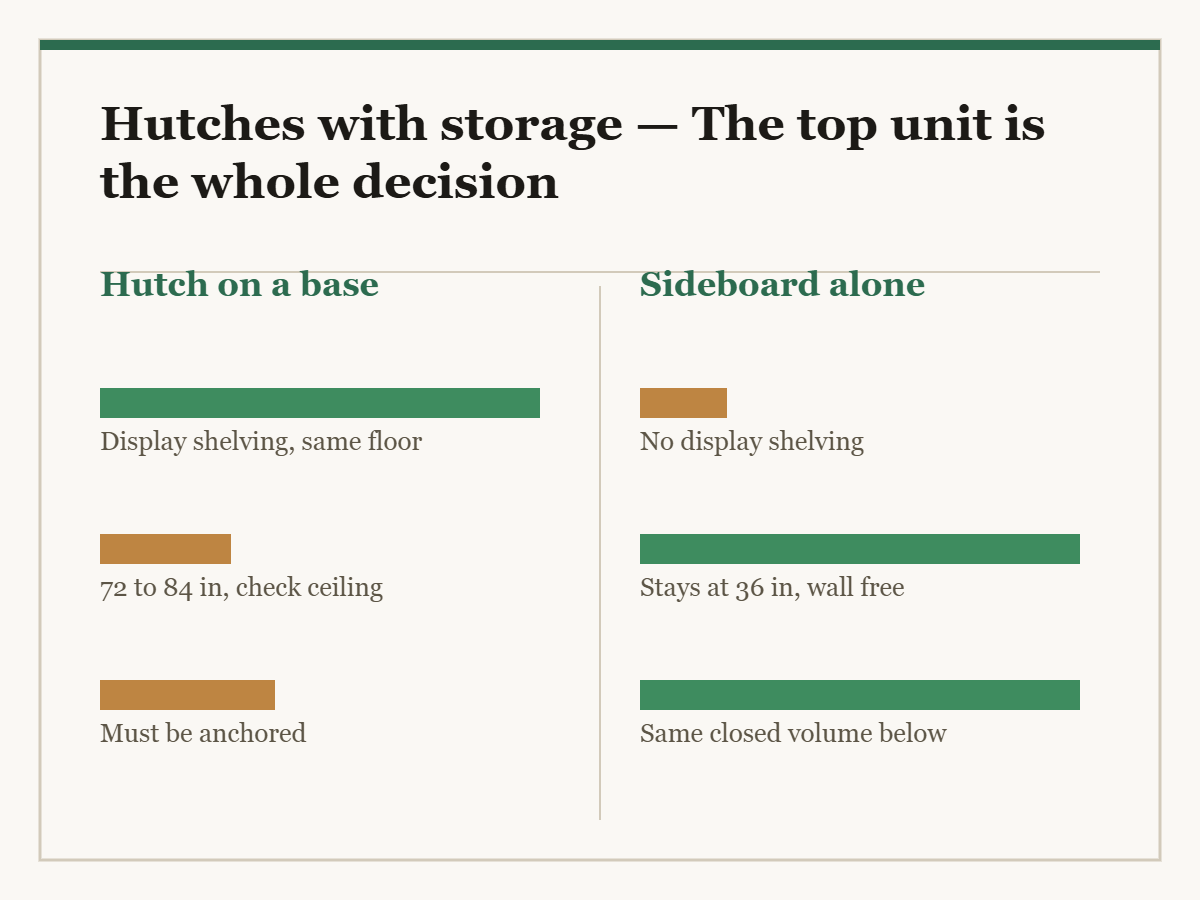
A hutch is the top half. The bottom is a sideboard or a buffet — a waist-high cabinet with doors and drawers — and the hutch is the open or glazed unit that sits on it and carries the display shelves.
People shop for the whole thing and judge it on the bottom, because that is where the storage volume is. The top is what decides whether you will live with it, and it is the half that most often goes wrong.
A hutch and base together stands 72 to 84 inches tall — check your ceiling and any cornice before you order. The base gives 10 to 18 cubic feet of closed storage; the hutch gives shelving that is 10 to 14 inches deep, which takes plates and glasses but not large serving bowls. The three things to check: whether the hutch bolts to the base or just sits on it, whether the shelves are adjustable (fixed shelves at the wrong pitch make half the height useless), and whether the back is a solid panel or thin hardboard, because the back is what stops the whole thing racking.
What the two halves each do
The base
Usually 34 to 36 inches high, 18 to 20 inches deep, with a run of drawers over cupboards. This is the working storage — table linen, flatware, serving dishes, the things you want hidden.
Because it is the load-bearing half, the base is where construction matters most. A hutch full of china standing on a base with a weak top is the failure mode nobody plans for.
The hutch
Shallower than the base by design — 10 to 14 inches, so it does not loom over whoever is standing at the cabinet. Open shelves, glazed doors, or a mix.
Depth is the constraint people miss. A dinner plate is 10 to 11 inches across and stands up fine. A large serving platter is 14 to 18 and will not.
The joint between them
This is the detail that separates a piece of furniture from two pieces stacked up.
Bolted or screwed. The hutch fixes down into the base through the base top or through a back rail. The whole thing then behaves as one carcase, and you can load the shelves without watching it sway.
Located but loose. Pins or a lip stop the hutch sliding, but nothing holds it down. Common, and acceptable, provided the piece is also anchored to the wall.
Simply resting. No fixing at all. This is the one to avoid, particularly with glass doors above.
Either way, anchor the whole assembly to a stud. A 78-inch cabinet with weight high up and a 19-inch base is exactly the geometry an anti-tip strap exists for — see anti-tip kits for dressers.
| Part | Height | Depth | Holds |
|---|---|---|---|
| Base cabinet | 34 to 36 in | 18 to 20 in | 10 to 18 cu ft, closed |
| Hutch unit | 36 to 48 in | 10 to 14 in | Plates, glasses, small bowls |
| Overall | 72 to 84 in | Base depth | Check ceilings and cornice |
| Worktop gap | Hutch set back 4 to 8 in | — | Room to stand at the base |
| Shelf pitch | 10 to 14 in apart | — | Stemware needs 11 in minimum |
Shelves: adjustable or wasted
Fixed shelves are set at the spacing the manufacturer chose, usually around 12 inches. That suits dinner plates and short tumblers and wastes the gap above anything shorter.
Adjustable shelves on pins let you set one bay at 8 inches for side plates and another at 13 for stemware, which is the difference between a cabinet that is full and one that looks full. If the shelves are adjustable, check what carries them — pins in a drilled row are the standard, and sizing them is covered in shelf pins and supports.
Check the shelf span too. A 40-inch shelf in thin material, loaded with plates, will bow — the mechanism and the fixes are in how to fix a sagging bookshelf, which is the same problem with lighter books.
The back panel, which does more than it looks
A tall cabinet made of four panels is a parallelogram waiting to happen. What stops it leaning is the back.
A solid or plywood back let into a groove triangulates the carcase and takes the racking load. This is what good casework does.
Thin hardboard pinned to the back edges is what most of the category uses. It works while the pins hold and it is the first thing to loosen, usually announced by doors that stop lining up.
If the hutch has glazed doors, this matters more: a carcase that racks by a few millimetres puts the glass out of square, and the doors catch.
Glass doors, and whether you want them
Glazed doors keep dust off and show the contents. They also mean the contents have to look arranged, which is a commitment.
Two practical points. Tempered glass is worth confirming in a house with children — it breaks into blunt pieces rather than shards. And glass doors need clearance to swing, typically the door width plus your hand, so a hutch in a corner may open onto a wall.
What it is made of
The base top carries the hutch and everything in it. That is the one surface in this piece where material genuinely decides longevity.
Solid timber or plywood holds the fixings and takes the load. Particleboard carries the weight fine but does not hold a screw under repeated load, which is where a bolted hutch joint loosens. The distinctions are in what engineered wood actually is and solid wood against engineered wood against veneer.
The base top is also a surface people set hot dishes on during a meal. Finishing options are in the best finish for a solid wood table top.
On the day it goes in
- Anti-tip strap 78 inches tall with the weight high up and a 19-inch base
- Levelling feet A tall cabinet turns a floor dip into doors that will not line up
- Shelf pins Lets you set one bay for plates and another for stemware
- Felt pads Under anything that sits on the base top, which is the display surface
What to buy


If you do not need the display half, a sideboard with storage gives the same closed volume at 36 inches, and a buffet with drawers adds flatware trays. The naming is untangled in credenza against sideboard against buffet. For a desk version of the same idea, see desks with a hutch and drawers.
Questions we get asked
How tall is a hutch and base together?
Seventy-two to 84 inches. Measure your ceiling and any cornice or picture rail before ordering.
How deep are the hutch shelves?
Ten to 14 inches. Dinner plates stand up fine; large serving platters do not fit.
Does the hutch bolt to the base?
On better pieces, yes. Some are only located by pins, and some simply rest. Anchor the whole assembly to the wall either way.
Are the shelves adjustable?
Often not, and it matters. Fixed shelves at 12 inches waste the gap above short items and will not take tall stemware.
Does a hutch add storage?
It adds display shelving, not closed volume. The 10 to 18 cubic feet was always in the base.
What is the back panel for?
It stops the carcase racking. A plywood back in a groove does that properly; thin hardboard pinned on is the usual compromise and the first thing to loosen.