Credenza vs sideboard vs buffet — Three words, two real differences
The Wooden Stars is a participant in the Amazon Services LLC Associates Program. We may earn a commission when you buy through links on our site, at no extra cost to you.

Three words for what looks like the same cabinet. Retailers use them almost interchangeably, which is why searching for one and finding the other two is normal rather than a mistake.
There are real distinctions underneath, but they are not the ones most articles give you. The useful differences are height, leg style and depth — and those are the three numbers that decide whether the piece works in your room.
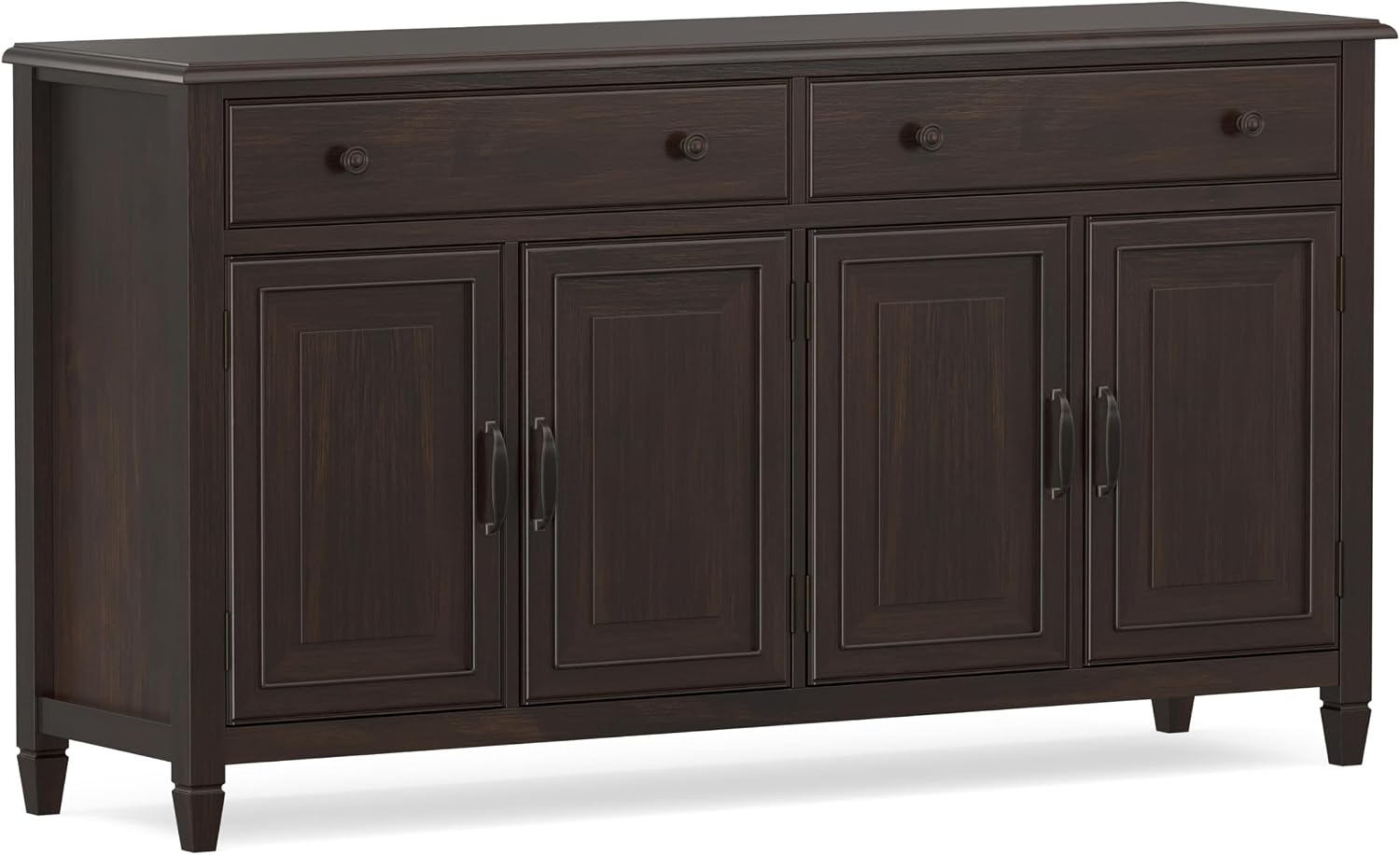
All three are long, low storage cabinets. Buffet is a dining-room word: taller, usually on legs, sized to serve food from and often designed to take a hutch on top. Sideboard is the same object in British usage, and in practice now means a long cabinet that sits lower and often closer to the floor. Credenza came from the office and tends to be the lowest and shallowest of the three, frequently with sliding doors. Nobody enforces these definitions. Buy on measured height, depth and leg style, and treat the name as a search term rather than a specification.
Where the three words actually came from
Buffet
A dining-room piece, named after the French word for the sideboard itself and long associated with serving. The design consequence that survived is height: a buffet is built to serve from, so its top is meant to be worked at standing up. That is why buffets are typically the tallest of the three and why the hutch — a shelved upper section — is a buffet fitting rather than a credenza one.
Sideboard
The same furniture, named for where it stood: at the side of the dining room. In British and Commonwealth usage “sideboard” simply is the word, and “buffet” reads as a hotel breakfast. In current US retail listings, sideboard has drifted to mean a longer, lower cabinet that may sit almost on the floor.
Credenza
An Italian word that arrived through the office furniture trade, where a credenza is the low unit behind a desk. It kept two habits from that life: it is low, and it is often shallow, because it had to sit behind a chair without blocking it. Sliding doors are more common here than on the other two, for the same reason.
The differences that survive into a real listing
Strip the etymology away and three measurements do the work.
| Feature | Buffet | Sideboard | Credenza |
|---|---|---|---|
| Typical role | Dining room, serving | Dining or living room, storage | Living room or office, storage |
| Height | Tallest of the three | Middle | Lowest |
| Legs | Usually raised on legs | Legs or plinth | Often low legs or none |
| Depth | Deeper, to hold serving dishes | Middle | Shallowest |
| Takes a hutch on top | Commonly designed to | Sometimes | Rarely |
| Doors | Hinged | Hinged | Hinged or sliding |
Read that table as tendencies, not rules. We checked the listings on this page against it and found cabinets sold as “sideboard buffet” in a single breath. That is not sloppiness on the retailer’s part so much as an admission that the categories overlap.
The three numbers to buy on instead
Height, against what it stands next to
If the piece is going in a dining room and you will serve from it, you want its top near working height rather than near seat height. If it is going under a wall-mounted television, the height decides the screen position and the sightline from the sofa. If it is going in a hallway, height decides whether it becomes a dumping ground at arm level.
Depth, against the walkway
This is the measurement that ruins dining rooms. A deeper cabinet holds serving dishes and platters that a shallow one cannot, but every inch of depth comes out of the gap between it and the dining chairs. Measure the walkway you will be left with, with the chairs pulled out, before you fall in love with a 20-inch-deep cabinet.
Legs, against the floor and the vacuum
Raised legs make a room read lighter and let you clean underneath. A plinth to the floor gives more internal volume for the same external height and stops things rolling under. Neither is better; they are opposite answers to the same trade-off.
What each one is genuinely good at
- Buffet: a dining room where food gets served from the side of the room. The height and depth are doing a job, and the option of a hutch above turns it into display storage without taking more floor.
- Sideboard: the general-purpose answer. Long, moderate depth, works in a dining room, a living room or a wide hallway.
- Credenza: under a television, behind a desk, or anywhere the wall behind it matters — art, a window sill, a low ceiling. Its shallowness is a feature in a narrow room.
Where the material claim usually hides
These are large flat-panel pieces, which is exactly where veneered board is most defensible and most common. A wide sideboard top in solid timber will move with humidity; the same top in veneered ply will not. So a piece being partly engineered is not automatically a downgrade here.
What matters is knowing which parts are which. On the listings below, the frames and legs are described as solid wood while tops and panels vary. If the listing says only “wood”, “wood composite” or “manufactured wood”, that permits board throughout — the vocabulary and how to read it is set out in solid wood, engineered wood or veneer. We have read the listing text on these products; we have not taken a saw to one.
Before you order
- Tape measure Depth first, then the walkway you have left with chairs pulled out
- Painter’s tape Mark the footprint on the floor and live with it for a day
- Furniture sliders A 60-inch cabinet is a two-person carry and a one-person slide
- Cable grommet If it is going under a television, plan the cable route before it is against the wall
So which word should you search for
Search all three. You will get the same cabinets in a different order, and filtering by measured height and depth will do more for you than any of the three names. If you want the shorthand:
- Dining room, serving, maybe a hutch later → search buffet.
- Long, general storage, any room → search sideboard.
- Low, shallow, under a TV or behind a desk → search credenza.
What to buy


If the piece is destined for a dining room, size it against the table before the wall — our note on how many chairs fit a 60-inch round table covers the clearance side of the same problem.
Questions we get asked
Is a credenza the same as a sideboard?
Close enough that retailers list them together. The working difference is that a credenza is usually lower and shallower, and more likely to have sliding doors. If a listing calls the same cabinet both, it is telling you the distinction does not apply to that piece.
What is the difference between a buffet and a sideboard?
Mainly height and intent. A buffet is a dining-room serving piece and tends to stand taller, often on legs, sometimes designed to carry a hutch. A sideboard is the same category of storage with less commitment to the serving job. In British usage they are one word.
Can a credenza go in a dining room?
Yes, and it often looks better than a buffet in a small one, because the lower height keeps the wall open. What you lose is worktop height for serving and some depth for large platters.
How tall should a sideboard be?
Decide from the job, not from a standard. Serving from it wants a top near counter height; sitting under a television wants the screen centre near seated eye level; standing in a hallway wants a top you can reach into a bowl on. There is no single correct figure and any article that gives you one has skipped the question.
How deep should a sideboard be in a dining room?
Deep enough for what you will store, shallow enough to leave a walkway with the dining chairs pulled out. Measure the chairs pushed back first; that number is your budget and the cabinet depth has to fit inside it.
Do sideboards have to match the dining table?
No, and matching the species exactly across two pieces made from different boards rarely reads as “matched” anyway. Matching the tone and the leg language does more work than matching the wood.