Round dinette tables — The small-kitchen table that seats more than it looks
The Wooden Stars is a participant in the Amazon Services LLC Associates Program. We may earn a commission when you buy through links on our site, at no extra cost to you.

A dinette is a small dining table for a kitchen, a breakfast nook, a studio or an apartment — somewhere between 28 and 42 inches across, seating two to four. It is the size where every inch is contested, and it is exactly where a round top earns its keep.
The reason is not style. It is that a small square wastes its corners and a small circle does not, and at this scale that difference is worth a whole place setting.
In small sizes, round beats square. A 36-inch square seats four, one per side, and the corners do nothing. A 36-inch round has no dead corners, so the same footprint seats four comfortably and four adults fit around it without anyone facing a corner. A round top also has no corners to walk into, which matters in a kitchen with a metre of circulation. Sizes: 28 to 32 inches seats two, 36 inches seats three to four, 42 inches seats four properly. Allow 30 inches of clear floor minimum, 36 if anyone must walk behind a diner.
The sizes, and what they really seat
| Diameter | Seats | Use case | Minimum room |
|---|---|---|---|
| 28 to 30 in | 2 | Studio, galley kitchen, balcony | About 7 ft square |
| 32 to 34 in | 2 to 3 | Breakfast nook | About 7.5 ft square |
| 36 in | 3 to 4 | Apartment main table | About 8 ft square |
| 42 in | 4 | Small family kitchen | About 9 ft square |
The room figures assume 30 inches of clear floor around the table, which is the practical minimum: enough to sit down and get up, not enough for someone to walk behind a seated diner. If the table sits against a wall on one side — common in a nook — you only need that clearance on the open sides.
Why round wins at small sizes
Take a 36-inch square. It has 144 inches of edge, which sounds generous, but nobody sits at a corner — so it seats one per side, four people, each with 36 inches of edge they cannot fully use because their neighbours’ corners are in the way.
Take a 36-inch circle. It has about 113 inches of edge and no corners, so every inch is seatable. At the 24 inches per diner rule that is four places, and they are evenly spaced rather than cornered.
Two more small-space advantages follow. A circle has no corner to walk into, which in a kitchen with narrow circulation is worth real money in bruised hips. And a circle is flexible about where people sit, so three people are not forced into a formal arrangement.
The base decides whether it works
At this size the base matters more than at any other, because the legs and the diners are competing for the same small volume.
A central pedestal is the right answer almost every time. It frees the whole perimeter, it lets a fourth person squeeze in, and nobody straddles a leg. On a 36-inch table, four corner legs effectively remove the flexibility that made you choose round in the first place.
Check the foot spans at least half the diameter — on a 36-inch top that means an 18-inch foot — or that the base is genuinely heavy. A small table tips more easily than a large one, because there is less mass to resist a lean.
A tripod or three-leg base is the other good option. It never rocks on an uneven kitchen floor, which is a real advantage in an old building.
Height, and the drop-leaf question
Standard dining height is 28 to 30 inches with a 17 to 19 inch seat. Some dinettes are sold at counter height — 34 to 36 inches — which pairs with a 24-inch stool and takes up less visual space in a small kitchen, because the eye reads under it.
Counter height also suits a table that doubles as worktop overflow. It does not suit long meals or small children.
Drop leaves are the classic dinette trick: a hinged section folds down against the base, turning a 36-inch round into a semicircle against a wall. Genuinely useful in a studio. Check the leaf support — a properly braced swing-out gate beats a small folding bracket, which will sag under an elbow.
Top construction at small sizes
A small round top is usually stave laminated from narrow strips, which is stronger and flatter than a single board and can be refinished repeatedly. At 36 inches a single board is actually plausible, and some makers use one — it looks superb and moves more.
Veneered tops are common at this price and are honest construction: a real wood face on a stable core, flat forever, refinishable once or twice. The three constructions are compared in wood dining tables, and the vocabulary in what engineered wood actually is.
One small-table-specific point: a dinette in a kitchen takes more water than a dining room table does. Whatever the top, the edge treatment matters — an intact edge keeps moisture out of a panel core, and a raw edge swells the first time a wet cloth sits on it.
What to check before ordering
- Diameter against your clear floor. Table plus 30 inches all round, or 36 if anyone walks behind a chair.
- Base type. Pedestal or tripod for flexibility; four legs only if you are content with fixed seating.
- Foot spread against diameter. At least half, or a heavy base, so it does not tip.
- Apron depth. A deep rail under the top stops chairs pushing in, which in a small kitchen is the difference between a walkway and none.
- Height class. Dining or counter — and buy the chairs to match, because a 24-inch stool at a 29-inch table is uncomfortable.
For a small kitchen table
- Felt pads A pedestal foot concentrates the load into a few contact points
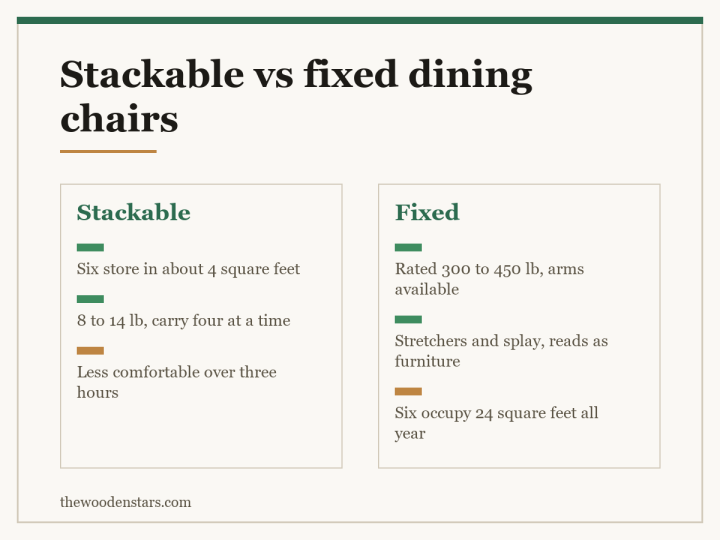
- Folding chairs The honest solution to a fourth diner in a two-person room
- Hardwax oil A kitchen table takes more water than a dining room one
- Trivets Small tables get used as worktop overflow, heat included
What to buy


For the solid timber version at this size, see round wood dinette tables. For the full sizing arithmetic, round dining tables, and if the seat count needs to vary, extendable tables.
Questions we get asked
What is a dinette table?
A small dining table for a kitchen, nook or apartment — typically 28 to 42 inches across and seating two to four.
Is a round or square table better for a small kitchen?
Round, usually. A small square wastes its corners and has corners to walk into; a circle seats the same number in the same footprint with more flexibility.
What size round table fits two people?
Twenty-eight to 30 inches is enough for two place settings. Thirty-six inches gives two people room to spread out or seats a third.
How much clearance does a dinette need?
Thirty inches of clear floor minimum, and 36 if anyone has to walk behind a seated diner.
Should I get a pedestal base for a small table?
Usually yes. It frees the whole perimeter, which is the main reason to choose round at this size.
Is counter height better in a small kitchen?
It can feel lighter and doubles as worktop overflow, but it suits short meals rather than long ones and is awkward for small children.