Dining benches with storage — Lid hinges and seat height
The Wooden Stars is a participant in the Amazon Services LLC Associates Program. We may earn a commission when you buy through links on our site, at no extra cost to you.
A storage bench is the only seat in the house that is also a box. That is either the neatest piece of furniture in a small dining room or a seat that is an inch too tall and a lid that lands on somebody’s fingers.
Which one you get comes down to two details, and both are visible in the specification if you know to look.
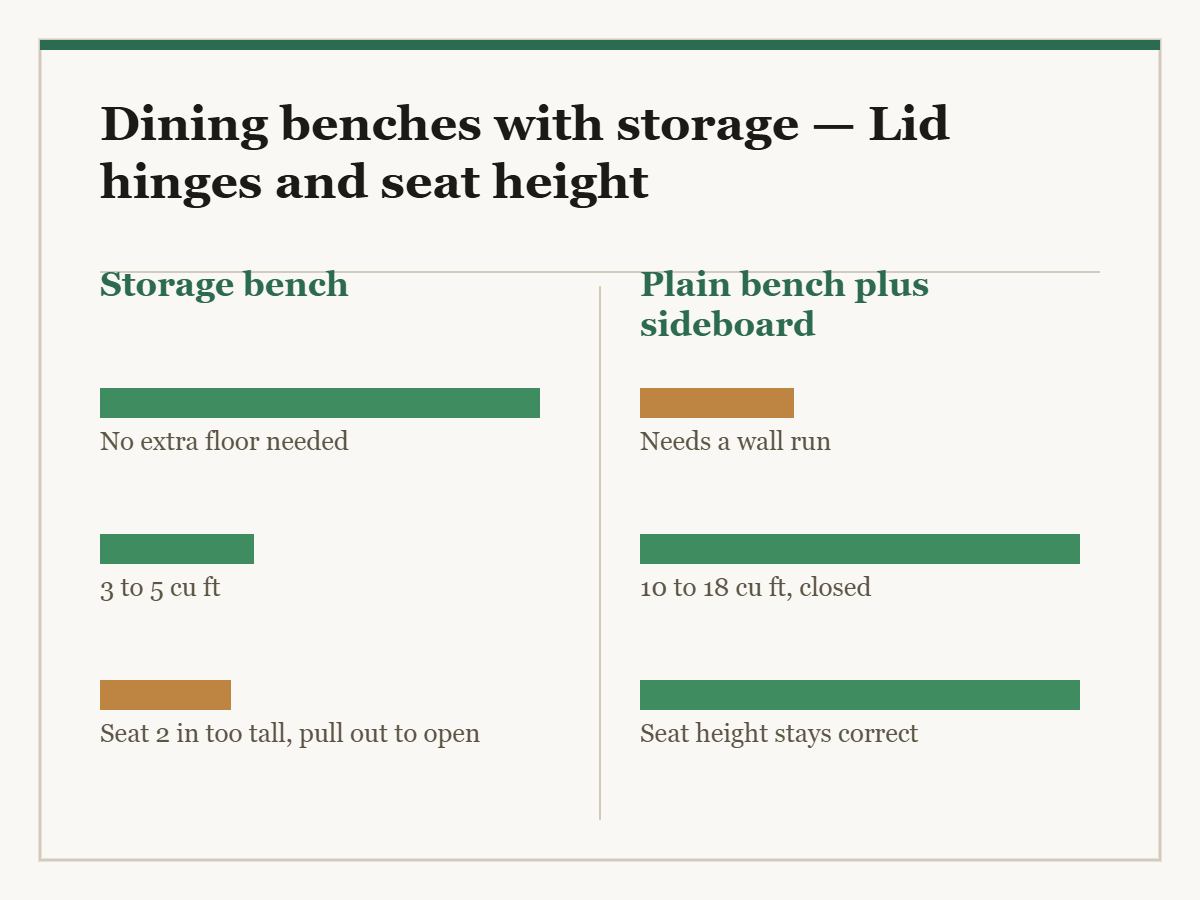
A dining bench should have a seat at 17 to 19 inches to pair with a 29 to 30-inch table. A storage box under the seat typically pushes that to 19 to 20 inches, which leaves only 9 to 10 inches of leg gap — check the stated seat height, not the bench height. The box holds 3 to 5 cubic feet in a 42 to 48-inch bench. The second detail is how the lid is held open: a friction stay or soft-close hinge holds it where you leave it, a plain hinge drops it. Allow the bench length plus a step of clear floor, because a bench under the table cannot be opened.
Seat height, which is where these go wrong
The gap you want between the seat and the underside of the table top is 10 to 12 inches. Against a standard 29 to 30-inch table that puts the seat at 17 to 19 inches.
A plain bench of the same design lands at 17 or 18. Put a box under the seat and you add the box floor, the box sides and the lid thickness — 19 to 20 inches is entirely normal, and at 20 your thighs are against the apron.
There is no fix after the fact. You cannot shorten a storage bench without cutting into the box, and raising the table is worse. So the seat height is the specification to find before ordering, and the one most likely to be quoted for the set rather than the bench.
The lid, which is the part that fails
A bench lid is a wide panel on a long hinge, lifted by someone standing over it and closed by gravity.
A friction stay or soft-close hinge
Holds the lid wherever you let go. This is the one feature that decides whether the bench gets used, because a lid you have to hold open with one hand while reaching in with the other is a lid you stop opening.
A plain butt hinge
The lid stands up only if the bench is backed against a wall, and falls the moment it is not. In a house with children this is a finger injury rather than an inconvenience.
A lift-off lid
No hinge at all. Cheapest, and it needs somewhere to rest while the bench is open, which in a dining room is the table.
A stay can be retrofitted if the bench you want has everything else right — it screws to the box side and the lid underside, and it is worth doing on day one rather than after the first knock.
| Measure | Plain bench | Storage bench |
|---|---|---|
| Seat height | 17 to 18 in | 19 to 20 in |
| Leg gap under a 29 in table | 11 to 12 in | 9 to 10 in |
| Heel space under the seat | Clear | Filled by the box |
| Storage | None | 3 to 5 cu ft |
| Weight | 20 to 35 lb | 45 to 70 lb |
| Opens under the table | Not applicable | No, pull it out first |
What actually goes in it
Three to five cubic feet is a real amount — a large laundry basket. In a dining room the things that fit the shape are table linen, place mats, board games, a folded high chair, spare cushions and Christmas crockery.
What does not work is anything you need mid-meal, because opening the bench means everyone on it stands up. Flatware and napkins belong in a buffet drawer, not under a seat.
The other thing to know: a storage bench is heavy when full, and it gets dragged rather than lifted. Felt pads or glides on the feet save the floor, and a bench with a solid plinth rather than four legs spreads the load better on a soft floor.
Structure, because it is a box people sit on
An ordinary bench is a seat board on legs with rails. A storage bench is a box, and boxes carry load differently: the seat spans the full length with no rail directly under it, and the sides take the weight through their panel edges.
- A centre divider inside the box carries the middle of the lid. Without one, a 48-inch lid in thin material flexes when two adults sit on it.
- A solid or plywood base panel rather than a thin sheet pinned underneath. The base holds the weight of the contents plus everything the sides transmit.
- Corner blocks where the sides meet the base. This is the joint that opens up first when a full bench gets dragged across a floor.
Solid timber also lets a scratched lid be sanded back, which matters on a surface people sit on in jeans — see how to fix scratches on wood furniture and solid wood against engineered wood against veneer.
The material terms are in what engineered wood actually is, and the reason particleboard behaves differently here is that all the load lands on screws in panel edges.
Fitting it to the table
- Check the bench clears the table apron. Push it in and the seat should slide under. If the apron hangs low, the bench parks proud and blocks the walkway.
- Allow the bench length plus a step. A lift-lid bench cannot be opened while it is under the table, so the floor in front has to take the whole bench pulled out.
- Bench length under the table length. A bench the same length as the table looks wrong and catches the legs; 6 to 10 inches shorter is the usual proportion.
- 24 inches of table edge per person. A 60-inch bench seats three adults. Sizing is in how wide a dining table should be.
If the bench is going against a wall rather than at a table, the geometry changes and under-window storage benches covers that case, including radiators and sill heights.
On the day it arrives
- Soft-close lid stay Retrofits to a lid that has no stay and drops shut
- Felt glides A full bench gets dragged, not lifted, and it is heavy
- Levelling feet A box base shows every dip in the floor as a rock
- Storage bins Keeps the contents from sliding to one end when the bench moves
What to buy


For the whole table and seating together, see dining sets with storage. If the storage would be better off the seating, sideboards hold three to four times as much. For small rooms, compact dining sets for small spaces.
Questions we get asked
How tall should a dining bench be?
Seventeen to 19 inches to the seat, against a 29 to 30-inch table. Storage benches often arrive at 19 to 20.
How much does a storage bench hold?
Three to 5 cubic feet in a 42 to 48-inch bench — about a large laundry basket.
Can I open it while it is under the table?
No. You pull it out first, so allow the bench length plus a step of clear floor.
What kind of hinge should it have?
A friction stay or a soft-close hinge that holds the lid where you leave it. A plain hinge drops the lid as soon as the bench is away from a wall.
Is a storage bench comfortable?
Less than a plain bench, because the box fills the space where your heels would tuck back and the seat usually sits an inch or two higher.
How long should the bench be?
Six to 10 inches shorter than the table, so it tucks in without catching the legs. Allow 24 inches of seat per person.