How thick should a dining table top be? 1 to 1.75 in
The Wooden Stars is a participant in the Amazon Services LLC Associates Program. We may earn a commission when you buy through links on our site, at no extra cost to you.
How thick should a dining table top be? Between 1 and 1.75 inches in solid timber, with 1.25 the figure that suits most tables — thick enough not to move, thin enough not to be absurd.
Thickness is also the easiest specification to fake, which is why a table can look substantial and be 18 millimetres of board with a fat edge glued on.
In solid hardwood: 1 to 1.25 inches is right for tables up to about 72 inches long, and 1.5 to 1.75 for longer tables or any top on a trestle or pedestal base. Below 0.75 inches a solid top will cup and will not take being re-sanded. Above 2 inches you are paying for weight — the top gets heavier faster than it gets stiffer, and a 96-inch table at 2.5 inches is a two-person lift per leaf. Watch for a thick edge on a thin panel: measure the underside, not the profile.
How thick should a dining table top be, by length
Thickness has to rise with the unsupported span, because a tabletop between two leg sets is a beam.
- Up to 60 inches: 1 inch is fine. Most legs sit close to the ends.
- 60 to 72 inches: 1.25 inches.
- 72 to 96 inches: 1.5 inches, or 1.25 with a substantial apron.
- Over 96 inches: 1.75 inches, and expect a centre leg or a heavy trestle.
An apron — the rail running under the top between the legs — changes this completely. A 1-inch top with a 3-inch apron is stiffer than a 1.75-inch top with none, because the apron is doing the beam work. That is why trestle and pedestal tables, which have no apron, need the thicker top.
| Table | Solid top | Note |
|---|---|---|
| Up to 60 in, with apron | 1 in | Legs sit near the ends |
| 60 to 72 in, with apron | 1.25 in | The common case |
| 72 to 96 in, with apron | 1.5 in | Or 1.25 with a deep apron |
| Trestle or pedestal, any length | 1.5 to 1.75 in | Nothing else carries the load |
| Over 96 in | 1.75 in | Plus a centre leg |
| Veneered top | 0.75 to 1 in | Stiffness comes from the core |
Why thinner than three-quarters of an inch fails
Two reasons, and both show up in the first few years.
Cupping. A solid timber board wants to move with humidity. A thicker board resists that; a thin one cups across its width until the surface is visibly dished. On a wide glued-up top this is what pulls at the joints — which is the cause behind tops cracking at the seams.
No material to lose. The point of a solid top is that it can be sanded back and refinished — twice, three times, over decades. Each refinish takes a fraction of a millimetre, but a repair to a deep scratch or a burn takes more. Below 0.75 inches there is not enough timber to do it safely once you allow for the tongue or biscuit joints beneath.
That second point is the whole argument for solid over veneer, and it disappears if the solid top is too thin to use.
The thick edge on a thin panel
This is the trick to know about, and it is common at every price point.
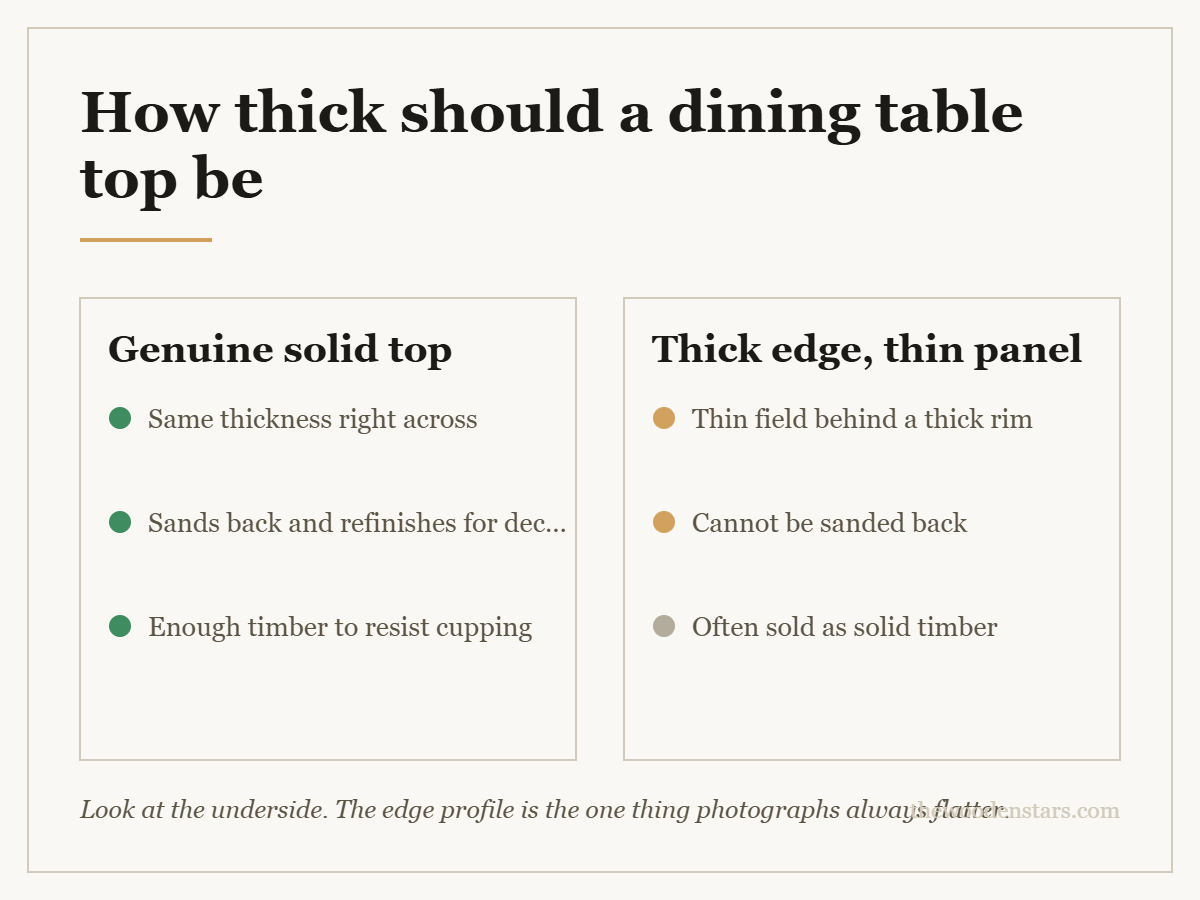
A table is photographed showing a chunky 2-inch edge. The top is actually an 18 mm panel with a mitred edge band or a glued-on lipping, creating a hollow box that reads as solid from the side.
How to tell:
- Look at the underside. A genuine thick top is the same thickness all the way across. A false one has a thin field and a thick rim.
- Check the specification for “top thickness” separately from “edge thickness”. Honest makers give both.
- Look at the end grain at a corner. On a solid top the grain runs through the edge; on a banded one it stops.
This is not automatically bad — a veneered top on a stable core is flatter than solid timber and perfectly legitimate. It is bad when it is sold as solid. The terms are sorted out in what engineered wood actually is and solid against engineered against veneer.
What extra thickness costs
Weight. A 72 × 38-inch oak top at 1.25 inches is about 75 lb. At 2 inches it is 120. That is the difference between two people moving a table and four.
Knee clearance. The top’s thickness comes off the space under it. A 30-inch table with a 2-inch top and a 3-inch apron leaves 25 inches of knee height, which is the comfortable minimum. Add a thick top to a deep apron and you are below it.
Money, disproportionately. Thickness is bought in board feet. Going from 1.25 to 2 inches on a large top is a substantial material cost for stiffness you did not need.
Overhang. A thicker top usually comes with more overhang past the apron, which is good for knees and bad for leverage — a heavy top with a long overhang will sag at the corners unless the apron is close to the edge.
The related numbers
- Overhang past the apron: 8 to 12 inches on the ends so a chair can pull in, 2 to 4 on the sides.
- Knee height: 25 inches minimum from the floor to the underside of the apron.
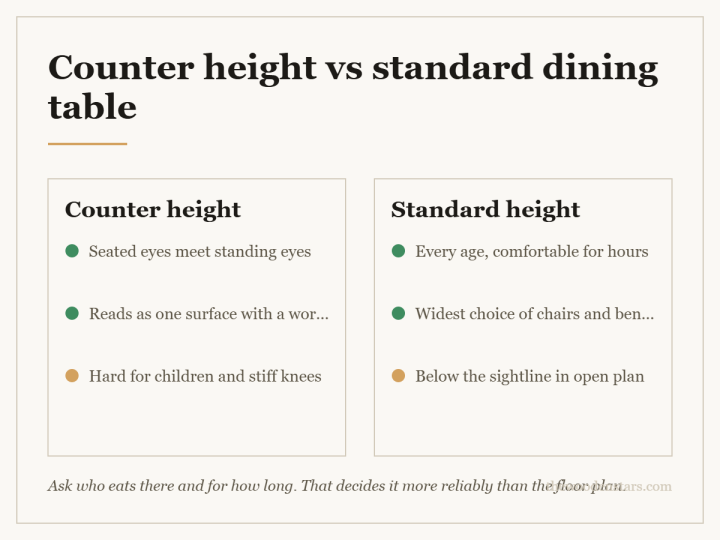
- Top height: 29 to 30 inches — see counter height against standard.
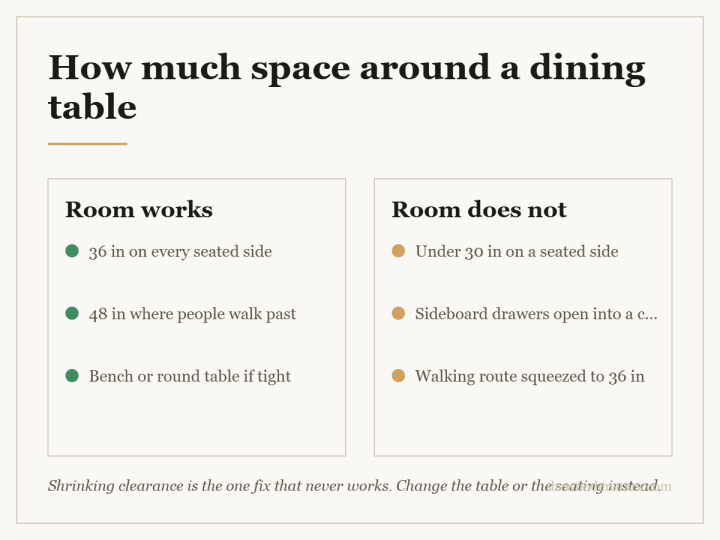
- Width: 36 inches minimum to set two places with dishes down the middle — dining table width.
And whatever the thickness, the finish decides how the top survives daily use: the best finish for a solid wood table top and removing water rings.
Looking after the top
- Table pad The cheapest protection for a top you intend to keep for decades
- Hardwax oil Repairable in place, unlike a lacquer that has to be stripped
- Digital calipers Settles whether a top is solid or a thin panel with a thick edge
- Felt floor glides A heavy top on an unlevel floor puts all its weight on two legs
What to buy


For tables, see solid wood dining tables, wood dining tables and extendable dining tables. For sizing, dining table width and how much space around a dining table. For problems, tops cracking at the seams and fixing a wobbly table.
Questions we get asked
How thick should a dining table top be?
One to 1.75 inches in solid timber, with 1.25 suiting most tables up to 72 inches long.
Does the base change the answer?
Yes. A trestle or pedestal has no apron, so the top does all the beam work and wants 1.5 to 1.75 inches.
Is a thicker top always better?
No. Past 2 inches you add weight and cost faster than stiffness, and you eat into knee clearance.
What is wrong with a thin solid top?
Below 0.75 inches it cups with humidity and there is not enough timber left to sand back and refinish.
How do I spot a fake thick edge?
Look at the underside. A genuine thick top is the same thickness across its width; a banded one has a thin field and a thick rim.
How much knee height should be left?
Twenty-five inches from the floor to the underside of the apron. A thick top plus a deep apron can drop below it.