Buffet vs hutch — One is the base, one is the top
The Wooden Stars is a participant in the Amazon Services LLC Associates Program. We may earn a commission when you buy through links on our site, at no extra cost to you.
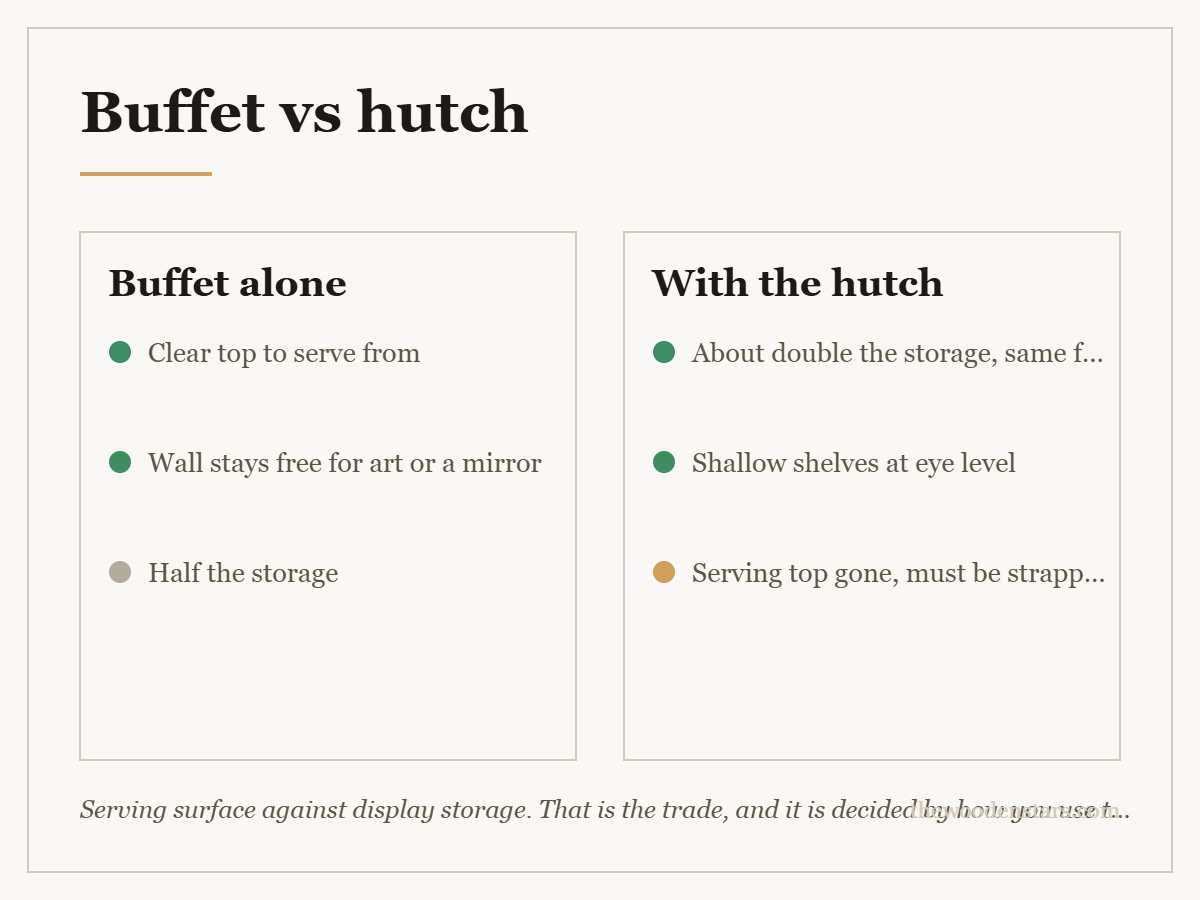
Buffet vs hutch is not two pieces of furniture competing. A buffet is the base cabinet; a hutch is the open or glazed unit that sits on top of it.
Ask which one you need and the honest answer is: you need the buffet, and then you decide whether to put a hutch on it.
A buffet is a low cabinet, 32 to 36 inches tall and 18 to 20 inches deep, with doors and drawers. It works alone. A hutch is the upper unit — shelves, often glazed — that stands on the buffet and takes the pair to 70 to 84 inches. Sold together the combination is usually called a “buffet and hutch” or a china cabinet. The hutch adds display and roughly doubles the storage, and it costs you the serving surface, the wall above, and it must be strapped to a stud. Buy the buffet if you serve from it; add the hutch if you have china to show.
Buffet vs hutch: the base and the top
The distinction is structural, not stylistic.
The buffet is the working half. Doors, drawers, a solid top at serving height, and it is what you actually put food on when people are eating. Bought alone it is often called a sideboard or a credenza — the words overlap almost completely in listings, which is sorted out in credenza against sideboard against buffet.
The hutch is the display half. It has no legs of its own — it sits on the buffet’s top, usually located by a lip or a pair of dowels, and it is rarely sold separately because it is built to one specific base.
That last point matters when buying: a hutch and a buffet from different ranges will not sit together properly, and retrofitting one is not realistic.
| Measure | Buffet | Hutch (on the buffet) |
|---|---|---|
| Height | 32 to 36 in | Adds 36 to 48 in, total 70 to 84 |
| Depth | 18 to 20 in | 12 to 16 in, set back |
| Storage | Doors and drawers | Open or glazed shelves |
| Serving surface | Yes, the whole top | Covered |
| Stands alone | Yes | No |
| Wall fixing | Advisable | Required, into a stud |
| Sold separately | Often | Rarely |
What you give up by adding the hutch
The serving surface. This is the one people regret. A buffet’s top is where dishes go during a meal; a hutch takes it, leaving perhaps 4 inches of ledge in front. If the piece is genuinely used for serving, that is a real loss.
Some designs keep a usable ledge by setting the hutch back 6 inches, which is worth looking for.
The wall. Seventy-eight inches of furniture means no picture, no mirror and no window where it stands. In a small dining room that changes the whole feel of the space.
Light. A tall unit on the wall opposite a window is fine. On the window wall it is a wall.
What you gain
Roughly double the storage, in the vertical plane, without using another square foot of floor. In a small dining room that is the strongest argument there is.
Display. Glazed doors turn china into something visible rather than stacked. That is the point of the piece, and if you have inherited a service it is the difference between using it and storing it.
Shallow, reachable shelves. A hutch is 12 to 16 inches deep, against the buffet’s 18 to 20. Shallower shelves at eye level are the most usable storage in the room — everything is visible and nothing is behind anything else.
The joint between them, which is the thing to inspect
A hutch is a tall, relatively shallow box standing on a cabinet. Everything about its stability comes from how it is located and fixed.
- Located, not just placed. Look for a lip, rebate or dowels that stop the hutch sliding forward off the base. A hutch that simply sits on a flat top is relying on friction.
- Strapped to a stud. Not optional. A glazed unit at 78 inches with plates in it has a high centre of gravity, and a child opening the lower doors can lever the whole thing.
- The buffet top carries the load. A 0.75-inch particleboard top under a loaded hutch will bow over years; solid timber or a properly framed top will not — what engineered wood actually is.
- Level first. A hutch on an out-of-level base puts its glazed doors out of square, and they stop closing. Shim the base before assembling the top.
The shelves and the glass
Adjustable shelves in the hutch matter more than in the base, because display items vary wildly in height. Fixed shelves at a 12-inch pitch waste the unit — shelf pins and support sizes.
Shelf span is the usual failure: a 40-inch glass or thin timber shelf loaded with plates deflects visibly. Under 0.75 inches in timber, or with no centre support, expect it — how to fix a sagging shelf.
Glazed doors keep dust off and make the contents the decoration. Open shelves look lighter and mean dusting everything. Neither is wrong; the glazed version is the one that suits china actually in use.
For the base on its own, see buffets with drawers and sideboards with storage; for the top unit as a product, hutches with storage.
Setting the pair up properly
- Furniture anti-tip strap Non-negotiable on a hutch, which is tall and loaded high
- Stud finder The strap has to reach timber, not drywall
- Shelf pins and supports Display items vary in height more than plates do
- Levelling shims A hutch on an out-of-level base throws its doors out of square
What to buy


For the base, see buffets with drawers, sideboards with storage and how deep a sideboard should be. For the top, hutches with storage and hutch desks with drawers. For the naming, credenza against sideboard against buffet.
Questions we get asked
What is the difference between a buffet and a hutch?
A buffet is the low base cabinet with doors and drawers. A hutch is the shelved upper unit that stands on top of it.
Can you buy a hutch on its own?
Rarely. A hutch is built to one specific base and located by a lip or dowels, so mixing ranges does not work.
How tall is a buffet with a hutch?
Seventy to 84 inches in total — a 32 to 36-inch buffet plus a 36 to 48-inch hutch.
Does a hutch have to be fixed to the wall?
Yes, strapped into a stud. It is tall, loaded high with china, and the lower doors give a child a lever.
Do you lose the serving surface?
Mostly. A hutch covers the buffet top, leaving a ledge of a few inches — unless the design sets the hutch back deliberately.
Which should I buy if I only want one?
The buffet. It works alone, keeps a serving surface and leaves the wall free. The hutch only makes sense on top of one.