Corner desks for small spaces — Measure two walls, not one
The Wooden Stars is a participant in the Amazon Services LLC Associates Program. We may earn a commission when you buy through links on our site, at no extra cost to you.
A corner is the least useful part of any room. It is too shallow for furniture, too awkward to walk through, and it usually ends up holding a plant. A corner desk converts that dead area into the only work surface a small room may have space for.
It also creates a problem no rectangular desk has: the deepest point of the desk is the point furthest from you, and that space is unreachable from the chair.
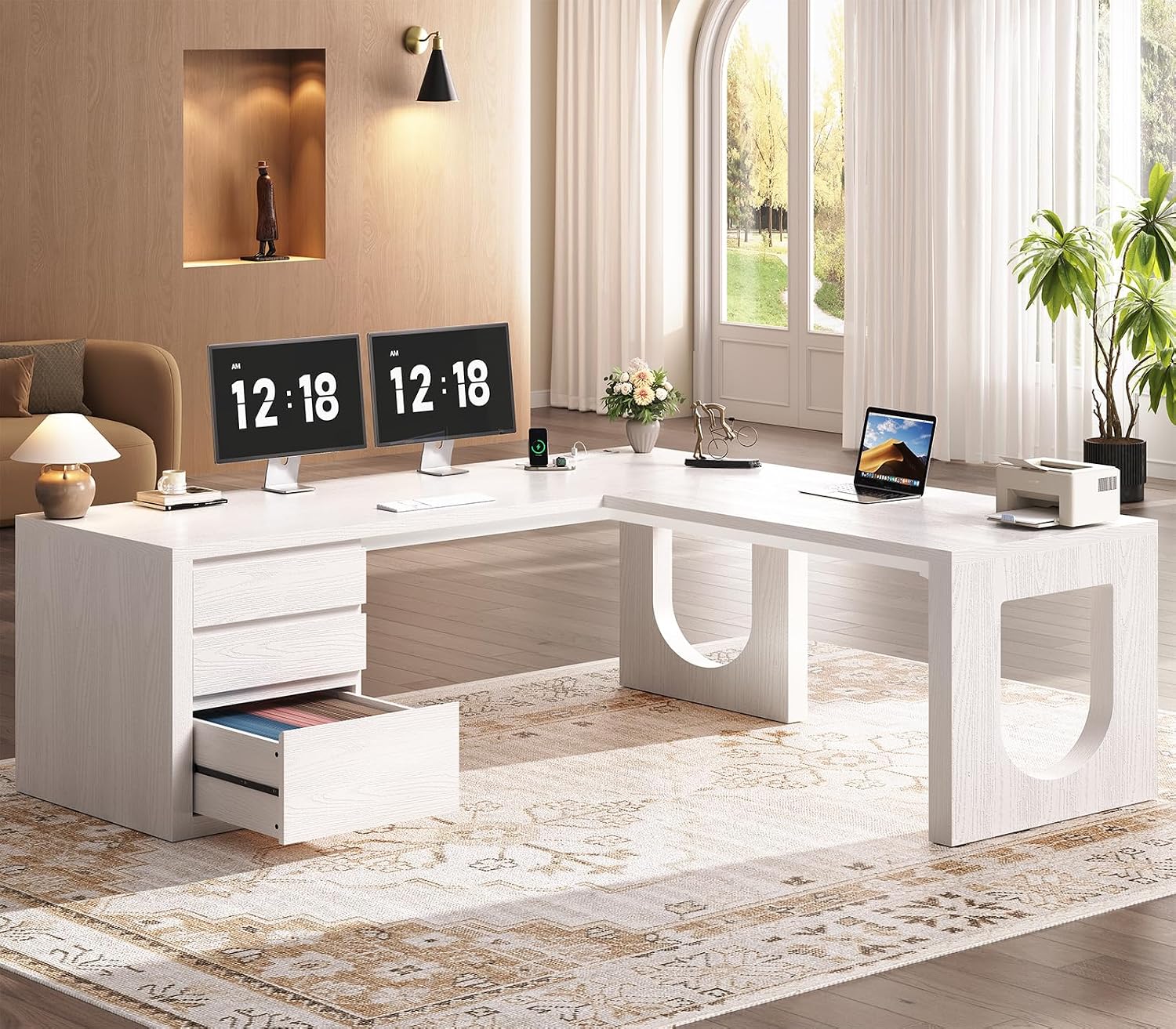
Two shapes get called a corner desk. A true corner desk is triangular or curved across the angle and puts you facing into the corner. An L-shaped desk has two straight legs meeting at 90°, and it is the more useful of the two because both legs stay at a normal working depth. Measure the two wall runs separately — a typical L needs about 55 and 40 inches. Allow 36 inches of clear floor behind the chair. The detail that decides the purchase is whether the desk is reversible, because a fixed left-hand L in a right-hand corner is unusable.
The two shapes, and why one is better
True corner desk
A single surface cut across the angle — triangular, or with a curved front edge. You sit facing into the corner.
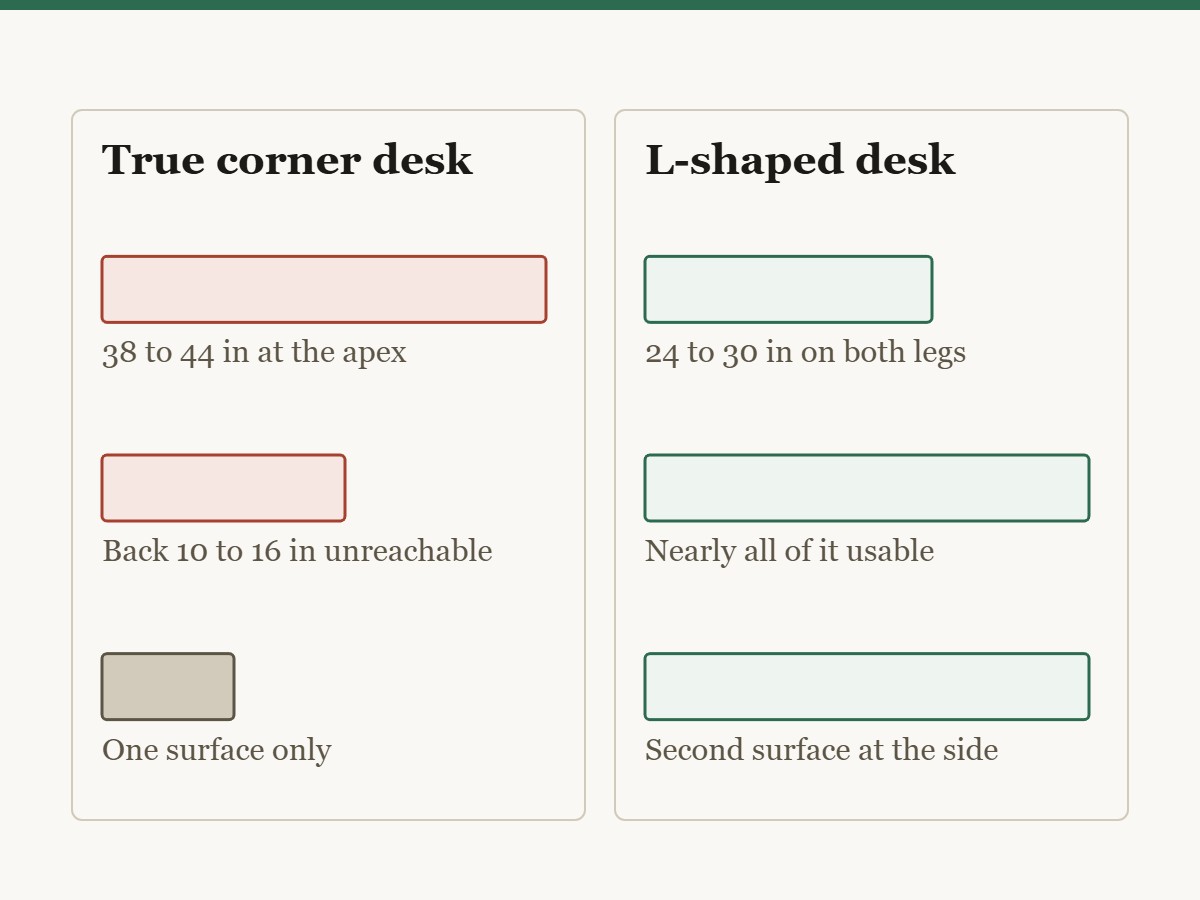
It uses the least wall of any desk shape and it fits where nothing else will. The cost is the geometry: measure from the front edge to the apex of the corner and you will often find 38 to 44 inches. Your comfortable reach from a seated position is about 28. So the back 10 to 16 inches is a shelf you cannot use without standing up, and it fills with cables, chargers and things you meant to deal with.
L-shaped desk
Two rectangular legs meeting at a right angle, each at a normal depth of 24 to 30 inches. You sit at the inside of the L with one leg in front and one to the side.
Nothing is out of reach, because neither leg is deeper than a normal desk. The corner where they meet is the natural spot for a monitor, and the side leg becomes the surface for everything that would otherwise be on top of your keyboard. This is the shape to buy if the walls allow it.
| Measure | True corner | L-shaped |
|---|---|---|
| Wall needed | One corner, about 47 in each way | Two runs, about 55 and 40 in |
| Depth at the deepest point | 38 to 44 in | 24 to 30 in |
| Usable surface | Perhaps 60 per cent | Nearly all of it |
| Monitor position | Directly into the corner | At the inside angle |
| Second surface | No | Yes, the side leg |
| Reversible | Symmetrical, so yes | Only if the listing says so |
Measure two walls, not one
This is where corner desks go wrong, because people measure the corner and not the runs leading away from it.
- Measure each wall separately from the corner outward, and note the first obstruction on each — a door swing, a radiator, a window reveal, a socket you need to reach behind.
- Check the shorter run first. An L-shaped desk quoted as “55 × 40 inches” needs 55 inches on one wall and 40 on the other. If your short wall gives 34, the desk does not fit however generous the long wall is.
- Allow 36 inches of clear floor behind the chair so you can push back and stand. In a corner this matters more than usual, because the chair has to move diagonally out of the angle.
- Check the diagonal, the distance across the open mouth of the L. That is the path you walk to get in and out, and on a large L it can be under two feet.
The reversible question
This is the single most common return in the category and the easiest thing to check.
An L-shaped desk has a long leg and a short leg. Whether the short leg lands on your left or your right is fixed by the frame on many models, and a desk built for a left-hand corner simply will not assemble into a right-hand one.
Look for the words “reversible” or “left or right configuration” in the specification. Reversible desks have symmetrical frames and a top that can be assembled either way, and they cost nothing extra. If a listing does not say, assume it is fixed and work out which hand you need before ordering.
To work it out: sit in the corner facing the way you want to face. The wall your writing hand is nearest is the side the short leg should be on for most people, because it keeps the main run clear in front of you.
Height and legroom
Standard desk height is 29 to 30 inches to the top, which suits a chair seat at 17 to 19 inches. That gives about 24 to 26 inches of knee clearance underneath.
Two corner-specific things eat into that:
A pedestal or drawer unit at the angle. Some L-shaped desks put storage exactly where the inside of the L is, which is where your knees go when you swivel between the two legs. Check the underside photograph.
A cross brace low down. Frames sometimes run a stretcher across the corner for rigidity. Structurally sensible, and it is at shin height.
If the desk will be used for long sessions, a clear span under both legs is worth more than the drawers.
Stability, which is the real weakness
An L-shaped desk is two surfaces joined at a corner, and that joint is a hinge unless it is engineered not to be. A wobbling L is almost always the join rather than the legs.
Three things to look for:
- A shared leg at the corner, or a proper bracket tying the two tops together. Two independent desks pushed into a corner will move relative to each other forever.
- Bolts into threaded metal inserts rather than screws into end grain or into particleboard. This is what lets you re-tighten the joint in year three.
- Adjustable feet. A corner is where two floors meet and floors are rarely flat there. Levelling feet solve in two minutes what otherwise needs folded card — the options are in levelling feet and glides.
If a desk already rocks, the diagnosis order is in how to fix a wobbly desk.
What the top is made of
A desk top takes forearms, mugs, a monitor stand and whatever gets dragged across it. It is closer to a coffee table than a dining table in how it wears.
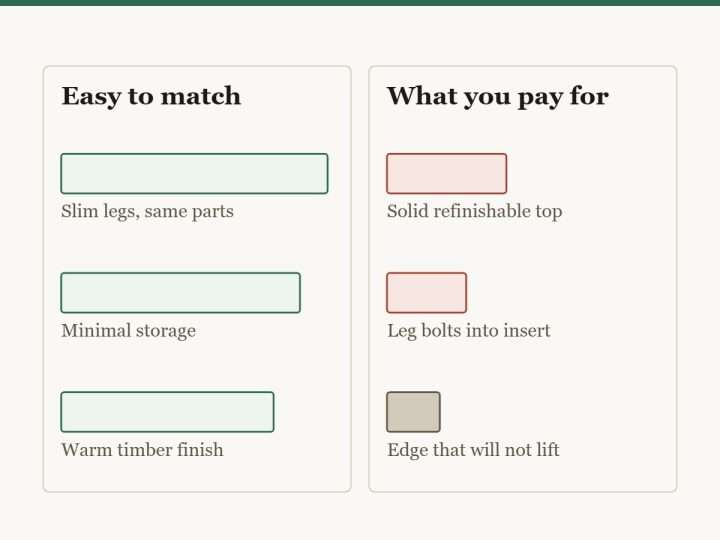
Solid timber can be sanded and refinished repeatedly, which over a decade is the property that matters.
Veneer on a stable core stays flatter — a real advantage on an L, where any twist shows at the join — and refinishes once or twice.
Laminate or melamine over particleboard is what most budget corner desks are. It is fine in use and it cannot be repaired at all; the failure point is a chipped edge band letting moisture into the core. The vocabulary is decoded in what engineered wood actually is.
If you want a solid top on a budget frame, a butcher block cut to an L is a common and durable route — the fixing method is in mounting a butcher block desktop, and leg options in wooden desk legs.
Cables, which a corner makes worse
A corner desk backs onto two walls, so sockets end up behind the deepest, least reachable part of the surface.
Plan for it before assembly rather than after: a power strip fixed to the underside of the desk, a grommet or a cut-out where the cables drop, and enough slack that you can pull the desk out to clean behind it. Grommet sizes and how to fit one are in desk grommets.
Before you order
- Tape measure Both wall runs separately, plus 36 in of clear floor behind the chair
- Levelling feet A corner is where floors meet and they are rarely flat there
- Under-desk power strip Sockets end up behind the least reachable part of the top
- Desk grommet A clean route for cables through the surface rather than over the edge
What to buy


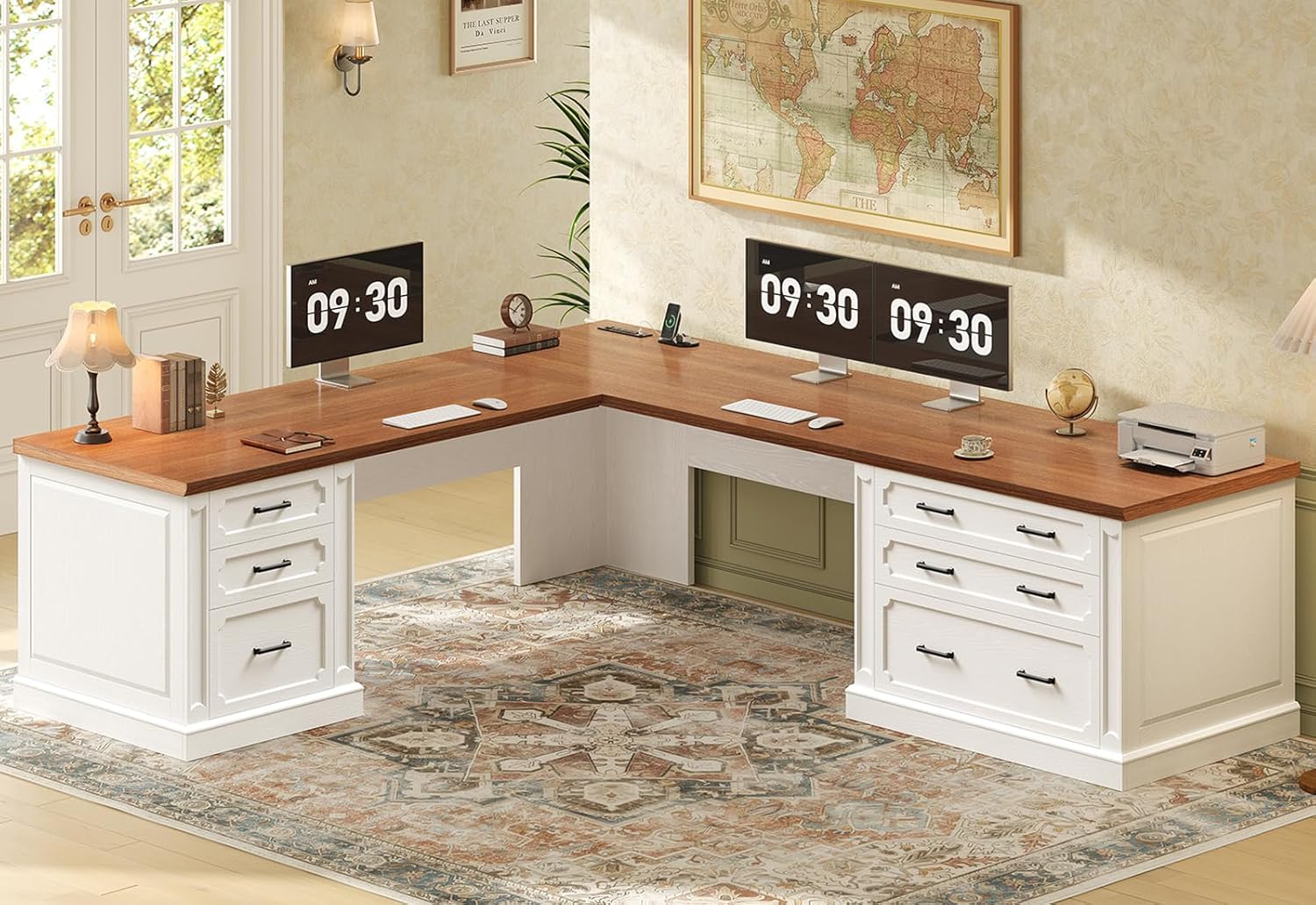
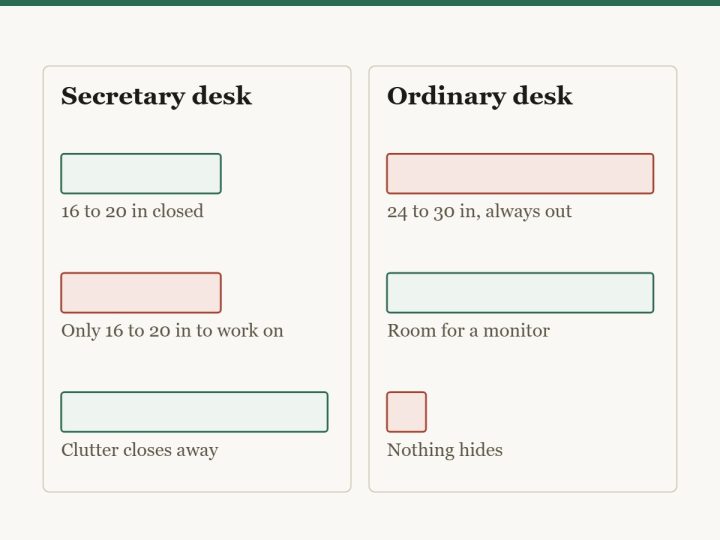
If the room cannot give you two wall runs, a secretary desk closes away and needs one short wall. For the frame and top separately, see wooden desk legs and mounting a butcher block desktop. For other small-room furniture, space saving bookshelves.
Questions we get asked
Is a corner desk good for a small room?
Yes — it uses the part of the room nothing else can. An L-shape is the better version, because a true corner desk wastes its deepest 10 to 16 inches.
How much space does a corner desk need?
Two wall runs, typically about 55 and 40 inches for an L, plus 36 inches of clear floor behind the chair.
What is the difference between a corner desk and an L-shaped desk?
A true corner desk cuts across the angle and puts the deepest point out of reach. An L-shaped desk keeps both legs at a normal working depth.
Should I buy a reversible desk?
If there is any chance the room will change, yes — and it usually costs nothing extra. A fixed-hand desk in the wrong corner cannot be assembled.
How tall should a desk be?
Twenty-nine to 30 inches, paired with a seat at 17 to 19. Check for a pedestal or cross brace at the inside of the L, where your knees swivel.
Why does my L-shaped desk wobble?
Almost always the join between the two tops rather than the legs. Look for a shared corner leg or a proper bracket, and fit levelling feet.