Desk Grommets: Cutting the Hole You Cannot Undo
The Wooden Stars is a participant in the Amazon Services LLC Associates Program. We may earn a commission when you buy through links on our site, at no extra cost to you.
A desk grommet is a plastic or metal ring that lines a hole cut through the desktop so cables can pass without chafing on bare timber. It costs very little, takes ten minutes to fit, and is the one desk job with no undo.
The grommet is not the decision. The hole is. Cut it in the wrong place, or the wrong diameter, and you own that mistake for as long as you own the desk.
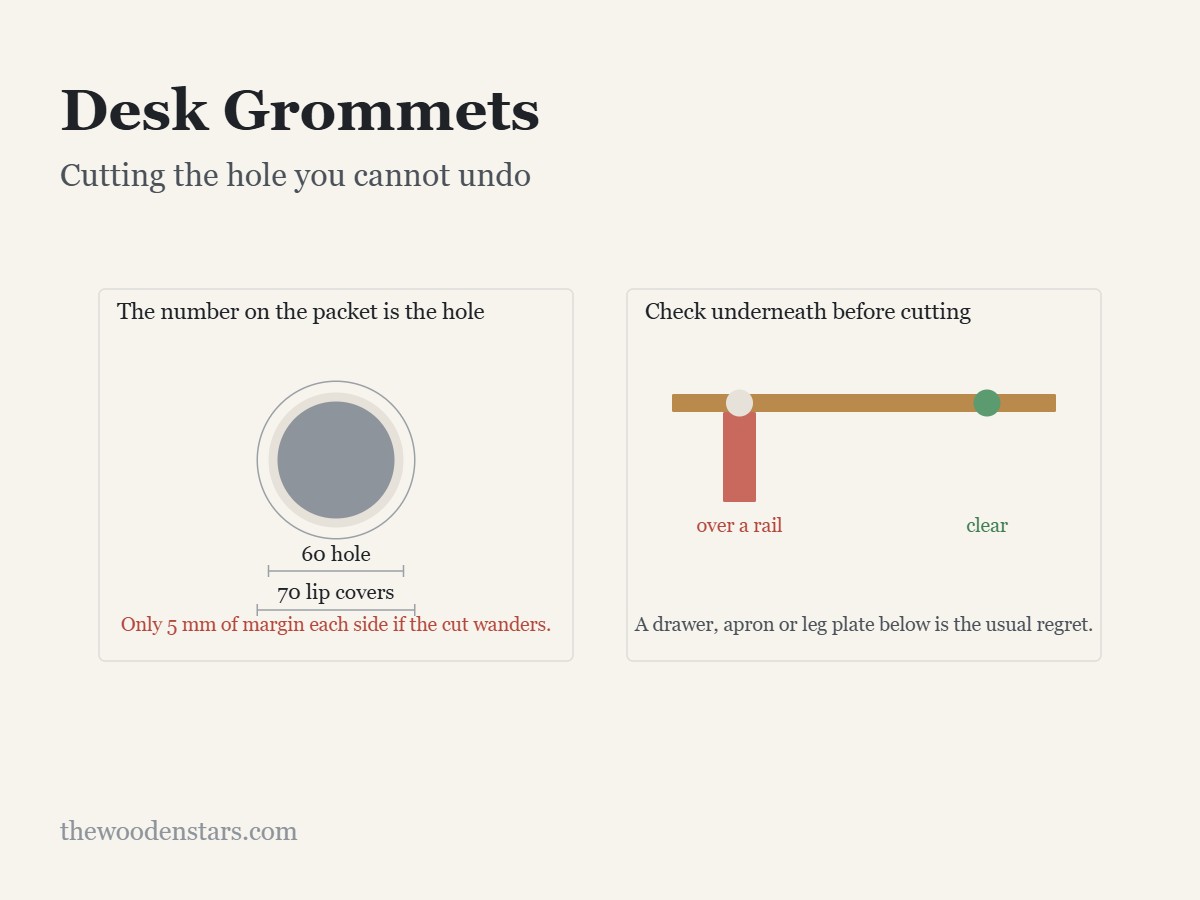
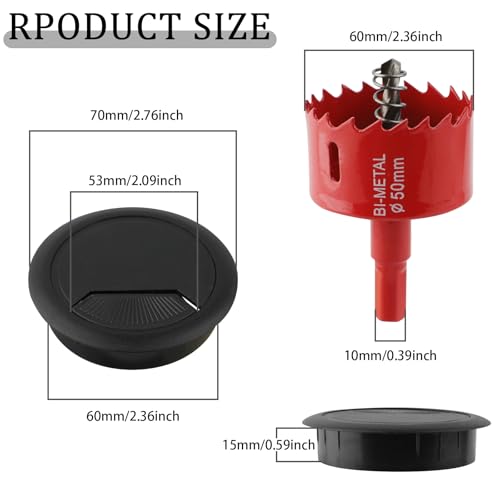
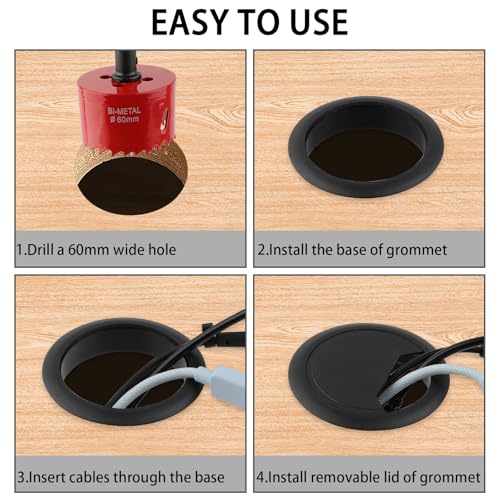
Grommets are sold by hole diameter, not by outside diameter — a “60 mm grommet” needs a 60 mm hole and its lip covers about 70 mm. The usual sizes are 50, 60 and 80 mm; 60 mm takes a monitor cable, a laptop charger and a USB cable comfortably. Put it in the back corner opposite the side you sit, 50–80 mm in from the back edge, and drill with a hole saw from the top face with a scrap board clamped underneath. Check what is directly beneath before you cut: a drawer, an apron rail or a leg plate in that spot means moving the hole, not the drawer.
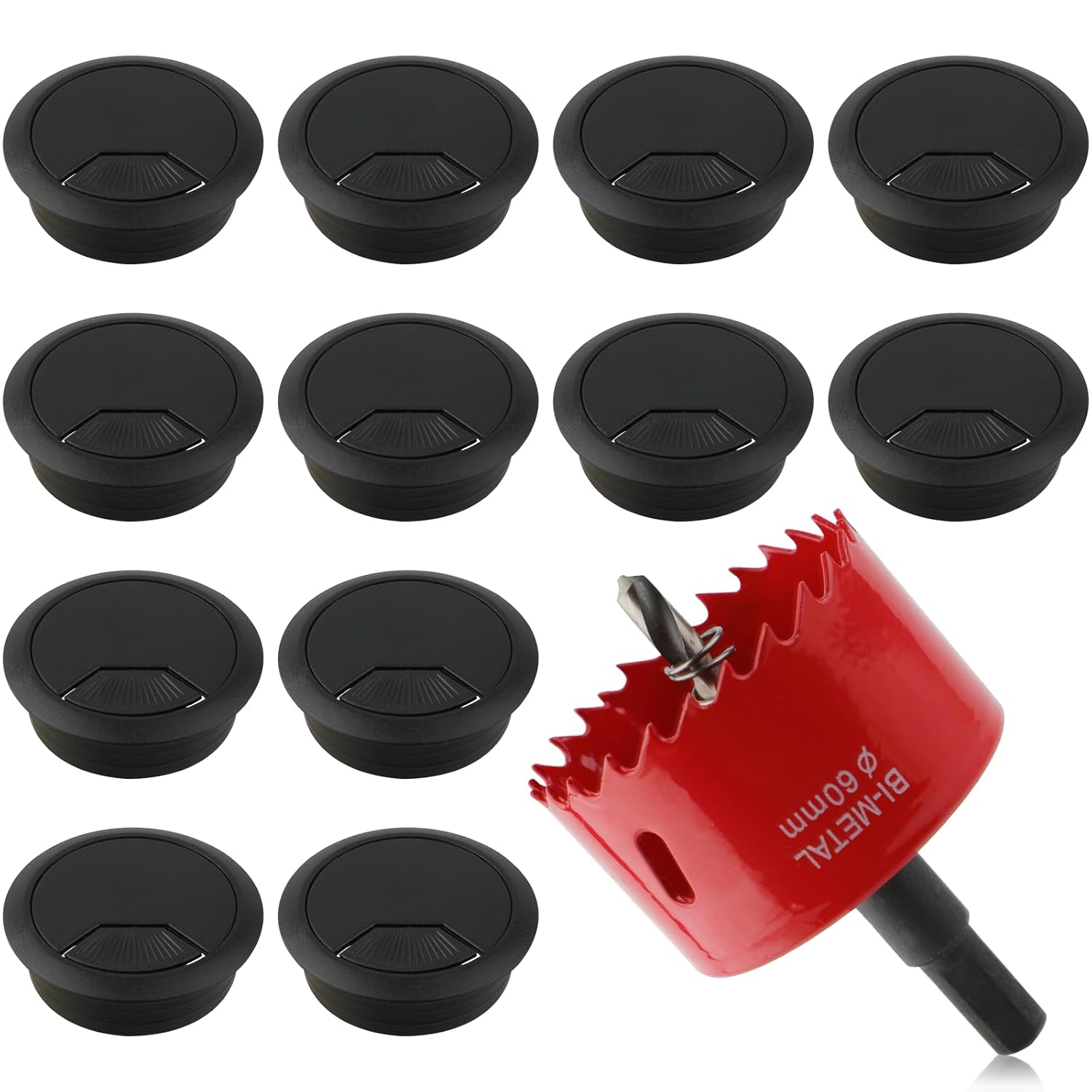
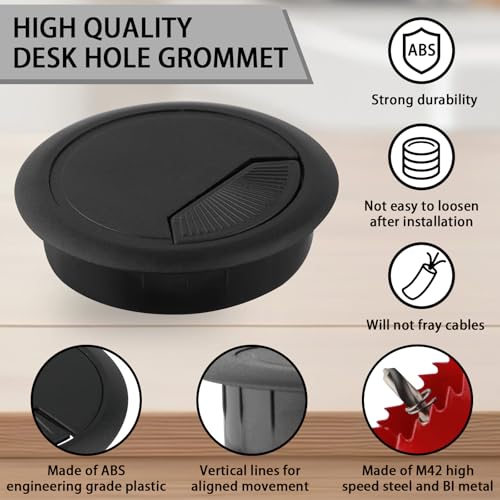
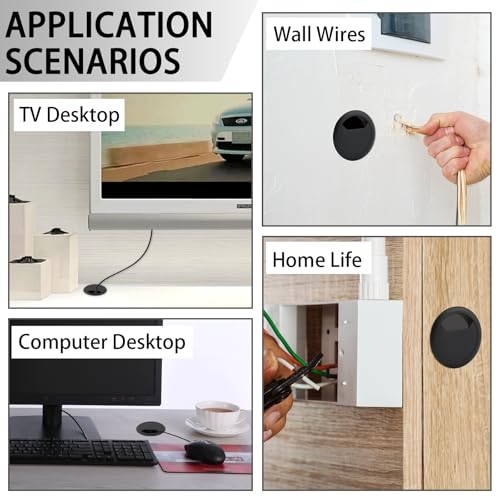
Prime 2-3/8 Inch(60mm) Desk Grommet,13 Pieces Wire Grommet, Desk Hole Cover for Cables with Hole Saw,Plastic Cable Cord Wire Hole Cover for Desk, Table,Cabinet,Countertop and Other Furniture(Black)


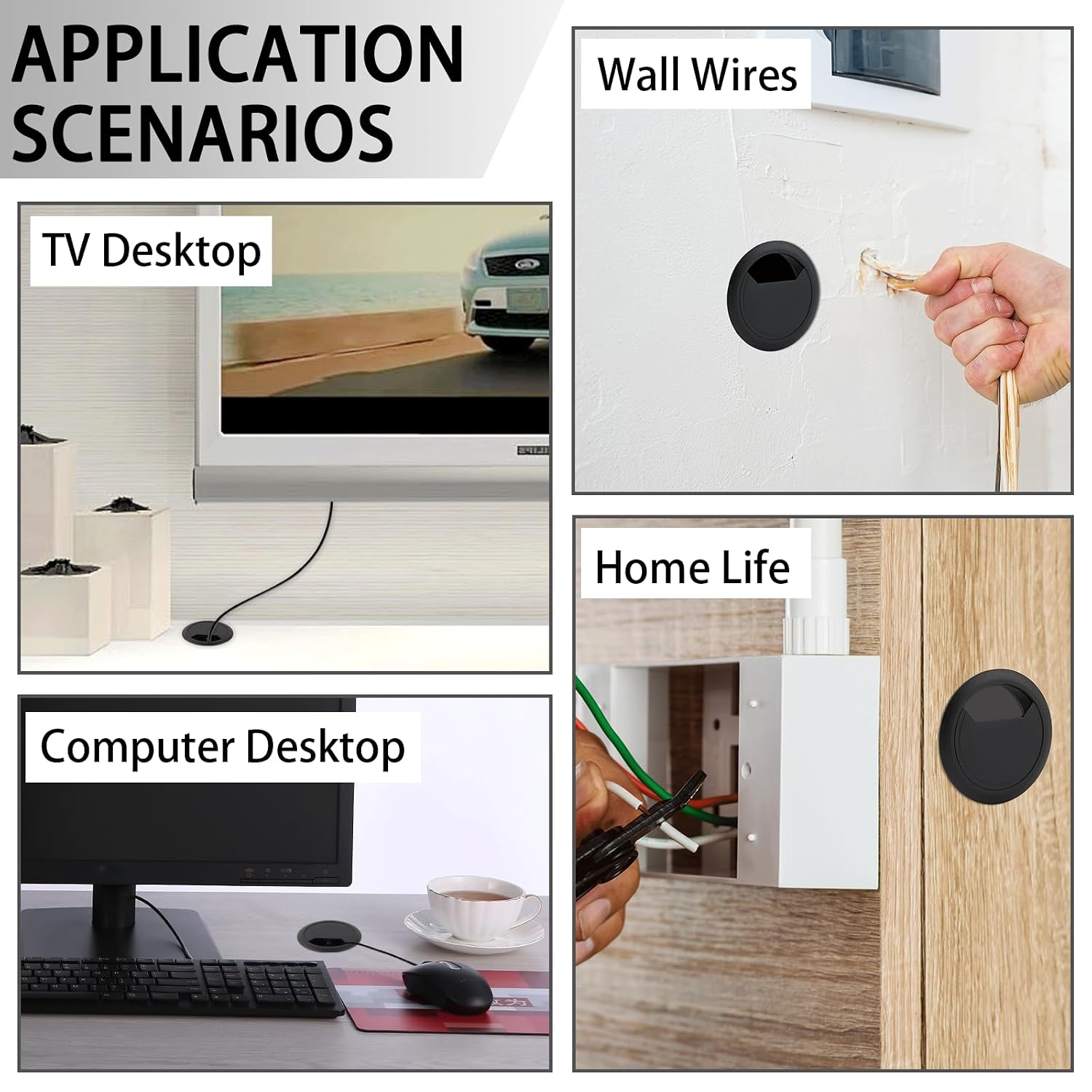




As an Amazon Associate we earn from qualifying purchases. Product prices and availability are accurate as of the date/time indicated.
Start here: buy the grommet before you cut anything, because the size on the packet is the hole you have to make and there is no undoing it.
Sizing: the number on the packet is the hole
| Nominal size | Hole to cut | Lip covers | Comfortably passes |
|---|---|---|---|
| 40 mm | 40 mm | 48–50 mm | Two thin cables |
| 50 mm | 50 mm | 58–62 mm | Three cables, no plugs |
| 60 mm | 60 mm | 68–72 mm | Monitor lead, charger, USB — the common choice |
| 80 mm | 80 mm | 90–95 mm | A moulded plug, several cables |
| 100 mm | 100 mm | 112–118 mm | A plug strip head, thick monitor cables |
The question that decides the size is not how many cables you have but whether a plug has to pass through. Threading a bare cable needs very little room. Passing an assembled monitor cable with its moulded connector, or feeding a plug down to a floor socket, needs 80 mm or more.
If you can unplug at both ends and thread the bare cable, 60 mm is plenty and looks less intrusive on the desk.
Position: the part people regret
Four checks, in this order, before anything touches the timber.
- Look underneath. Turn the desk over or get under it with a torch. A drawer box, an apron rail, a stretcher or a leg mounting plate directly below the hole is the most common reason a cut grommet becomes useless.
- Sit at the desk and reach. The grommet should be behind your monitor and to the side away from your dominant hand, so you are not reaching across the working area to plug something in.
- Keep it 50–80 mm from the back edge. Closer and the lip can overhang the edge or hit the wall; further and the cables loop visibly across the desk.
- Check the wall side. If the desk sits hard against a wall, leave a gap behind it for the cable to drop, or the grommet feeds cables into a wall.
On a two-person or double desk, two smaller grommets almost always beat one large central one, because each user gets their own drop and neither reaches across.
Cutting the hole
A hole saw in a drill is the right tool. A jigsaw wanders and leaves an edge the grommet lip will not fully cover.
- Mark the centre and check it twice against what is underneath. The pilot bit goes through first, and it is the last moment you can change your mind.
- Clamp a sacrificial board hard against the underside at the exit point. Without it, the last few millimetres tear out, and the tear-out is bigger than the grommet lip on the back face.
- Drill from the top face, so the clean side is the side you look at.
- Go slowly and back the saw out to clear the dust. A hole saw that is packed with shavings burns the timber, and a burnt ring shows around a metal grommet.
- Test-fit before finishing. Most grommets are a friction fit and want a snug hole; if it is tight, sand the hole rather than forcing the ring, which cracks plastic grommets.
On a veneered or laminated top, put masking tape over the cut line first and score the circle with a knife before drilling. That stops the veneer chipping at the edge of the cut.
One caution on a solid slab: a grommet hole removes timber from a top that is already moving with the seasons, so keep it well away from the ends and from any existing fastener. The movement rules for a slab desktop are in our guide to mounting a butcher block desktop.
| Top | Hole saw | Extra step | Watch for |
|---|---|---|---|
| Solid hardwood | Bi-metal | Backing board | Burning if you go too fast |
| Butcher block | Bi-metal | Backing board | Glue lines can grab the saw |
| Plywood | Bi-metal | Backing board, tape the line | Tear-out on the face veneer |
| MDF | Any | Backing board, dust mask | Dust; the edge is fragile until the grommet is in |
| Veneered board | Bi-metal | Tape and score the circle | Veneer chipping at the rim |
Choosing the grommet itself
- Plastic, two-part with a snap lid. The default. Cheap, comes in black, white and grey, and the lid closes over the hole when nothing is passing through.
- Metal. Brushed steel or brass, heavier, and better looking on a solid wood or slab desk where a plastic ring reads as office furniture.
- Brush grommet. A ring filled with stiff bristles that closes around the cables. Best where cables move — a sit-stand or a desk you rearrange — because it seals whatever is passing through.
- Grommet with a built-in socket or USB. Convenient, but it is an electrical fitting in a hole you cannot move, and it dates faster than the desk does.
On a thick slab, check the grommet’s collar depth against the top thickness. Many are made for an 18–25 mm top and will not clamp on a 40 mm butcher block; deep-collar versions exist and are worth seeking out rather than forcing.
The rest of the cable run
A grommet only gets cables through the top. What happens underneath decides whether the desk actually looks tidy.
- A tray or channel between the back legs holds the power strip off the floor, and is far easier to fit while the desk is upside down.
- Leave the desk 30–50 mm off the wall so the drop has somewhere to go.
- Plan this before the legs go on. The order of operations for a new build, including where the legs land relative to the grommet, is in our guide to wooden desk legs.
What to buy
- Desk grommets, 60 mm The common size: takes a monitor lead and a charger On Amazon →
- Bi-metal hole saw kit The only tool that cuts a clean round hole in a desktop On Amazon →
- Desk grommets, 2 pack If you only need one hole On Amazon →
- Masking tape Scored through, it stops veneer chipping at the rim
- Under-desk cable tray Keeps the power strip off the floor
What to buy


When not to cut a hole at all
Three cases where the answer is to leave the top alone.
- An antique or a piece you might sell. A drilled top affects the value of an older desk far more than the tidiness gains.
- A thin veneered top over hollow core. There may be nothing but cardboard honeycomb inside, and a grommet has nothing to clamp to.
- When a clamp-on cable channel would do. Trays and clips that fix to the back edge or the underside solve most cable problems without a permanent hole.
Questions we get asked
What size hole does a desk grommet need?
Exactly its nominal size — a 60 mm grommet needs a 60 mm hole. The lip covers roughly 10 mm more than the hole, which is your only margin if the cut wanders. Buy the grommet before drilling and check the fitting instructions rather than assuming.
Where should a grommet go on a desk?
Back corner, on the side away from your dominant hand, 50–80 mm in from the back edge, and never directly above a drawer, rail or leg plate. Check underneath with a torch before marking the centre.
Can I cut a grommet hole with a jigsaw?
You can, and the result usually shows. A jigsaw wanders on a curve and the grommet lip only covers about 5 mm past the hole edge. A hole saw is inexpensive and cuts a round hole in one pass.
Will a grommet fit a thick butcher block top?
Only if it is a deep-collar version. Most grommets are sized for 18–25 mm tops and will not clamp on a 38–40 mm slab. Check the stated top thickness range before buying, because forcing a shallow grommet leaves it loose.
How do I stop the underside tearing out when I drill?
Clamp a scrap board tightly against the underside where the saw will exit, and drill from the top. The scrap supports the fibres as the saw breaks through, so both faces come out clean.