How much space in front of a dresser? 36 inches
The Wooden Stars is a participant in the Amazon Services LLC Associates Program. We may earn a commission when you buy through links on our site, at no extra cost to you.
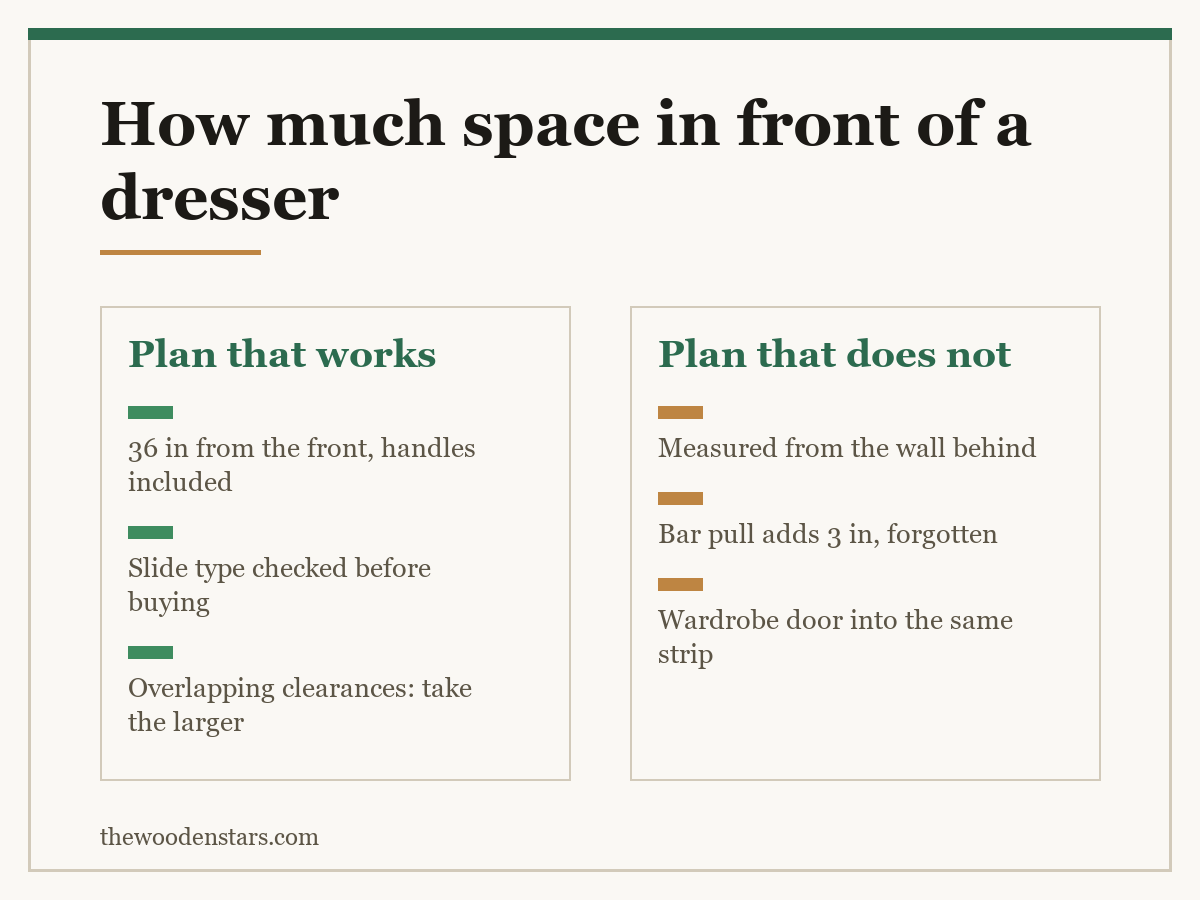
How much space in front of a dresser? 36 inches — the drawer pulls out about 20, and you need somewhere to stand while it does.
It is the clearance that decides whether a dresser fits a bedroom, and the one people leave out of the plan.
Allow 36 inches from the dresser front to whatever is opposite. That is the drawer extension — 16 to 20 inches for a full-extension slide on an 18-inch-deep dresser — plus 16 to 20 inches for you to stand in. Tighten to 30 inches only if nobody walks past while a drawer is open. Go to 42 to 48 if the dresser faces the bed’s side and people use that route, or if a wardrobe door opens into the same space. Below 26 inches the drawer hits the bed before it is fully open.
How much space in front of a dresser, broken down
- Drawer extension: 16 to 20 inches. A full-extension slide brings the whole box clear of the carcass, so on an 18-inch-deep dresser the drawer front travels about 17 inches. Three-quarter slides travel 12 to 14.
- Standing room: 16 to 20 inches. Enough to stand square to the drawer and reach into it, rather than sideways-on.
- Total: 36 inches. Which is the same figure as every other piece of furniture you have to stand at and open.
Measured from the front face of the dresser, including any handles that project — a knob adds 1 to 2 inches and a bar pull can add 3.
| Situation | Clearance | Why |
|---|---|---|
| Nobody passes while open | 30 in | Drawer plus a squeeze |
| Normal bedroom | 36 in | Drawer plus standing room |
| Main walking route | 42 to 48 in | Someone passes an open drawer |
| Wardrobe door opens in | 48 in | Two swings in one space |
| Facing the foot of a bed | 36 in | Measured to the bed frame |
| Absolute minimum | 26 in | Drawer hits the bed |
What the drawer actually does
The extension varies more than people expect, and it changes the clearance you need.
Full-extension ball-bearing slides bring the entire drawer clear of the carcass. On an 18-inch dresser that is about 17 inches of travel, and it is what lets you reach the back of the drawer.
Three-quarter slides stop with the last 4 to 5 inches still inside. You need less clearance — 30 inches works — but the back of every drawer becomes hard to reach, which is a daily annoyance traded for a one-off measurement.
Side rollers are usually three-quarter and also the weakest — how much weight a dresser can hold covers the ratings, and dresser drawer not sliding the failures.
Practical point: if the room genuinely cannot give 36 inches, a dresser with three-quarter slides is a legitimate choice rather than a compromise — but check it before buying, because you cannot swap to shorter slides later without losing the full-extension you paid for.
The bedroom arithmetic
A dresser is rarely alone in the room, so its clearance has to share.
Against the wall opposite the bed: 36 inches from the dresser front to the bed frame. A queen bed is 60 inches wide plus a frame, so a 12-foot wall gives you 144 − 60 − 36 = 48 inches for the dresser’s depth and spare. Comfortable.
Against the wall beside the bed: the dresser’s clearance overlaps the bed’s own walkway, which is 24 inches minimum — see how far a nightstand should be from the bed. Where they overlap, take the larger figure, not the sum.
Facing a wardrobe: the worst case. Both doors and drawers swing into the same strip, so allow 48 inches or arrange them on adjacent walls instead — single against double wardrobe and how tall a wardrobe should be.
When the room will not give it
Four moves, in order of how much they return.
Go taller and narrower. A 34-inch-wide tall chest needs the same 36 inches in front but takes far less wall, and it stores as much — tall wood dresser and how tall a dresser should be.
Go shallower. A 16-inch-deep dresser instead of 20 gives back 4 inches of drawer travel as well as 4 of footprint — how deep a standard dresser is.
Move it to the wall the bed’s foot faces, where the 36 inches is walkway you already needed.
Use a wardrobe with drawers inside so the swing and the pull share one clearance — armoire closet with drawers.
What does not work: choosing knobs over bar pulls to save 2 inches, then still being 8 inches short. Handles are worth checking — dresser knobs — but they are a tiebreaker, not a solution.
One thing worth doing before the dresser arrives, and it takes a minute: open the drawer of whatever is currently in that spot and measure where the front edge lands. People are consistently surprised by how far a full-extension drawer travels, and a tape measure held out from the wall settles the argument in ten seconds — far better than discovering it on delivery day when the bed is already made up.
And check the handle projection on the model you are buying, not on a similar one. Cup pulls and long bar handles vary from flush to 3.5 inches, which is the difference between a dresser that fits and one that does not in a tight bedroom.
Measuring the room
- Tape measure Dresser front including handles, to whatever is opposite
- Painter’s tape Mark the open-drawer footprint on the floor before ordering
- Anti-tip furniture straps An open drawer in a tight room gets leaned on
- Furniture slides For shifting a loaded dresser without dragging it on carpet
What to buy


For sizing, see how tall a dresser should be, how deep a standard dresser is and how deep a dresser drawer should be. For the same sum elsewhere, how much space behind a desk.
Questions we get asked
How much space in front of a dresser?
Thirty-six inches — about 17 for the drawer to come out and 19 for you to stand in.
Where do I measure from?
The front face of the dresser, including handles. A bar pull can add 3 inches.
What is the minimum?
Thirty inches if nobody walks past while a drawer is open. Below 26 the drawer hits the bed.
How far does a drawer actually come out?
Sixteen to 20 inches on full-extension slides, 12 to 14 on three-quarter slides.
What if the dresser faces a wardrobe?
Allow 48 inches, or put them on adjacent walls so the swings do not share a strip.
Do I add the bed’s walkway to the dresser’s?
No. Where two clearances overlap, take the larger one.