How tall should a wardrobe be? 70 to 80 inches
The Wooden Stars is a participant in the Amazon Services LLC Associates Program. We may earn a commission when you buy through links on our site, at no extra cost to you.
How tall should a wardrobe be? 70 to 80 inches for a freestanding one — tall enough to hang a coat without it touching the bottom, short enough to get through a door.
The ceiling sets the maximum. A hanging garment sets the minimum, and the minimum is higher than people guess.
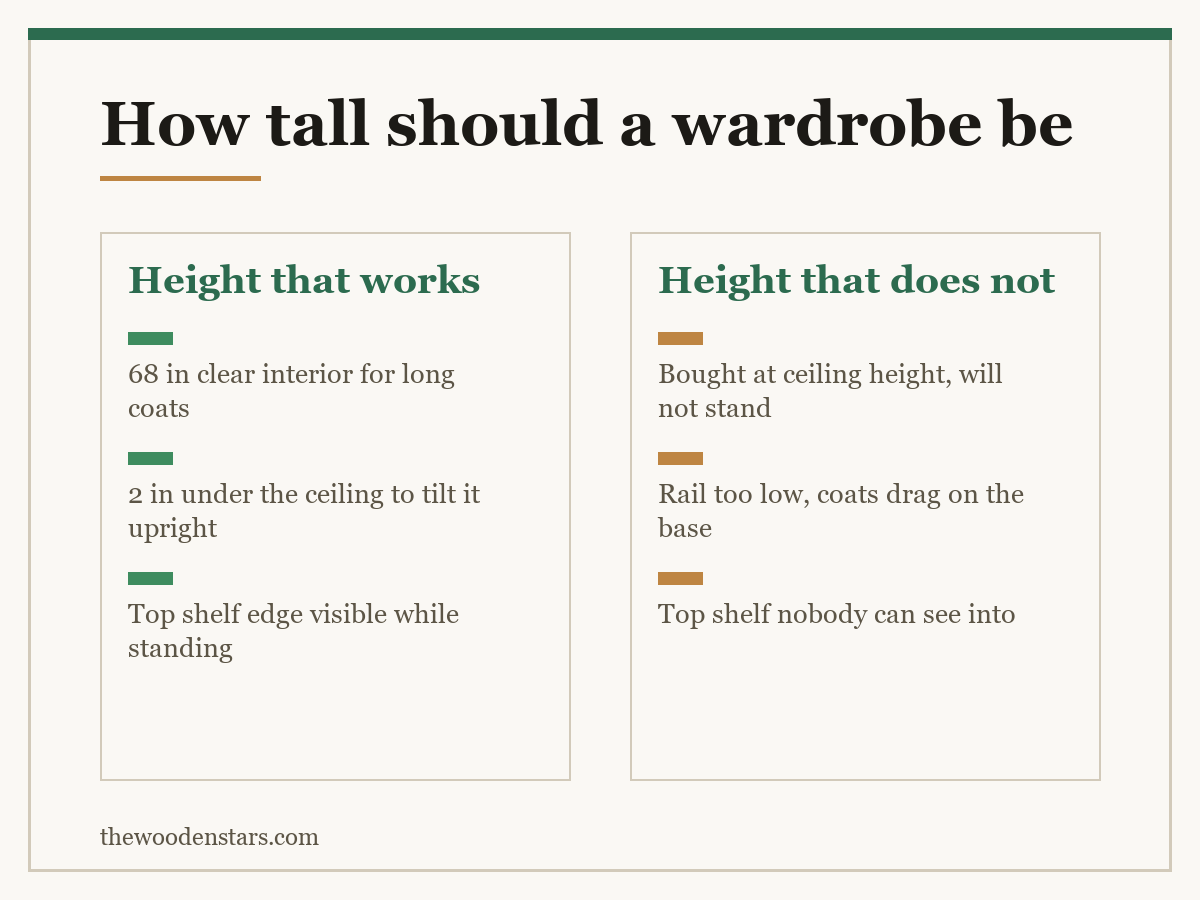
Freestanding wardrobes run 70 to 80 inches, and built-in runs to the ceiling at 96. The minimum is set by what hangs inside: a single rail needs 68 inches of interior for long coats and dresses, or 40 to 42 for shirts and jackets only. A double-hang section fits two rails in 84 inches of interior. Add 3 to 5 inches for the carcass top and base. Two limits nobody checks: ceiling height minus 2 inches so you can tilt it upright in the room, and the doorway diagonal, which stops most one-piece wardrobes over 78 inches.
How tall should a wardrobe be for what hangs in it
- Shirts and jackets only: 40 to 42 inches of hanging height. Allows a double-hang layout.
- Trousers folded over a hanger: 44 to 48.
- Dresses: 52 to 64 depending on length.
- Long coats: 66 to 68. This is the figure that sets a single-rail wardrobe’s height.
- Double-hang, two rails: 84 inches of interior — 42 above, 42 below.
Add the carcass: a top panel, a base and any plinth come to 3 to 5 inches. So a wardrobe that hangs long coats properly is 71 to 73 inches overall, which is why 72 is such a common size.
How much of that height you can actually use for rail depends on whether there is a shelf above — and how much rail you get across is the separate question in how much hanging space in a wardrobe.

| Layout | Interior | Overall | Suits |
|---|---|---|---|
| Shirts and jackets only | 40 to 42 in | 46 to 50 in | Over a chest of drawers |
| Trousers and shirts | 44 to 48 in | 50 to 54 in | Small rooms |
| Single rail, dresses | 52 to 64 in | 58 to 70 in | Most bedrooms |
| Single rail, long coats | 66 to 68 in | 70 to 73 in | The common size |
| Double hang | 84 in | 88 to 90 in | Two people, one wardrobe |
| Built-in to ceiling | Up to 92 in | 96 in | Storage above the rail |
The two limits that stop you going taller
Tilting it upright. A flat-packed wardrobe assembled on its back has to be stood up in the room, and its diagonal is longer than its height. A 78-inch wardrobe that is 22 inches deep has an 81-inch diagonal, so an 8-foot ceiling is marginal. The rule of thumb: ceiling height minus 2 inches is the tallest you should buy, and less if the wardrobe is deep.
The fix, where a maker offers it, is a carcass that assembles standing up. Worth looking for on anything over 76 inches.
Getting it into the room. A one-piece wardrobe has to come through a doorway, up a stairwell and round a landing. Standard interior doors are 78 to 80 inches tall and 30 to 32 wide, and the turn at the top of the stairs is usually the real obstacle rather than the door.
This is why most freestanding wardrobes over 72 inches ship flat-packed, and why a solid one-piece antique is so often found in the room it was built for.
Above the rail, and whether to use it
The space above the hanging rail is the cheapest storage in a bedroom and the least used.
A shelf at 12 to 16 inches above the rail takes suitcases, spare bedding and out-of-season clothes. On a 72-inch wardrobe that shelf sits at about 62 inches — reachable.
On a 90-inch built-in, the top shelf is at 78 to 80 inches, which needs a step. That is fine for things you touch twice a year and useless for anything else.
The honest test: can you see the front edge of the shelf while standing? If not, whatever goes up there is stored, not used. The same eye-level reasoning governs dressers — how tall a dresser should be.
Height, stability and the wall
A wardrobe is the tallest, narrowest thing in most bedrooms, and the doors make it worse — an open door moves weight outside the footprint.
Anchor anything over 60 inches to a stud. Not optional in a room a child uses, and sensible everywhere. The kit is the same as for a chest — anti-tip kits for dressers.
Check the plinth. A wardrobe standing on four small feet on carpet will rock; one on a continuous plinth will not. Levellers are worth fitting either way, because a wardrobe out of plumb has doors that swing open on their own.
Watch the depth-to-height ratio. Anything over 72 inches tall on a base under 20 inches deep is the risky proportion.
For the width side of the decision, see single against double wardrobe; for the alternatives, armoire against wardrobe and armoire against dresser; and for the clearance in front, the same 36-inch rule as how much space in front of a dresser.
One thing that catches people with sloped ceilings and dormer bedrooms: the wardrobe has to clear the lowest point of the ceiling along its whole depth, not just at the wall. A 72-inch wardrobe against a wall under a 45-degree slope needs the ceiling to be 72 inches high at a point 22 inches out from the wall, which in a typical loft conversion it is not. Measure at the front edge of where the wardrobe will stand.
Before it arrives
- Anti-tip furniture straps Required past 60 inches and in any child’s room
- Tape measure Ceiling height, doorway, and the turn at the top of the stairs
- Furniture levellers A wardrobe out of plumb has doors that swing on their own
- Hanging rail and brackets For adding a second rail in a tall single-hang wardrobe
What to buy


For the rest, see single against double wardrobe and how much hanging space in a wardrobe. For alternatives, armoire against wardrobe and armoire closet with drawers.
Questions we get asked
How tall should a wardrobe be?
Seventy to 80 inches freestanding. Built-in runs to the ceiling at about 96.
What is the minimum height?
Sixty-eight inches of clear interior if long coats hang in it, or 40 to 42 for shirts and jackets only.
Why is 72 inches so common?
Sixty-eight inches of hanging plus 3 to 5 for the carcass top and base lands there.
Can I buy one as tall as my ceiling?
No. The diagonal is longer than the height, so you cannot tilt it upright. Allow ceiling height minus 2 inches.
How tall for a double-hang layout?
Eighty-four inches of interior — two 42-inch rails — so 88 to 90 overall.
When does it need anchoring?
Past 60 inches, and in any room a child uses. An open door moves weight outside the footprint.