How much space behind a desk? 36 to 48 inches
The Wooden Stars is a participant in the Amazon Services LLC Associates Program. We may earn a commission when you buy through links on our site, at no extra cost to you.
How much space behind a desk? 36 inches for the chair alone, 48 if anyone has to walk past you while you are sitting at it.
It is the measurement that decides whether a 60-inch desk fits a room, and almost nobody takes it before ordering.
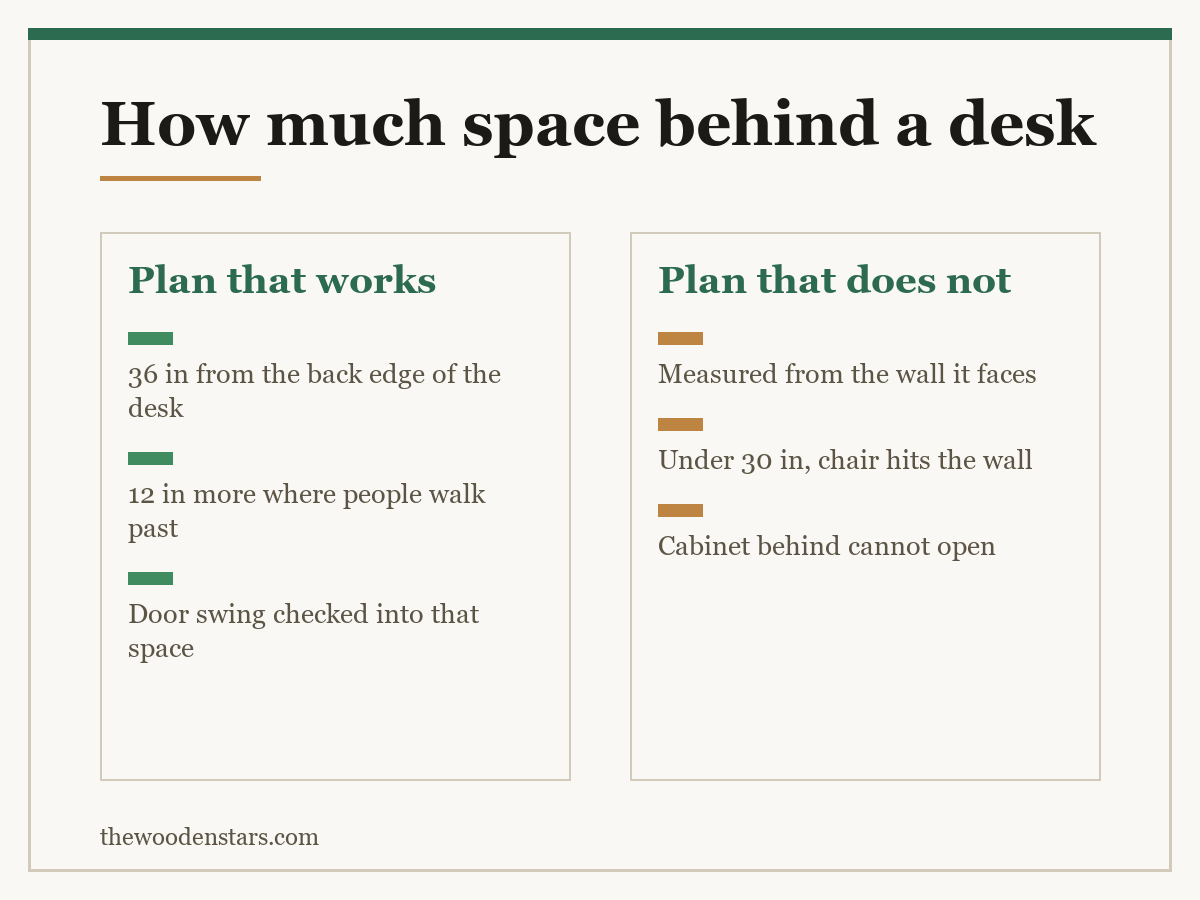
Measure from the back edge of the desk to whatever is behind you. You need 36 inches for the chair to roll back and for you to stand up — that is the chair’s own depth plus the movement. Make it 42 to 48 if there is a walkway behind, and 60 if a door opens into that space or there is a filing cabinet you open. Below 30 inches the chair hits the wall before you are clear of the desk. Against a wall you can reclaim room by using a desk without a modesty panel and pushing it fully back.
How much space behind a desk, by situation
- Desk against a wall, nobody passes: 36 inches behind the desk edge. This is the floor-plan minimum.
- Someone walks behind you: 42 to 48. Thirty-six is the chair; a person needs another 6 to 12.
- A door opens into the space: 60, or the swing has to clear the chair’s parked position.
- Storage behind that opens: 60. You need to roll clear and then open a drawer or a cupboard door.
- Desk floating in the room, chair on both sides: 36 each side, so 72 plus the desk depth.
The number is measured from the back edge of the desktop — the side you sit at — not from the wall the desk faces. That confusion costs people a foot of plan.

| Situation | Clearance | Why |
|---|---|---|
| Nobody passes | 36 in | Chair depth plus roll-back |
| Walkway behind | 42 to 48 in | Chair plus a person |
| Door swings in | 60 in | Swing must clear the parked chair |
| Storage opens behind | 60 in | Roll clear, then open |
| Desk floats, two sides | 36 in each | Plus the desk depth |
| Absolute minimum | 30 in | Chair hits the wall first |
Where the 36 inches goes
It is not arbitrary. Break it down:
- Chair depth, 22 to 26 inches. An office chair with a five-star base is wider and deeper than it looks.
- Roll-back to stand, 10 to 14 inches. You push the chair away before you get up, and you do it dozens of times a day.
- Tuck-in, negative. The chair goes partly under the desk when parked, which is why the figure is 36 rather than 40.
At 30 inches the chair hits the wall while your knees are still under the desk, so you stand up by shuffling sideways. At 24 the chair does not fit behind the desk at all and lives permanently pushed in.
Chairs without castors need less — a dining chair at a writing desk wants about 30 inches, because you lift it rather than rolling it. That is one reason a secretary desk for small spaces works where a full office setup does not.
Reclaiming the space you do not have
Four moves, in order of how much they give back.
Turn the desk. A desk along the long wall of a narrow room leaves nothing behind it. The same desk across a corner, or against the short wall, often finds the 36 inches — corner desk for small spaces and L shaped desk against rectangular.
Lose the modesty panel. A back panel stops the desk pushing fully against the wall, and it stops your chair going under at the sides. Removing it or choosing a desk without one can find 3 to 5 inches.
Change the chair. A compact task chair without arms is 20 to 22 inches deep against 26, and it tucks fully under. This is the cheapest fix and the one people resist.
Use a narrower desk. Counter-intuitive, but a 40-inch desk against the short wall beats a 60-inch one that leaves you 28 inches behind — the width arithmetic is in how wide a desk should be.
The clearances that go with it
Knee clearance under the desk: 24 to 27 inches floor to underside, 20 inches of clear width. Drawers eat into this — desk with drawers against without.
Screen distance: 20 to 30 inches from your eyes, which sets the desk’s depth rather than the room’s — how deep a desk should be.
Side clearance: 24 inches at one end if you need to walk round the desk, or it becomes a dead corner.
Cable run: the socket wants to be behind or beside the desk, not across the walkway you just measured — desk grommet covers routing through the top.
The same reasoning applied to a dining room is in how much space around a dining table, and to a bedroom in how much space in front of a dresser.
One measurement people take and then ignore: the chair’s parked footprint. Mark it on the floor with tape before ordering, sit in the room for a day, and see whether you walk round the tape or over it. It is the only reliable way to tell whether 36 inches is genuinely enough in your room, because a walkway that looks fine on a plan behaves differently when a radiator, a door handle or a skirting board is in it.
Measuring the room
- Tape measure Back edge of the desk to the wall behind, before ordering
- Painter’s tape Mark the chair’s parked footprint on the floor and live with it a day
- Chair mat A chair that rolls properly needs less room than one that drags
- Desk cable tray Keeps the cable run out of the walkway you just measured
What to buy


For the desk itself, see how wide a desk should be, how tall a desk should be and how deep a desk should be. For tight rooms, corner desk for small spaces.
Questions we get asked
How much space behind a desk?
Thirty-six inches from the back edge of the desk for the chair alone, and 42 to 48 if anyone walks past.
Where do I measure from?
The back edge of the desktop — the side you sit at — not the wall the desk faces.
What is the absolute minimum?
Thirty inches. Below that the chair hits the wall while your knees are still under the desk.
What if a door opens into the space?
Allow 60 inches, or check that the swing clears the chair in its parked position.
How do I gain clearance in a small room?
Turn the desk to another wall, lose the modesty panel, use an armless chair, or buy a narrower desk.
Does a chair without castors need less?
Yes, about 30 inches, because you lift it rather than rolling it back.