How deep is a dining chair seat? 16 to 20 inches
The Wooden Stars is a participant in the Amazon Services LLC Associates Program. We may earn a commission when you buy through links on our site, at no extra cost to you.
How deep is a dining chair seat? 16 to 20 inches from the front edge to the backrest — and unlike height, which the table dictates, this one has to fit the people.
It is the dimension that decides whether a chair is comfortable for two hours or twenty minutes.
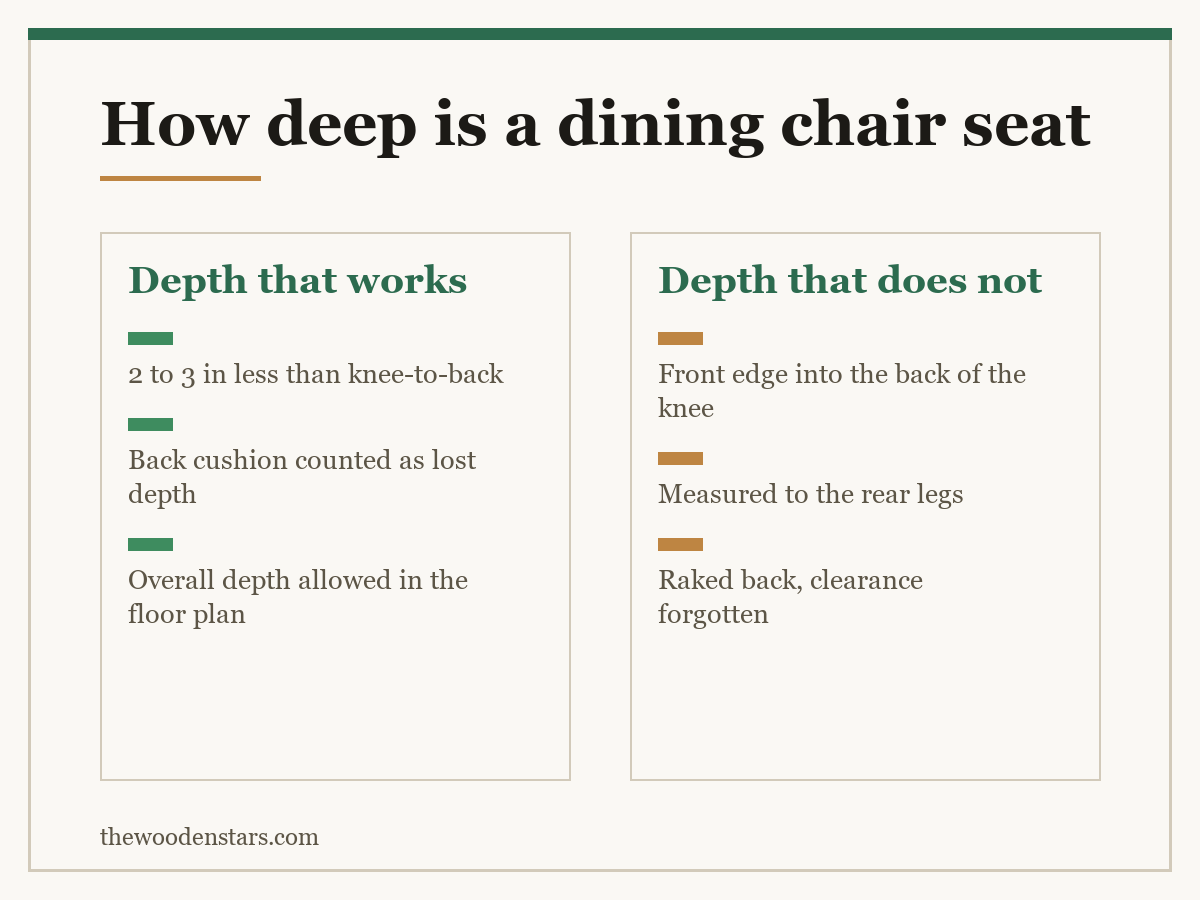
Seat depths: 15 to 16 inches on a compact or bistro chair, 16 to 18 as the standard, 18 to 20 on an upholstered or parsons chair, and 20 to 22 on a dining armchair meant for long meals. The fit rule: measure from the back of your knee to your lower back seated — 17 to 21 inches on most adults — and take a seat 2 to 3 inches less. Too deep and the front edge presses behind the knee; too shallow and your thighs are unsupported. Overall chair depth including the back and the leg splay is 20 to 24 inches, and that is the figure the room has to give.
How deep is a dining chair seat, by type
- Compact or bistro chair: 15 to 16 inches.
- Standard wooden side chair: 16 to 18. The commonest size by far.
- Upholstered or parsons chair: 18 to 20, because the padding takes some of it.
- Dining armchair or carver: 20 to 22.
- Bench, for comparison: 14 to 18, and no back to lean into.
The seat depth is measured front edge to the face of the backrest, not to the back legs. Overall chair depth — what the floor plan needs — is 3 to 5 inches more once you add the back and the leg splay.

| Chair | Seat depth | Overall depth | Suits |
|---|---|---|---|
| Compact or bistro | 15 to 16 in | 18 to 20 in | Small rooms, short sitters |
| Standard side chair | 16 to 18 in | 20 to 22 in | Most adults |
| Upholstered parsons | 18 to 20 in | 22 to 24 in | Long dinners |
| Dining armchair | 20 to 22 in | 24 to 26 in | Head of the table |
| Under 5 ft 4 in | 15 to 16 in | — | Feet reach the floor |
| Over 6 ft | 19 to 21 in | — | Thighs supported |
Matching depth to the person
The measurement that matters is from the back of your knee to your lower back, seated. On most adults that is 17 to 21 inches, and the seat should be 2 to 3 inches less.
Too deep and the front edge presses into the back of your knee. You compensate by sliding forward, which means you lose the backrest entirely and end up perched — which is why a too-deep chair feels worse over a long meal than a too-shallow one.
Too shallow and your thighs are unsupported past the halfway point, so your weight concentrates on a smaller area. Tolerable for a quick breakfast, tiring at dinner.
Rough guide by height: 5 ft 2 in → 15 inches, 5 ft 6 in → 16 to 17, 5 ft 10 in → 17 to 18, 6 ft 2 in → 19 to 20.
Where a household spans that range, 17 inches suits most people, and a lumbar cushion lets the shorter sitters effectively shorten it. The corresponding logic for bar seating is in how deep a bar stool seat is.
Where the backrest angle changes everything
Seat depth alone does not tell you how a chair feels, because most dining chairs lean the back slightly.
A vertical back gives you the full published depth. A back raked 5 to 15° — normal on a comfortable dining chair — effectively adds an inch or two at shoulder height while the seat stays the same, which is why two chairs with identical 17-inch seats can feel different.
Two practical consequences:
- A raked back needs more floor. Overall depth grows, and so does the push-back clearance the room must provide — how much space around a dining table.
- A raked back suits long dinners; a vertical one suits tucking in. If chairs must slide fully under the table between meals, a vertical back and a shallow seat is the combination that does it.
Upholstery adds depth too: a 2-inch back cushion takes 2 inches off the usable seat, so an 18-inch upholstered seat behaves like a 16-inch timber one — the trade set out in upholstered against wood dining chairs.
What to check before ordering
Ask for the seat depth and the overall depth separately. Listings often give only one, and sometimes give the overall while calling it the seat.
Check it against your table’s apron. A deep chair with a raked back may not tuck in even if the arms clear — dining chair with arms against without.
Add the push-back. Overall depth plus 12 to 18 inches is what a person needs to stand up, on top of the 36 inches of clearance the room already owes.
Sit in one if you can. Twenty minutes is the honest test; five is not. A chair that feels fine in a showroom and wrong at Christmas is almost always a depth problem rather than a height one.
The other two dimensions are set elsewhere: how tall a dining chair should be and how wide a dining chair is. And the frame’s capacity is in how much weight a dining chair can hold.
Getting the depth right
- Tape measure Front edge to the backrest face, and again to the rear legs
- Lumbar cushion Effectively shortens a seat that is too deep for a shorter sitter
- Seat pads for dining chairs Supports the thigh on a seat that is too shallow
- Felt furniture pads Deep chairs get dragged more because they tuck less easily
What to buy


For the other dimensions, see how tall a dining chair should be and how wide a dining chair is. For the seat itself, upholstered against wood.
Questions we get asked
How deep is a dining chair seat?
Sixteen to 20 inches. Standard side chairs are 16 to 18; upholstered chairs reach 20.
Where do I measure from?
The front edge of the seat to the face of the backrest — not to the back legs.
What depth suits me?
Two to 3 inches less than your knee-to-lower-back measurement, seated. That is 15 inches at 5 ft 2 in and 19 to 20 at 6 ft 2 in.
Is too deep or too shallow worse?
Too deep. You slide forward to relieve the front edge and lose the backrest entirely.
Does a back cushion change it?
Yes. A 2-inch cushion takes 2 inches off the usable seat.
How much floor does the chair need?
Overall depth of 20 to 24 inches, plus 12 to 18 to stand up, inside the room’s 36 inches of clearance.