How much weight can a dresser hold? 150 to 400 lb
The Wooden Stars is a participant in the Amazon Services LLC Associates Program. We may earn a commission when you buy through links on our site, at no extra cost to you.
How much weight can a dresser hold? 150 to 400 lb in total — but the figure that decides whether it survives is the drawer, and drawers are rated at 25 to 75 lb each.
Nobody overloads a dresser top. Everybody overloads the bottom drawer.
Totals by construction: 150 to 200 lb for particleboard, 200 to 300 for solid timber with stapled drawer boxes, 300 to 400 for solid timber with dovetailed drawers and full-extension slides. Per drawer: 25 to 35 lb on side rollers, 50 to 75 on ball-bearing slides. For scale, a drawer packed with folded jeans is 30 to 40 lb and one full of books is 60 to 90. The top holds 50 to 100 lb and a wall-mounted TV puts none of its weight there. The real failure is the back panel racking, not anything breaking.
How much weight can a dresser hold, part by part
- Whole unit: 150 to 400 lb depending on carcass material and joinery.
- Per drawer: 25 to 35 lb on side rollers, 50 to 75 on ball-bearing slides, 75 to 100 on heavy-duty full-extension.
- The top: 50 to 100 lb spread. A 55-inch TV on a stand is 40 to 60 and well within it.
- A single point on the top: much less. Someone sitting on the edge is the load it was never designed for.
The mismatch to watch: a solid oak dresser with stapled plywood drawer boxes has a strong carcass and weak drawers. That pairing is extremely common and it is why drawers fail on furniture that otherwise looks fine — the materials question is set out in solid wood dresser and what “all wood” actually means.
| Part | Weak | Strong |
|---|---|---|
| Carcass | Particleboard, 0.6 in | Solid timber, 0.75 in or more |
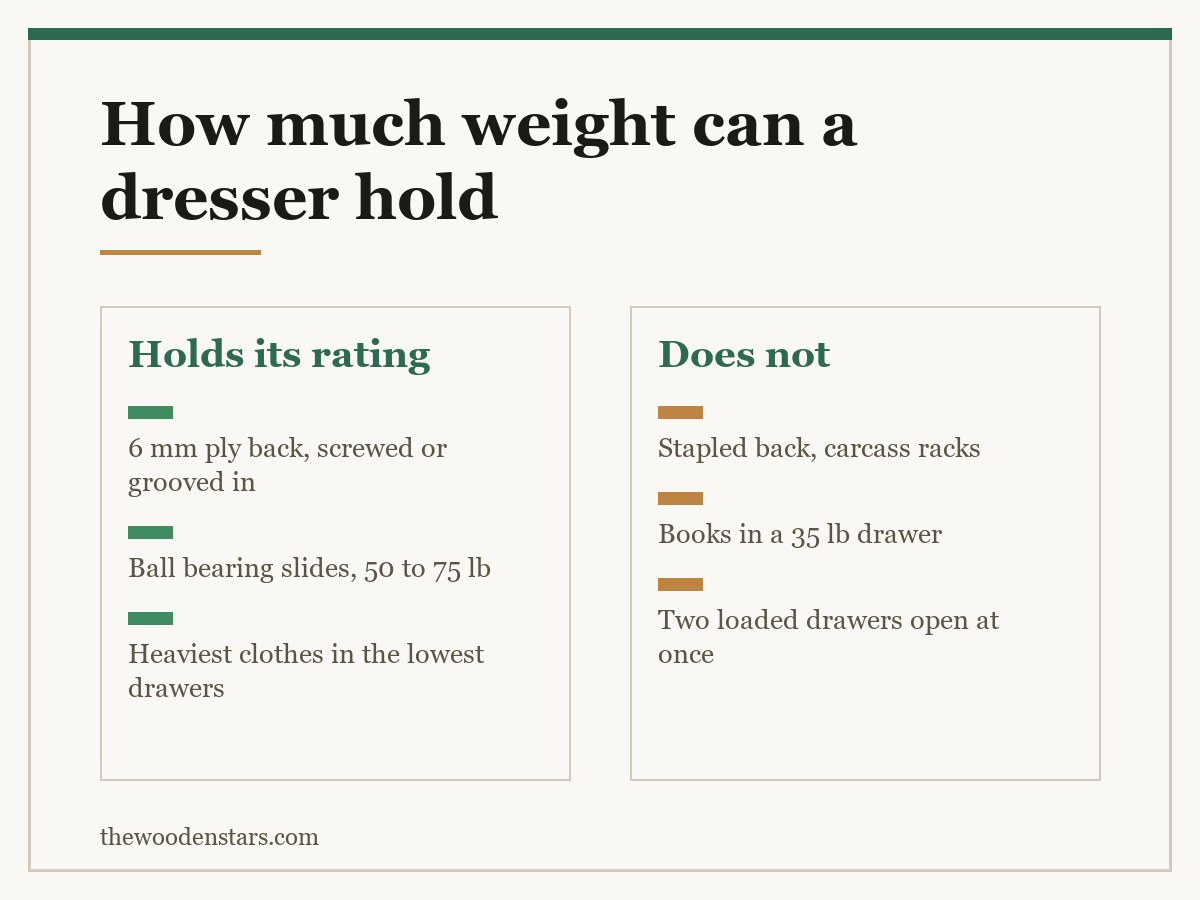
| Back panel | 3 mm hardboard, stapled | 6 mm ply, screwed or grooved in |
| Drawer box | Stapled plywood | Dovetailed solid sides |
| Drawer bottom | 3 mm hardboard, loose | 6 mm ply in a groove |
| Slides | Side rollers, 25 to 35 lb | Ball bearing, 50 to 75 lb |
| Base | Plastic feet screwed in | Plinth or rails into the carcass |
The back panel is what fails
Ask what actually breaks on a dresser and it is almost never a drawer front or the top. It is the back.
A 3 mm hardboard panel stapled into a rebate is the only thing holding the carcass square. Drag the unit sideways to clean behind it, or load the drawers unevenly, and the staples pull. Once the back is loose the carcass racks into a parallelogram, the drawers stop running true, and every drawer in the unit starts catching.
What good looks like: a back of 6 mm ply or better, screwed rather than stapled, or housed in a groove in the carcass sides. Listing photographs of the rear usually tell you.
The fix on a unit you own: run screws with washers through the existing back into the carcass every 6 inches, and add a diagonal batten if it has already racked. If drawers are catching already, dresser drawer not sliding works through the causes in order.
Loading it so the rating holds
Three habits, and they cost nothing.
Heavy at the bottom. Jeans, jumpers and anything dense in the lowest drawers; socks and light layers up top. This lowers the centre of gravity, which matters for tipping, and it puts the heaviest load on the shortest slides.
One drawer open at a time. Two loaded drawers out at once moves the centre of gravity beyond the front feet. This is the mechanism behind every dresser tipping incident, and it is why anchoring is not optional — anti-tip kits for dressers.
Do not put books in it. A drawer of books is 60 to 90 lb, which exceeds side rollers outright and sits at the top of what ball bearings are rated for. Books belong on a shelf sized for them — how tall a bookcase should be.
Reading a listing that gives no rating
Most do not publish one. Four things in the photographs tell you more than a number would.
- Pull a drawer out in the images. Dovetails at the corners mean a solid box. Staples through a plywood side mean the front will separate eventually.
- Look at the slide. A metal channel with visible ball races is 50 lb-plus. A plastic wheel running in a groove is 25 to 35.
- Look at the bottom. A 6 mm panel sitting in a groove holds; a 3 mm sheet pinned underneath drops out of one corner and jams.
- Look at the feet. Plastic feet screwed into particleboard end grain work loose under any sideways load. A plinth or rails joined into the carcass do not.
Depth and drawer size decide what you can actually put in — how deep a standard dresser is and how deep a dresser drawer should be. Height and stability are in how tall a dresser should be, and the same static-rating reasoning for seating is in how much weight a bar stool can hold.
One more thing worth checking before you load it: whether the drawers run on the carcass sides or on a centre rail. A centre-mounted rail under the drawer carries less and lets the drawer rock side to side as it opens, which puts a twisting load into the front joint every time. Side-mounted slides spread the load into both carcass panels and are what any drawer over about 30 lb wants.
Making one last
- Anti-tip furniture straps The item on this list that is about safety, not wear
- Ball-bearing drawer slides Doubles a drawer’s rating over side rollers
- Wood glue for loose joints Restores a carcass that has started to rack
- Drawer liners Stops contents sliding and loading one corner on every pull
What to buy


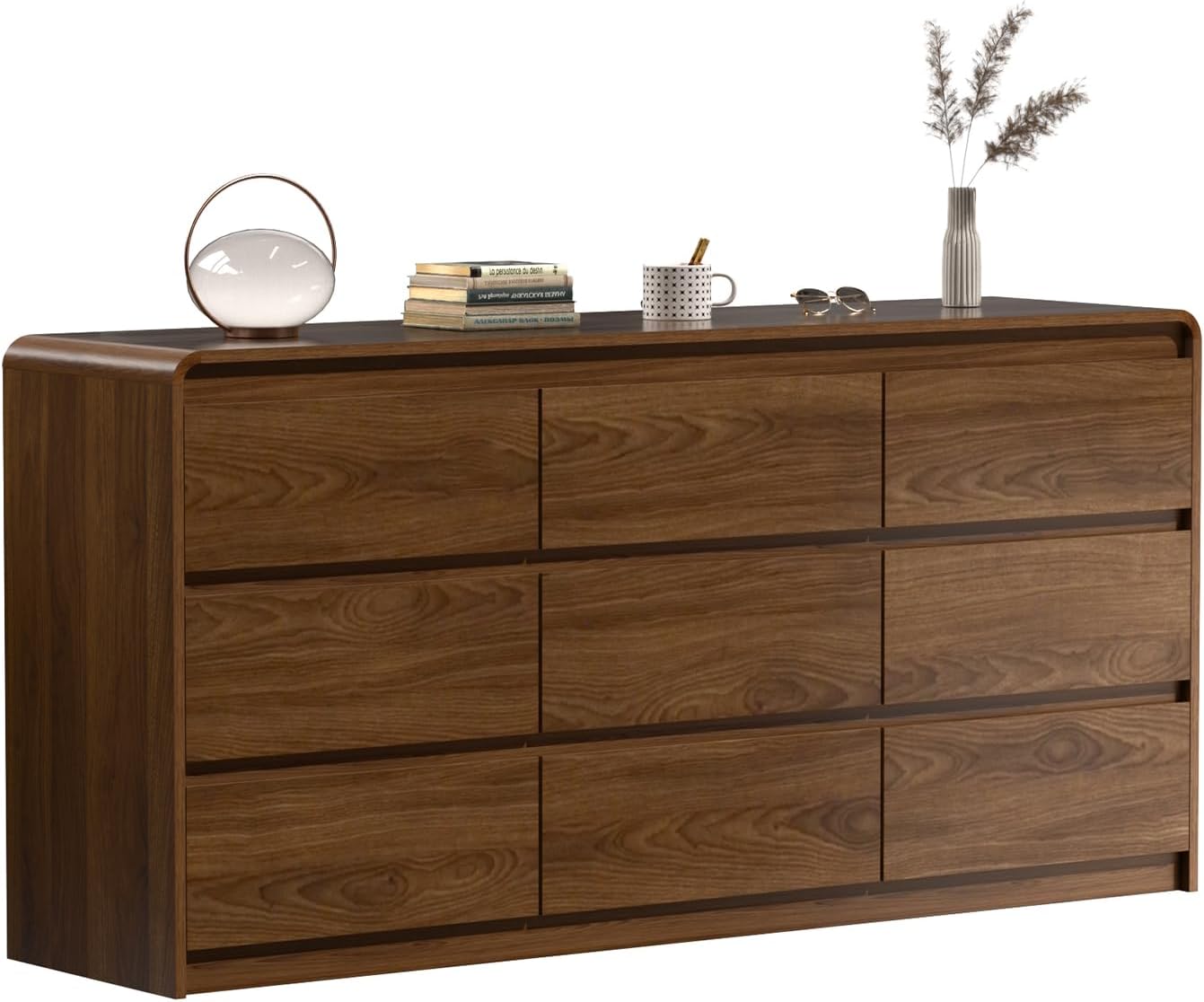

For sizing, see how tall a dresser should be and how deep a standard dresser is. For construction, solid wood dresser and engineered wood against hardwood.
Questions we get asked
How much weight can a dresser hold?
One hundred and fifty to 400 lb in total, and only 25 to 75 lb per drawer depending on the slides.
What fails first?
The back panel. A stapled 3 mm hardboard back is what keeps the carcass square, and it pulls loose.
How heavy is a drawer of clothes?
Twenty to 30 lb for folded clothes, 30 to 40 for packed jeans. Books are 60 to 90 and exceed side rollers.
How much can the top hold?
Fifty to 100 lb spread. A 55-inch TV on a stand is 40 to 60 and fine.
Can I sit on a dresser?
Better not. It is a concentrated point load on a top designed for spread weight.
How do I judge a dresser with no rating?
Look for dovetailed drawer boxes, ball-bearing slides, a 6 mm grooved bottom and feet joined into the carcass rather than screwed into board.