How deep should a dresser drawer be? 6 to 12 in
The Wooden Stars is a participant in the Amazon Services LLC Associates Program. We may earn a commission when you buy through links on our site, at no extra cost to you.
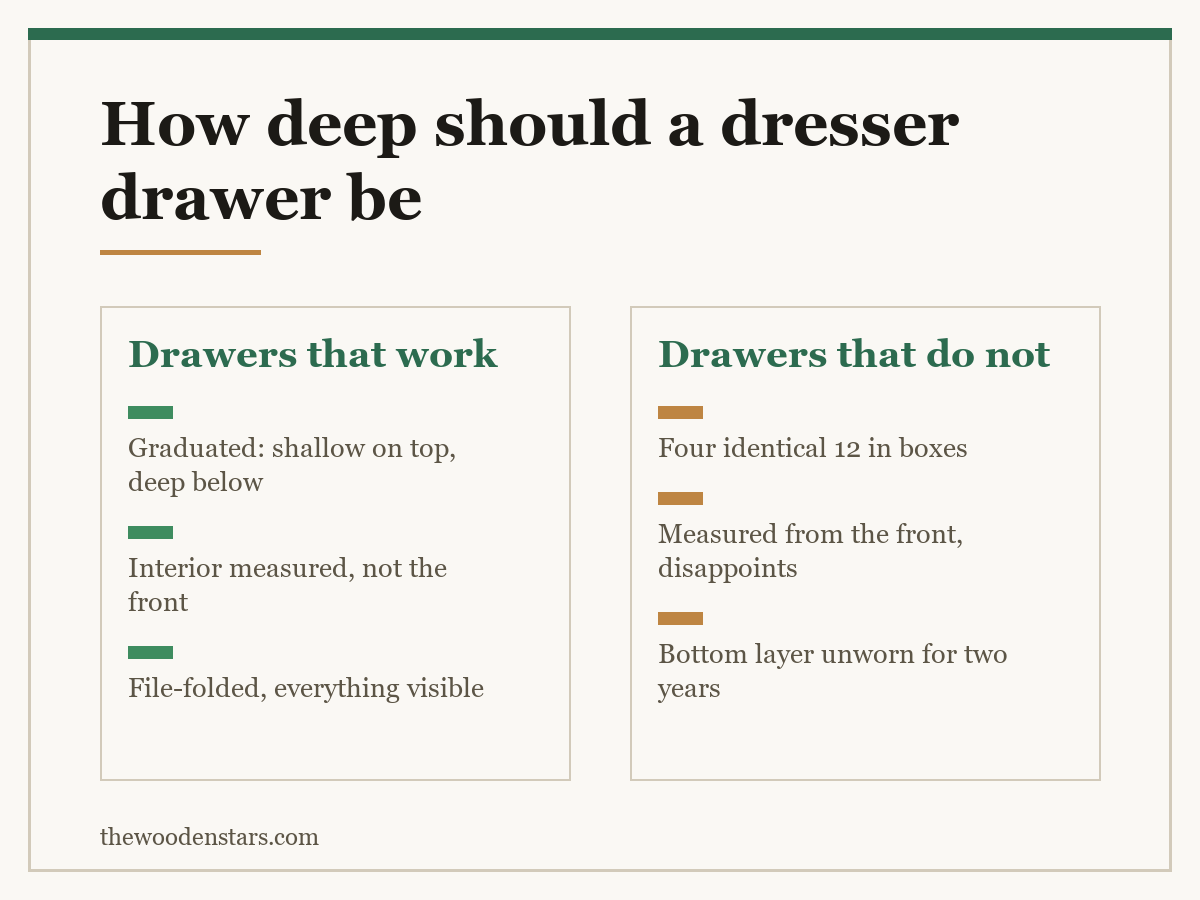
How deep should a dresser drawer be? 6 to 12 inches from the inside bottom to the top of the sides — and the useful answer is that most drawers are too deep, not too shallow.
Past about 10 inches you stop stacking and start burying.
Interior depths that work: 3 to 4 inches for socks, underwear and accessories, 6 to 8 for folded shirts and trousers — the single most useful size — 10 to 12 for jumpers and bedding, and 14 inches or more only for duvets and pillows. The number is the interior, measured from the inside bottom to the top edge of the side, not the drawer front. A dresser with graduated depths — shallow at the top, deeper at the bottom — is worth more than one with four identical drawers, because clothes are not all the same height.
How deep should a dresser drawer be for each thing
- Socks, underwear, accessories: 3 to 4 inches. Deeper and everything migrates to the bottom.
- Folded T-shirts and shirts: 6 to 8 inches. A folded shirt is about 2 inches, so three or four stack visibly.
- Trousers and jeans: 8 to 10.
- Jumpers and sweatshirts: 10 to 12. A folded jumper is 3 to 4 inches on its own.
- Bedding, duvets, pillows: 14 and up, and that is a blanket box rather than a dresser drawer.
The measurement is the interior: inside bottom to the top of the drawer side. A drawer front of 10 inches typically gives 8 to 8.5 inches inside once you subtract the bottom panel and the overlay.
| Contents | Interior depth | Front height | Note |
|---|---|---|---|
| Socks, underwear | 3 to 4 in | 4 to 5 in | Use dividers |
| Shirts, T-shirts | 6 to 8 in | 8 to 10 in | The most useful size |
| Trousers, jeans | 8 to 10 in | 10 to 12 in | Fold in thirds |
| Jumpers | 10 to 12 in | 12 to 14 in | Three stack visibly |
| Bedding | 14 in and up | 16 in and up | Really a blanket box |
Why deeper is usually worse
A deep drawer does not hold more usable clothes. It holds the same clothes in a taller pile, and a taller pile has two problems.
You cannot see the bottom third. Anything below about 8 inches from the top is out of sight when you open the drawer, so it stops being worn. Every household has a bottom layer in a deep drawer that has not moved in two years.
Pulling one item collapses the stack. Taking a shirt from the middle of a 12-inch pile disturbs everything above it, so the drawer is untidy again within a week.
Two fixes if you already own deep drawers:
- File-fold vertically. Stand folded items on edge in rows rather than stacking them. Everything is visible and nothing collapses. This is the single change that makes a 12-inch drawer usable.
- Use dividers or boxes to split the depth into compartments so small items stay near the top.
The corresponding weight limits matter here too — a deep drawer packed solid is easily 40 to 60 lb, which is above what side-roller slides are rated for, per how much weight a dresser can hold.
Graduated depths, and why they are worth paying for
A well-designed dresser does not have four identical drawers. It has shallow ones at the top and deeper ones at the bottom, usually something like 4, 6, 8, 10 inches down the stack.
Three reasons this is better:
It matches what clothes are. Socks are small, jumpers are bulky, and a single depth serves one badly.
It puts weight low. The heaviest items end up in the bottom drawers, which lowers the centre of gravity and reduces tipping risk — anti-tip kits for dressers.
It puts small things where you can see them. A shallow top drawer at chest height shows its whole contents at a glance.
Where drawer counts come in: more drawers in the same carcass means shallower drawers, which is the real trade behind 6 drawer against 9 drawer. And the total height available is set by how tall a dresser should be.
What else to check on the drawer
The interior length and width, not just depth. A dresser 18 inches deep front-to-back gives about 15 inches of drawer interior, which folds a shirt in thirds rather than halves — how deep a standard dresser is.
Full extension or not. A drawer that only pulls out three-quarters leaves the back 4 inches permanently hard to reach, which turns a good depth into a bad one.
The bottom panel. A 6 mm panel in a groove carries a deep drawer’s load. A 3 mm sheet pinned underneath bows and eventually drops out of a corner — that and the other failure points are in dresser drawer not sliding.
Dovetails at the front corners. The deeper and heavier the drawer, the more the front tries to separate from the sides. On a 12-inch drawer this is where cheap construction shows first — solid wood dresser.
One measurement that changes what a depth is worth: the drawer’s internal width. A dresser 52 inches wide with two drawers side by side gives about 24 inches inside each — too narrow to lay a folded shirt flat, so everything gets folded smaller and stacks higher. The same 52 inches as one full-width drawer gives 48 inches inside, where shirts lie flat in two rows and a 6-inch depth holds more than an 8-inch one in the narrow version.
Making the depth usable
- Drawer dividers Splits a deep drawer so small items stay near the top
- Fabric drawer organisers What makes file-folding hold its shape
- Drawer liners Stops stacks sliding and collapsing on every pull
- Ball-bearing drawer slides A packed deep drawer exceeds what side rollers hold
What to buy

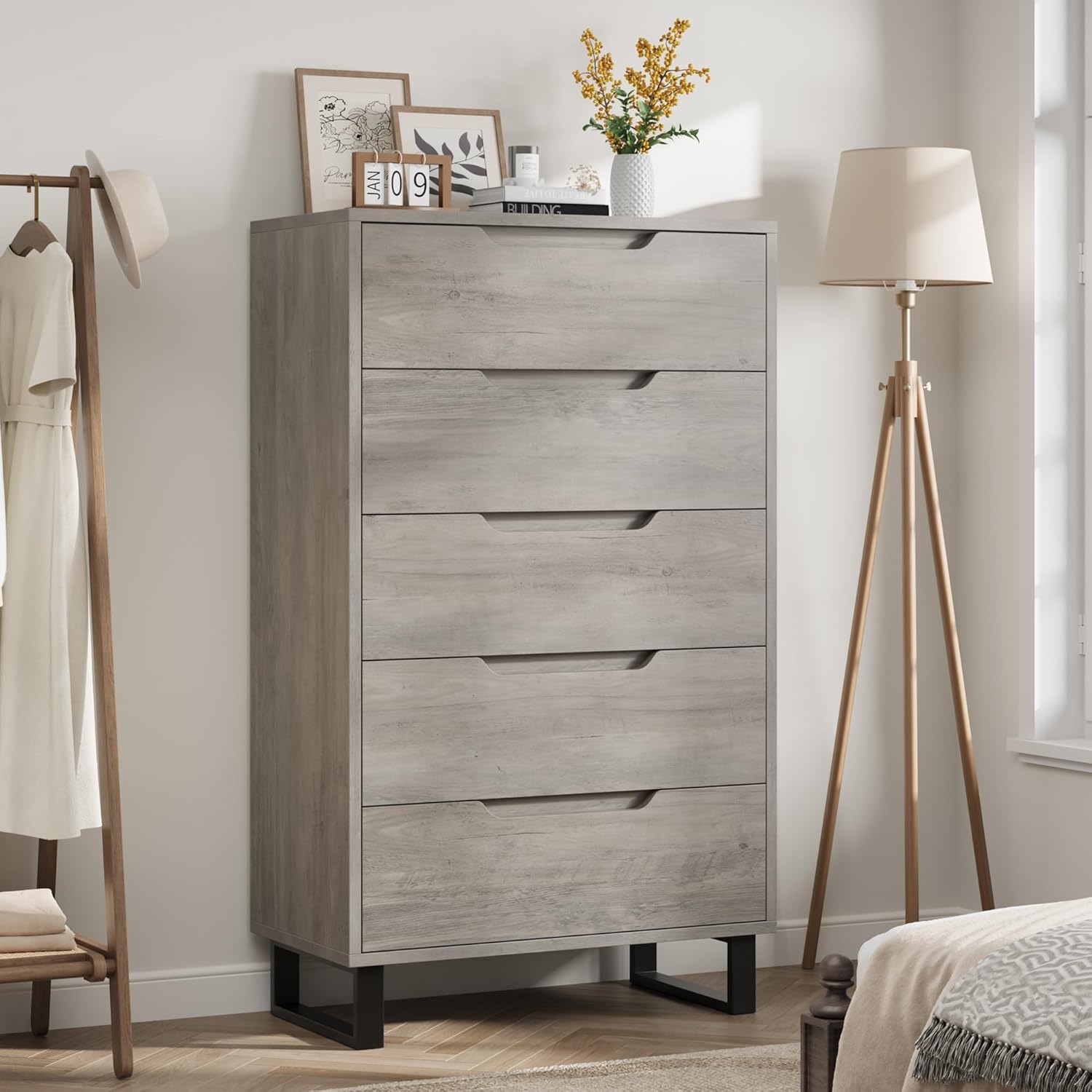


For the rest of the sizing, see how tall a dresser should be, how deep a standard dresser is and 6 drawer against 9 drawer. For loads, how much weight a dresser can hold.
Questions we get asked
How deep should a dresser drawer be?
Six to 12 inches inside. Three to four for socks, 6 to 8 for shirts, 10 to 12 for jumpers.
Do I measure the front or the inside?
The inside, from the bottom panel to the top of the side. A 10-inch front usually gives about 8.5 inches inside.
Is a deeper drawer better?
Rarely. Past about 10 inches you cannot see the bottom third, and pulling one item collapses the stack.
How do I make a deep drawer work?
File-fold — stand items on edge in rows rather than stacking them — and add dividers.
Why do graduated depths matter?
Clothes are not all the same height, and putting the bulky items low also lowers the centre of gravity.
What does a full drawer weigh?
Forty to 60 lb when packed, which is above what side-roller slides are rated to carry.