How much weight can a dining chair hold? 250 to 500 lb
The Wooden Stars is a participant in the Amazon Services LLC Associates Program. We may earn a commission when you buy through links on our site, at no extra cost to you.
How much weight can a dining chair hold? 250 to 500 lb — and the number depends almost entirely on one thing most listings never mention: whether the legs are tied together by a stretcher.
Dining chairs rarely snap. They loosen, then wobble, then come apart at a joint.
Typical ratings: 250 to 300 lb on light side chairs and moulded seats, 300 to 350 on ordinary timber chairs, 350 to 450 on solid hardwood with a stretcher or an H-frame, and 450 to 600 on commercial-rated chairs. Ratings are static — dropping into a chair applies two to three times body weight for a moment, and leaning back onto two legs concentrates everything into two joints. Rate for roughly double the heaviest regular user. What sets the number: the leg-to-seat joint, a stretcher, and the back-to-seat joint on anything with a tall back.
How much weight can a dining chair hold, by build
- Light side chair, moulded or thin frame: 250 to 300 lb.
- Standard timber dining chair: 300 to 350. Doweled or screwed joints, slim sections.
- Solid hardwood with a stretcher: 350 to 450.
- Commercial or contract-rated: 450 to 600, and these are the ones restaurants buy for a reason.
- Upholstered parsons chair: 250 to 350 — the padding hides a frame that is often lighter than it looks.
Two patterns worth noticing. A stretcher is worth more than mass: a 12 lb chair with a full H-stretcher outlasts an 18 lb one without. And a tall back lowers the rating, because leaning back turns the backrest into a lever working on the seat joint.

| Feature | Weak | Strong |
|---|---|---|
| Leg-to-seat joint | Screwed into end grain | Mortise and tenon, or bolted |
| Stretcher | None | Full H-frame or box stretcher |
| Back-to-seat joint | Screwed through the seat | Through-tenon or bolted |
| Seat | Thin ply under a pad | Solid timber, 0.75 in or more |
| Leg stance | Vertical | Splayed slightly outward |
| Corner blocks | None | Glued and screwed at all four |
Why static ratings understate real use
A published figure is what the chair holds sitting still, loaded evenly. Nobody uses a dining chair that way.
Dropping into it applies two to three times body weight for a fraction of a second, unevenly, usually onto the back two legs.
Leaning back onto two legs — which every household has someone who does — concentrates everything into two joints and adds a bending load to the back. This is the single commonest way a dining chair dies.
Dragging rather than lifting racks the frame sideways at every meal, three times a day, for years.
So the working rule is the same as elsewhere in seating: rate for roughly double the heaviest regular user. A 250 lb-rated chair is not a chair for a 240 lb adult who uses it daily; it is a chair for occasional use. The same arithmetic for bar seating is in how much weight a bar stool can hold.
The stretcher does more than brace your feet
This is the most useful thing to look for in a listing photograph.
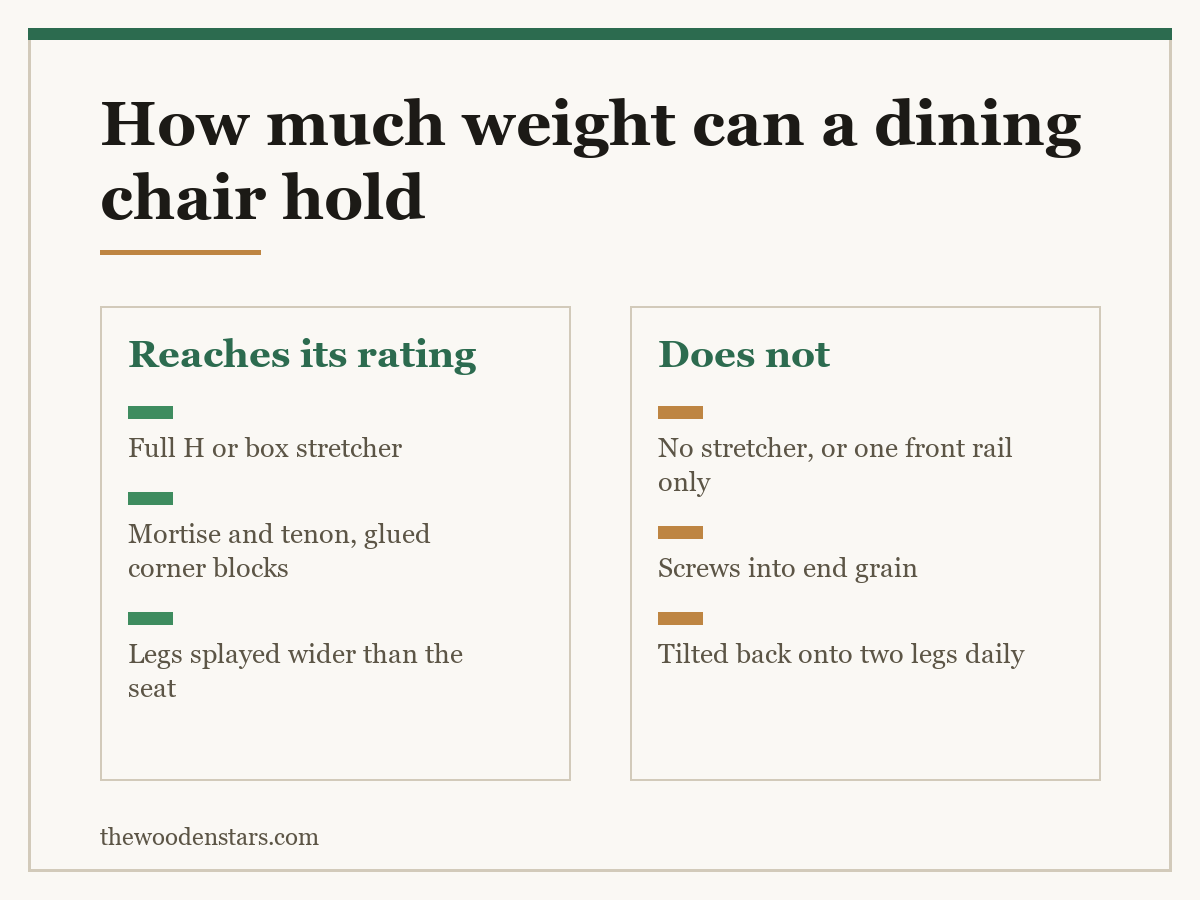
A rail between the legs — an H-stretcher, a box stretcher or a full ring — turns four separate levers into one braced frame. Without it, every shift of weight racks the legs independently, the joints work, and within two or three years the chair has a wobble that tightening does not cure.
What good looks like:
- A full H or box stretcher, not a single rail across the front. One rail braces one axis and leaves the other free.
- Joined properly — a tenon into the leg, not a screw through the side of it.
- Corner blocks under the seat at all four corners, glued as well as screwed. On a chair with no stretcher, these are doing the whole job.
- Slight splay to the legs, so the stance at the floor is wider than the seat.
When a chair does loosen, it is repairable and worth repairing — how to reglue a loose joint — and broken legs can often be replaced outright, per replaceable chair legs.
Reading a listing that gives no rating
Most do not publish one. Four things in the photographs tell you more than a number would.
Look under the seat. Corner blocks at all four corners mean somebody thought about racking. A bare frame means they did not.
Look at the leg-to-seat joint. Visible screw heads going into the end of a leg is the weak version. A tenon shoulder or a bolt with a nut is the strong one.
Look at the section. Legs under about 1.25 inches square in a softwood are the ones that snap; the species matters as much as the size, per the wood hardness scale and best wood for furniture.
Read the material claim honestly. “Wood finish” usually means veneer over engineered board — engineered wood against hardwood and what “all wood” actually means.
If you genuinely need a heavy-duty chair, look for a contract or commercial rating. Those chairs are built for hundreds of sittings a week and the rating is tested rather than estimated.
Keeping a chair at its rating
- Wood glue for loose joints The leg-to-seat joint opens first, and glue restores it
- Ratchet strap or band clamp What holds a chair square while the glue sets
- Felt furniture pads Dragging is what racks a frame; this reduces the force
- Furniture levellers A chair that rocks is loading three legs instead of four
What to buy


For sizing, see how tall a dining chair should be and how wide a dining chair is. For the seat, upholstered against wood dining chairs.
Questions we get asked
How much weight can a dining chair hold?
Two hundred and fifty to 500 lb. Standard timber chairs sit at 300 to 350; hardwood with a stretcher reaches 450.
How much margin should I leave?
Rate for roughly double the heaviest regular user, because sitting down applies two to three times body weight momentarily.
What matters most in the construction?
A full H or box stretcher. It is worth more than extra weight or thicker legs.
Why do chairs loosen rather than break?
Because the load racks the frame sideways — from dragging, and from leaning back onto two legs — and the joints work loose over years.
What if no rating is published?
Assume the bottom of the class, then look for corner blocks, a stretcher and tenoned rather than screwed leg joints.
Is a loose chair worth repairing?
Usually yes. Knocking it apart, cleaning the joints and regluing restores a solid timber chair completely.