Round vs rectangular coffee table — Traffic decides
The Wooden Stars is a participant in the Amazon Services LLC Associates Program. We may earn a commission when you buy through links on our site, at no extra cost to you.
Round vs rectangular coffee table is decided by how people walk through the room, not by the shape of the sofa.
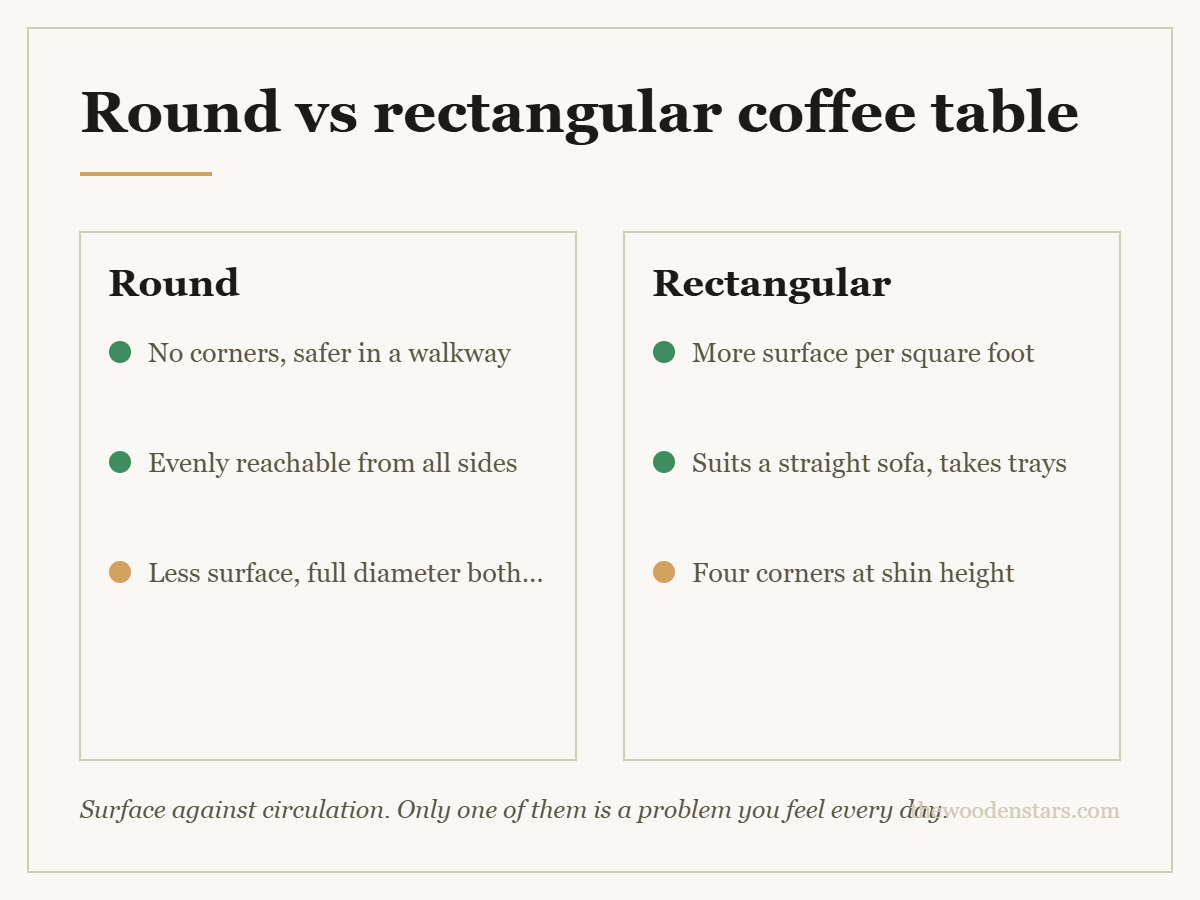
A round table has no corners to catch a shin and no orientation to get wrong. A rectangular one puts more usable surface within reach of more seats. Which matters more depends on the traffic.
A round coffee table suits a room people walk through, a corner sofa or an L-shaped seating arrangement, and any household with small children — there are no corners. It wastes surface: a 36-inch round gives about 7 square feet against 9 for a 48 × 24 rectangle in a similar footprint. A rectangular table suits a straight sofa facing a wall, gives more reachable surface per seat, and needs 14 to 18 inches of gap to the sofa either way. Both should be two-thirds the sofa’s length and within 2 inches of its seat height.
Round vs rectangular coffee table: the traffic test
Stand where people enter the room and look at the route to the seats.
If they walk past the table — a doorway on one side, a route to the kitchen, children running through — the round table wins outright. A corner at shin height in a walkway is a piece of furniture people learn to resent.
If the table sits in a dead-ended arrangement — sofa facing a fireplace or a television, with nobody passing between — the rectangle wins, because nothing is walking into it and you get the extra surface.
That is the test, and it decides most rooms before any of the other arguments matter.
| Measure | Round | Rectangular |
|---|---|---|
| Usable surface | About 7 sq ft at 36 in dia | About 9 sq ft at 48 × 24 |
| Corners | None | Four, at shin height |
| Suits | L-shape, walkways, children | Straight sofa, dead-ended |
| Reach from each seat | Even from all sides | Best from the middle seats |
| Seats around it | Works for four | Works for two sides |
| Common sizes | 30 to 42 in diameter | 40 to 54 × 20 to 28 in |
| Base | Pedestal keeps legs clear | Four legs, or a plinth |
Surface, and why round loses it
Area is where the rectangle is simply better.
- 36-inch round: 7.1 square feet.
- 42-inch round: 9.6 square feet, but its footprint is now 42 inches in both directions.
- 48 × 24 rectangle: 8 square feet in a 48 × 24 footprint.
- 54 × 28 rectangle: 10.5 square feet.
The rectangle wins per square foot of floor because a room is usually longer than it is deep, and the table can be too. A 42-inch round needs 42 inches of depth from the sofa, which most rooms do not want to give.
Against that: a round table’s surface is evenly reachable. On a long rectangle, the person at the far end of a three-seat sofa reaches only their own end. That is worth something, particularly when the table holds food.
The two numbers that apply to both
Height: within 2 inches of the sofa seat. A sofa seat is 17 to 19 inches, so the table wants to be 16 to 19. Higher and it blocks the view of the room from the sofa; much lower and you stoop to reach it. This is measured from the sofa, never from the room.
Length: about two-thirds of the sofa. An 84-inch sofa wants a 48 to 56-inch table, or a 36 to 42-inch round. Shorter looks lost; longer crowds the ends and stops people getting past.
Both numbers, plus depth, are worked through in coffee table dimensions.
The gap, which people get wrong in both directions
Leave 14 to 18 inches between the sofa edge and the table.
Under 12 inches and you cannot get past without turning sideways, and nobody can stand up straight from the middle seat. Over 20 inches and you have to lean forward off the sofa to put a cup down, which defeats the table.
On the other sides — towards a chair, a walkway or a fireplace — allow 30 inches to walk through comfortably, 24 at a squeeze.
These gaps are why a round table often ends up the practical answer in a small room: the same clearance measured to a curve rather than a corner feels wider, and there is no corner to clip on the diagonal.
The base matters more on a round table
A round top on four legs puts a leg exactly where a foot goes, because you approach a circle from any angle.
A pedestal or a plinth base solves this and is worth paying for on a round table — it also lets someone sit close on a floor cushion. The trade is stability: a pedestal with a small foot can be tipped by leaning on the edge, so look for a base spread of at least half the top’s diameter.
On a rectangle, four legs are fine because you approach from known sides. What matters more there is whether the legs are inset — legs set in from the corners look lighter and are exactly the ones you catch your toe on.
Construction and finish points are in hardwood coffee table durability and metal coffee table legs.
Storage, briefly
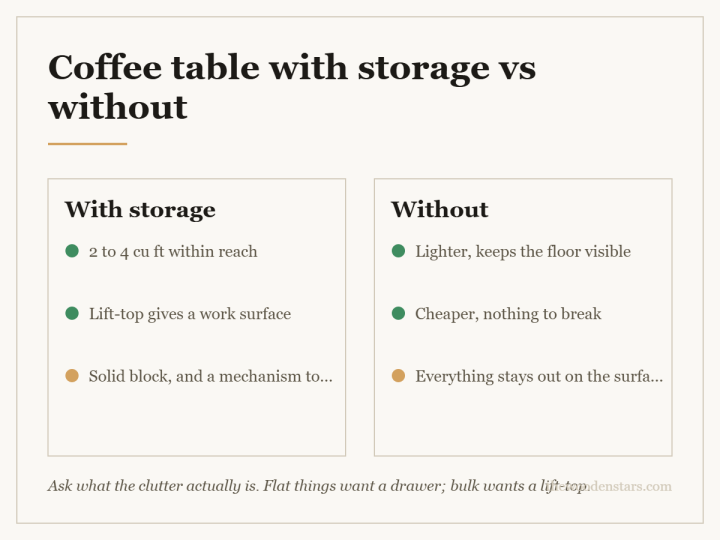
Rectangles take storage better. A drawer wants a straight run, and a lift-top mechanism wants a rectangular frame — both are awkward on a circle, where storage usually means an open lower shelf.
Whether you want storage at all is its own decision: coffee table with storage against without, coffee tables with drawers and lift-top coffee tables.
Either shape
- Serving tray with handles Turns any coffee table into a surface you can clear in one move
- Felt floor glides Coffee tables get pushed about more than any other piece
- Corner guards For a rectangular table in a house with a toddler
- Wood wax or oil The top takes cups, feet and sunlight more than any other surface
What to buy


For the round option, see round wood coffee tables. For sizing, coffee table dimensions. For storage versions, coffee tables with drawers and lift-top coffee tables. For durability, hardwood coffee table durability.
Questions we get asked
Is a round or rectangular coffee table better?
Round if people walk past it or the seating is L-shaped; rectangular if the sofa faces a wall and nobody passes between.
Which gives more surface?
The rectangle. A 48 × 24 gives about 8 square feet against 7 for a 36-inch round, in less room depth.
How big should a coffee table be?
About two-thirds the sofa’s length — a 48 to 56-inch rectangle or a 36 to 42-inch round for an 84-inch sofa.
How far from the sofa should it sit?
Fourteen to 18 inches. Closer and you cannot stand up from the middle seat; further and you lean off the sofa to reach it.
What height should it be?
Within 2 inches of the sofa seat height, so 16 to 19 inches for most sofas. Measure the sofa, not the room.
Is a pedestal base better on a round table?
Usually, because you approach a circle from any angle and four legs put one where a foot goes. Look for a base spread of at least half the diameter.