How thick should a desktop be? 1 to 1.5 inches
The Wooden Stars is a participant in the Amazon Services LLC Associates Program. We may earn a commission when you buy through links on our site, at no extra cost to you.
How thick should a desktop be? 1 to 1.5 inches for a normal desk — and past a 48-inch span, thickness is the cheapest thing you can buy more of.
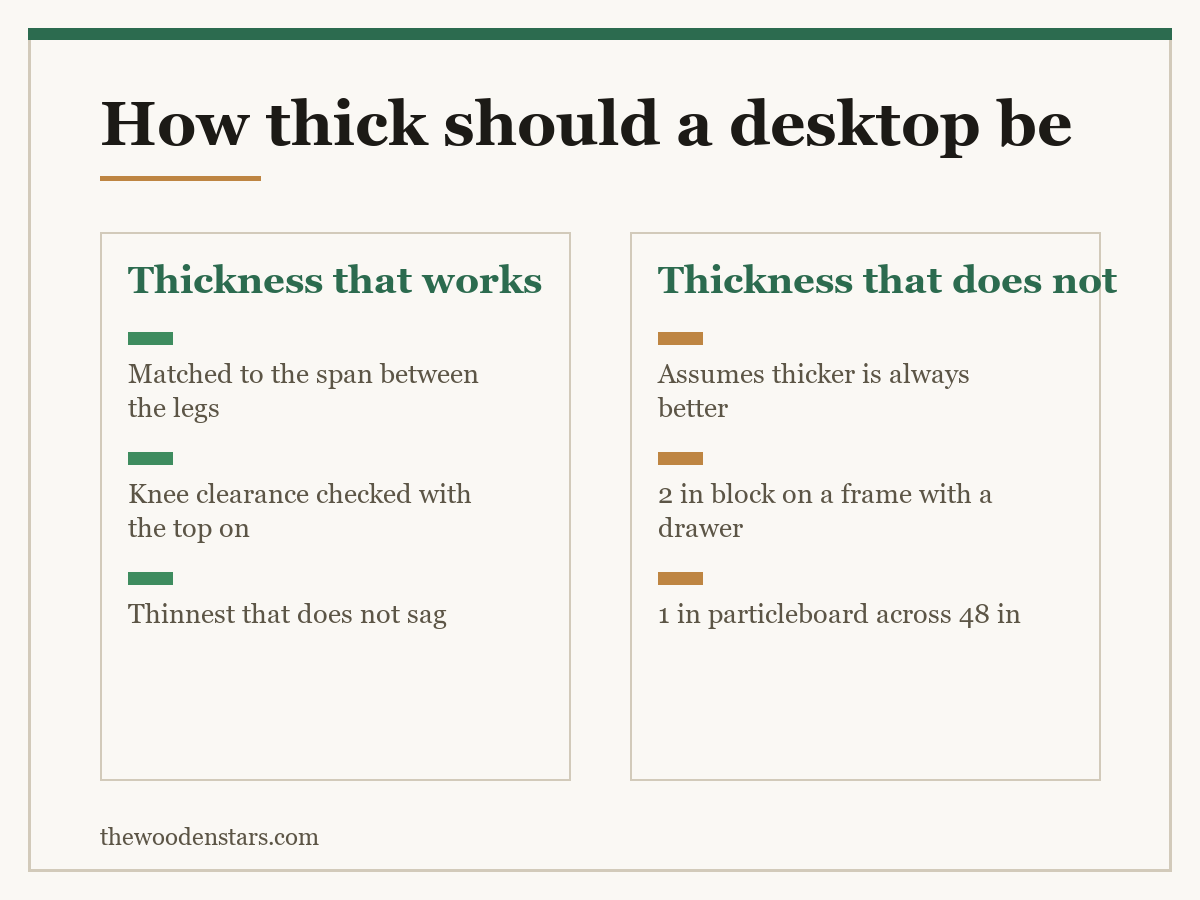
It is also the number that quietly eats your knee clearance, which is why thicker is not simply better.
Solid timber: 0.75 inch is too thin for anything over 40 inches, 1 to 1.25 is the normal range, 1.5 to 1.75 is what a 60-inch unsupported span wants, and 2 inches is butcher-block territory — handsome, heavy, and it costs you an inch of knee space. Engineered board needs to be thicker for the same stiffness and still creeps. Two consequences to plan for: every inch of thickness comes off your knee clearance unless the frame drops to match, and a 2-inch top at 60 inches weighs 60 to 80 lb, which can use up a standing frame’s lift rating on its own.
How thick should a desktop be, by span
- Up to 40 inches unsupported: 0.75 to 1 inch is fine in solid timber.
- 40 to 48: 1 inch, and it is the standard for a reason.
- 48 to 60: 1.25 to 1.5, or add a stretcher between the legs.
- 60 to 72: 1.5 to 1.75, and a centre support is better than more thickness.
- Over 72: centre support regardless of thickness.
Measure the span between the inside faces of the legs, not the desk’s overall width. A 60-inch desk on a frame with legs set 6 inches in from each end has a 48-inch span and behaves like a 48-inch desk.
| Material | Normal | Long span | Creeps |
|---|---|---|---|
| Solid hardwood | 1 to 1.25 in | 1.5 to 1.75 in | Slowly |
| Butcher block | 1.5 to 2 in | 1.75 to 2 in | Very slowly |
| Softwood or pine | 1.25 to 1.5 in | 1.75 in | Moderately |
| Plywood | 0.75 to 1 in | 1.25 in | Slowly |
| MDF | 1 to 1.25 in | Needs support | Fast |
| Particleboard | 1 in | Needs support | Fastest |
What thickness costs you
Knee clearance. This is the one people miss. A desk frame set at 29 inches with a 1-inch top gives 28 inches to the underside. Put a 2-inch butcher block on the same frame and you have 27 — still fine. But add a drawer, or start at a 28-inch frame, and you are under the 26 to 27 inches a tall adult needs. The height arithmetic is in how tall a desk should be and the drawer trade in desk with drawers against without.
Weight. A 60 × 30-inch top in solid oak at 1 inch is roughly 40 lb; at 2 inches it is 75 to 80. That matters for carrying it upstairs, for what the frame is rated to lift, and for whether one person can fit it — how much weight a desk can hold.
Money. Timber is sold by volume. Doubling thickness roughly doubles the material cost of the top, and the top is most of the cost of a good desk.
So the right answer is usually the thinnest top that does not sag, not the thickest you can afford.
Why engineered board needs more of it
Particleboard and MDF are less stiff than solid timber, and they creep — deflect slowly and permanently under sustained load rather than springing back.
Practically: a 1-inch particleboard top at 48 inches with a monitor in the middle will show a visible dip against a straight edge within a couple of years, where a 1-inch solid top will not. Thickening the board helps but does not remove the creep; only shortening the span does.
Two things to check on a listing:
- Is the stated thickness the board or the edge? A 1-inch-looking laminate desk is often 0.6-inch board with a thick edge band. The profile in the photograph tells you.
- Is it “solid wood” or “wood”? The distinction is the whole ballgame — engineered wood against hardwood and what “all wood” actually means.
Thickness and the edge you see
A top’s apparent thickness is a design decision separate from its structural one.
A chamfered or bevelled underside makes a 1.5-inch top read as 1 inch from standing height while keeping the depth where the bending happens. It is the standard cabinetmaker’s trick and it costs nothing.
A dropped edge — a strip glued under the perimeter — makes a 0.75-inch top look 2 inches thick. It adds stiffness at the edges, which is not where a top sags, so treat the apparent thickness as decoration.
A live edge varies along its length, so quote the thickness at the thinnest point.
On any solid top, the finish matters as much as the thickness for how it survives — best finish for a solid wood table top — and the species decides how it dents, per the wood hardness scale and best wood for furniture. If you are fitting a slab to a frame yourself, mounting a butcher block desktop covers the fixings that let it move.
One thing to check if you are buying a top and a frame separately: how the two will be joined. A solid timber top moves across its width with humidity — as much as a quarter-inch across 30 inches over a year — so it must be fixed with slotted holes, figure-8 fasteners or buttons that let it slide. Screwed rigidly to a steel frame at both ends, a thick top will split rather than move, and it will do it in the first winter.
Choosing and fitting a top
- Tape measure Span between the legs, then thickness to match
- Straight edge The only way to check a top is still flat
- Table top fasteners Let a solid top expand without splitting at the frame
- Hardwax oil What keeps a thick timber top from drinking every spill
What to buy


For the span, see how wide a desk should be and how much weight a desk can hold. For clearance, how tall a desk should be. For the equivalent question on a dining table, how thick a dining table top should be.
Questions we get asked
How thick should a desktop be?
One to 1.5 inches in solid timber. Go to 1.5 to 1.75 past a 60-inch unsupported span.
Is thicker always better?
No. Every inch comes off your knee clearance, adds 30 to 40 lb on a large top, and roughly doubles the material cost.
Is 0.75 inch enough?
Only up to about 40 inches of span. Beyond that it will deflect under a monitor.
Do I measure the desk width or the span?
The span between the inside faces of the legs. A 60-inch desk with legs set in 6 inches behaves like a 48-inch one.
Does particleboard need to be thicker?
Yes, and it still creeps. Only shortening the span fixes that.
Why do some thick-looking tops sag?
Because the thickness is a dropped edge strip glued round the perimeter, not real depth where the bending happens.