How tall should a desk be? 28 to 30 inches
The Wooden Stars is a participant in the Amazon Services LLC Associates Program. We may earn a commission when you buy through links on our site, at no extra cost to you.
How tall should a desk be? 28 to 30 inches is what almost every desk is built at — and for most people that is about an inch or two too high.
The standard was set for a 6-foot man in 1960. Your elbows decide the real number.
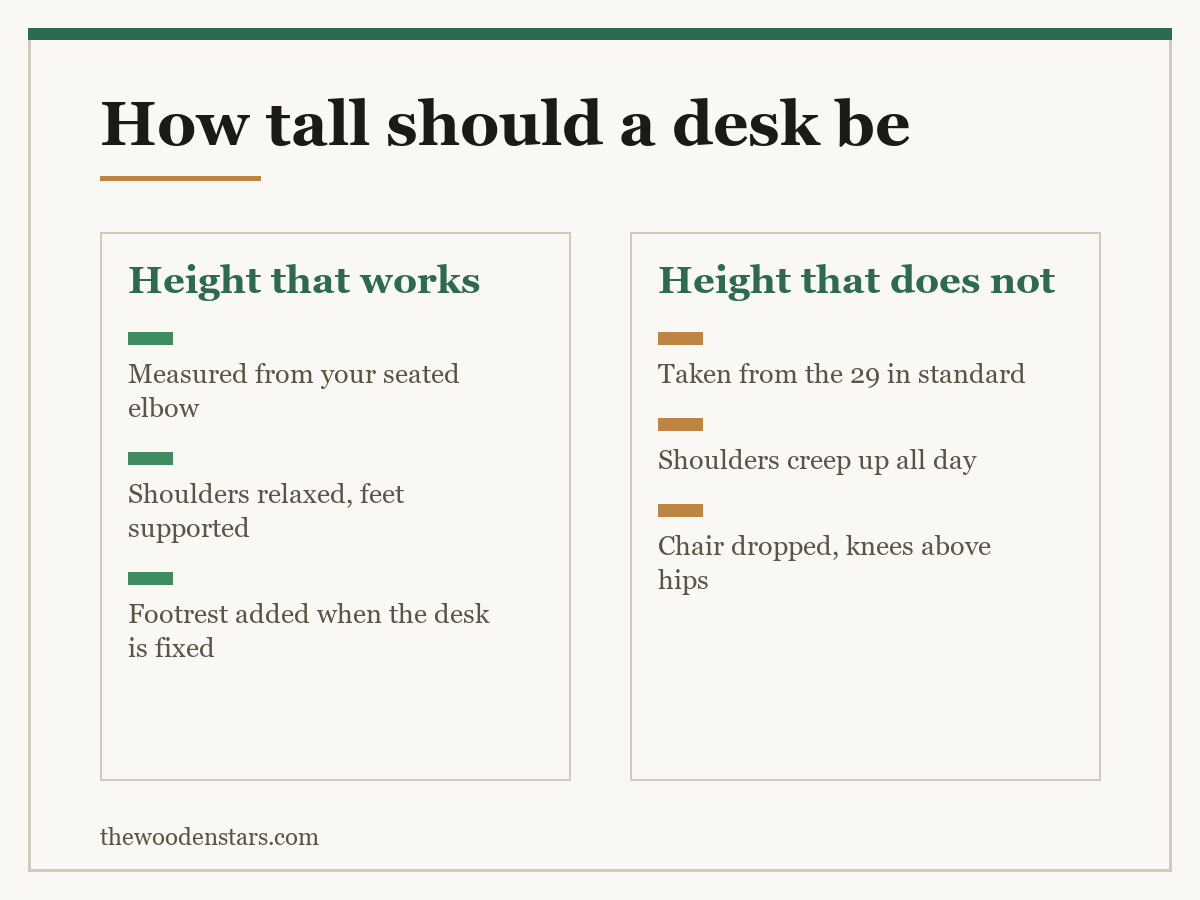
The manufacturing standard is 29 to 30 inches, and adjustable desks run 23 to 49. The figure that actually fits you: sit with feet flat and upper arms hanging straight down, then measure floor to elbow. That is your desk height, usually 1 to 2 inches below the fixed standard. Rough guide by height: 5 ft 4 in → 25 inches, 5 ft 8 in → 27, 6 ft → 29, 6 ft 3 in → 30. If the desk is fixed and too tall, raise the chair and add a footrest — that is cheaper and works better than cutting the legs.
How tall should a desk be for your body
Sit properly first: feet flat on the floor, thighs level, back against the chair. Let your upper arms hang straight down and bend the elbows to 90°. Measure from the floor to the underside of your forearm.
That number is the desk height. For most adults it lands between 25 and 30 inches, which is why a 29-inch desk suits tall people and quietly punishes everyone else.
- 5 ft 2 in: about 24 inches
- 5 ft 6 in: about 26
- 5 ft 10 in: about 28
- 6 ft 2 in: about 29 to 30
Two inches sounds trivial. It is the difference between shoulders that stay down and shoulders that creep up towards your ears for eight hours.

| Your height | Desk height | Chair seat | Footrest |
|---|---|---|---|
| 5 ft 0 to 5 ft 3 in | 24 to 25 in | 15 to 16 in | Usually yes |
| 5 ft 4 to 5 ft 7 in | 25 to 27 in | 16 to 17 in | Often |
| 5 ft 8 to 5 ft 11 in | 27 to 28 in | 17 to 18 in | Sometimes |
| 6 ft 0 to 6 ft 3 in | 29 to 30 in | 18 to 20 in | No |
| Over 6 ft 3 in | 30 to 32 in | 20 to 21 in | No |
Why 29 inches became the standard
It comes from mid-century office furniture, sized around the average American man of the time. It has stayed because desks are made in volume and a single height is cheaper.
The result is that a fixed desk fits roughly the top third of adults properly. Everyone else compensates — usually by raising the shoulders, which is exactly the posture that produces neck and upper-back complaints after a few months.
The honest reading: a fixed 29-inch desk is a tall person’s desk. If you are under about 5 ft 10 in, plan on adjusting something.
Fixing a desk that is the wrong height
If the desk is too tall — the usual case — raise the chair until your elbows are level with the surface, then put a footrest under your feet so your thighs stay level and your feet are supported. This is the standard ergonomic fix and it costs very little. A stack of books works while you decide.
If the desk is too short, raise the desk rather than lowering yourself. Furniture risers under the legs add 2 to 5 inches, and on a solid timber desk they are the neat answer. Lowering the chair below about 15 inches puts your knees above your hips, which is worse than the original problem.
Cutting the legs works on a solid wood desk and nothing else. Cut all four equally, check for square afterwards, and refinish the ends. On a laminate-over-particleboard desk the legs are usually hollow or bolted to a frame, and cutting them ends the desk — the material difference is set out in engineered wood against hardwood. Replacement legs are often simpler either way: wooden desk legs.
An adjustable frame solves it permanently and costs the most. It is the right answer if two people share the desk, or if you want to alternate sitting and standing.
The three numbers that go with the height
Knee clearance. You need 24 to 27 inches from the floor to the underside of the desk, and at least 20 inches of width free of drawers. A desk with a deep apron or a drawer box directly under the top eats this, which is the real argument in desk with drawers against without.
Depth. Screen distance sets it, not the desk — worked through in how deep a desk should be.
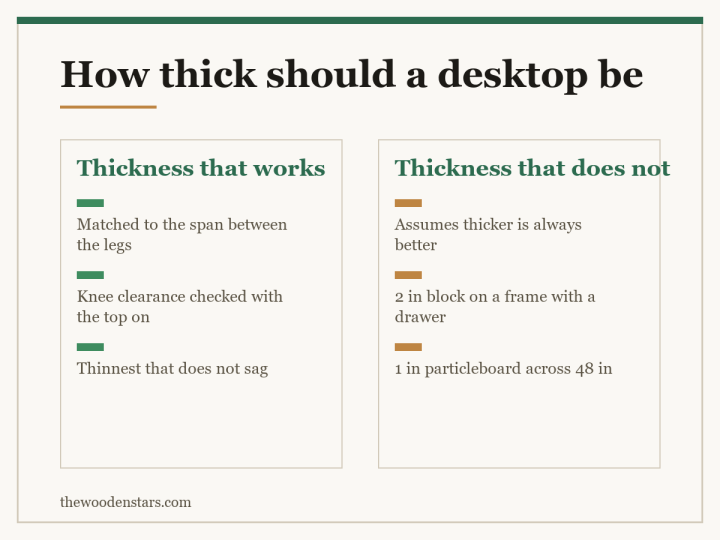
Top thickness. A thick top reduces knee clearance by its own thickness, so a 2-inch butcher block on a 29-inch frame gives you 27 inches of clear space — how thick a desktop should be and mounting a butcher block desktop.
The same elbow-and-clearance logic governs other work surfaces: counter height against standard dining table and how tall a bar stool should be.
Standing height, if the desk goes up
Standing desk height uses the same elbow rule, standing up: for most adults 38 to 46 inches, roughly your height minus 26 inches.
Three practical notes. An adjustable frame that only reaches 44 inches is too short for anyone over about 6 ft 1 in, and the range is easy to miss on a spec sheet. A heavy solid timber top needs a frame rated for it. And the keyboard wants to stay at elbow height at both settings, which a single fixed top cannot do perfectly — screen height is what you adjust instead.
Storage on an adjustable desk is its own problem, since drawers have to travel with the top — standing desk with drawers.
Getting the height right
- Under-desk footrest The fix for a fixed desk that is an inch or two too tall
- Furniture risers Adds 2 to 5 inches when the desk is too short
- Tape measure Floor to elbow, seated properly, before anything else
- Monitor stand or arm Screen height is what you adjust once the desk is set
What to buy


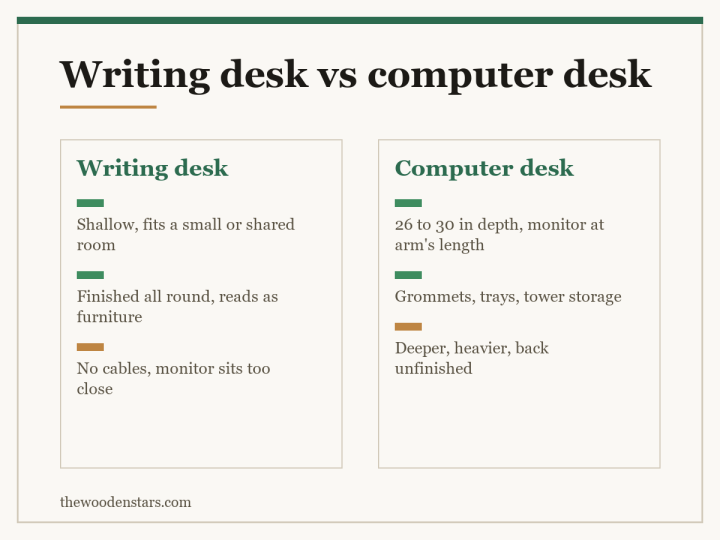
For the other dimensions, see how deep a desk should be, how wide a desk should be and how much space behind a desk. For the type, writing desk against computer desk and desk against table.
Questions we get asked
How tall should a desk be?
Twenty-eight to 30 inches as sold, but your own figure is floor to elbow while seated — usually 1 to 2 inches lower.
How do I measure my correct height?
Sit with feet flat and thighs level, hang your upper arms straight down, bend the elbows to 90°, and measure floor to forearm.
Why are desks all 29 inches?
The standard comes from mid-century office furniture sized for the average man of the time, and volume manufacturing has kept it.
My desk is too tall. What now?
Raise the chair until your elbows are level with the top, then add a footrest so your thighs stay level and feet stay supported.
Can I cut the legs down?
On a solid wood desk, yes — all four equally, then refinish. On laminate over particleboard the legs are usually hollow or frame-mounted, and cutting ends the desk.
What height for standing?
Thirty-eight to 46 inches, roughly your height minus 26. Check the frame’s maximum, because many stop at 44.