How tall should a dining chair be? 18 inches
The Wooden Stars is a participant in the Amazon Services LLC Associates Program. We may earn a commission when you buy through links on our site, at no extra cost to you.
How tall should a dining chair be? 18 inches to the top of the seat — and that single number is fixed by the table, not by the chair or by you.
Almost every dining chair sold is 17 to 19 inches, because almost every dining table is 30.
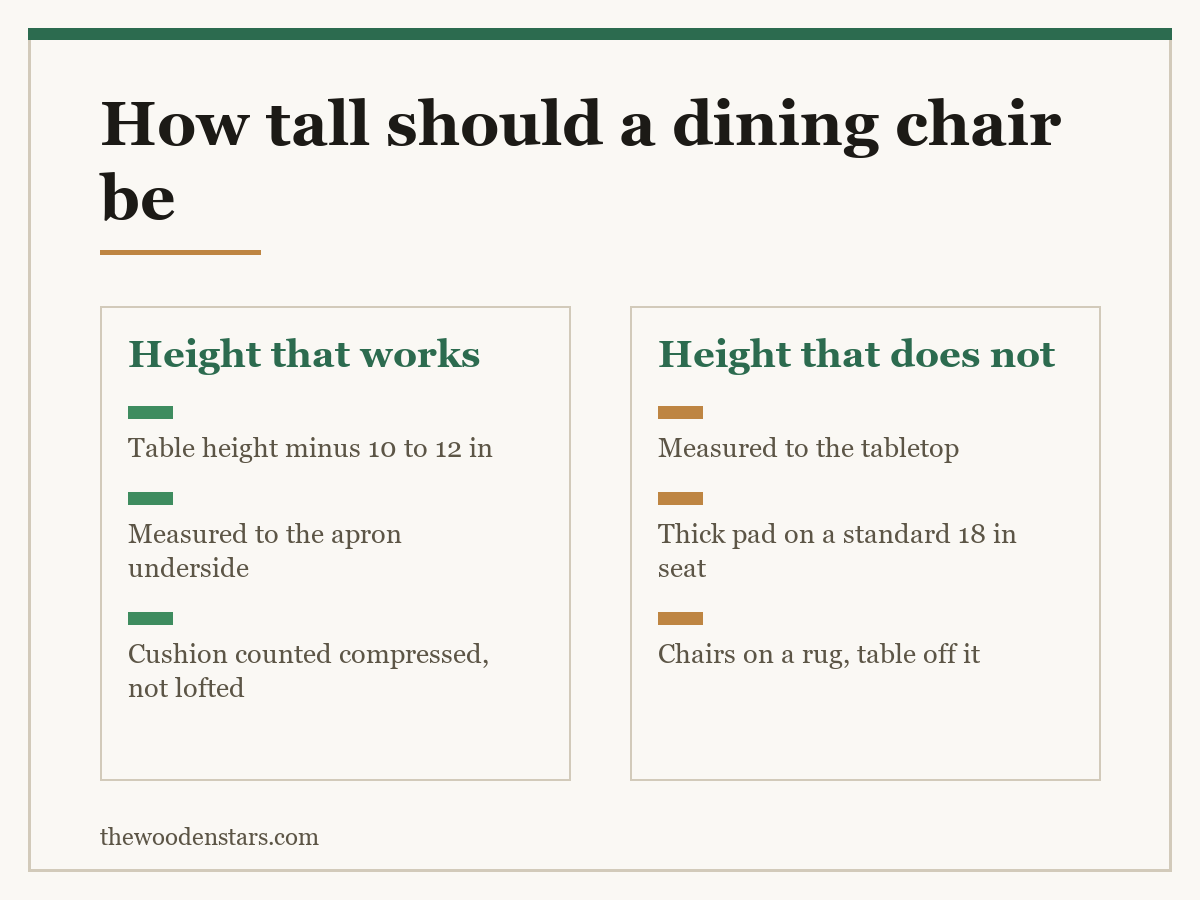
Seat height is 17 to 19 inches, with 18 as the standard. It is derived, not chosen: a dining table is 28 to 30 inches tall and you want 10 to 12 inches of clear space between the seat and the underside of the table — not the tabletop. A 30-inch table with a 1-inch top and a 3-inch apron leaves 26 inches underneath, so an 18-inch seat gives you 8 inches of thigh clearance and that is already tight. Measure the apron before buying. With a cushion, count its compressed thickness, not its loft.
How tall should a dining chair be for your table
- Standard dining table, 30 inches: seat 18 inches.
- Low or vintage table, 28 to 29: seat 17 to 17.5.
- Counter-height table, 36: seat 24 to 26 — that is a stool, not a chair, and the difference is set out in counter height against standard dining table.
- Bar-height table, 42: seat 29 to 32.
- Children at an adult table: a booster or a 21 to 23-inch youth chair, not a cushion on an 18.
The rule underneath all of them: surface height minus 10 to 12 inches. It is the same rule that governs bar seating, worked through in how tall a bar stool should be.

| Table | Height | Seat | Clearance |
|---|---|---|---|
| Low or vintage | 28 to 29 in | 17 to 17.5 in | 10 to 11 in |
| Standard dining | 30 in | 18 in | 8 to 12 in |
| Counter height | 36 in | 24 to 26 in | 10 to 12 in |
| Bar height | 42 in | 29 to 32 in | 10 to 12 in |
| Child at adult table | 30 in | Booster or 21 to 23 in | — |
The apron is what catches people
The published clearance rule says 10 to 12 inches, and most people measure from the tabletop. That is the wrong surface.
A dining table usually carries a stiffening rail — the apron — running between the legs under the top. It is commonly 3 to 4 inches deep, and it is what your thighs actually meet.
So on a 30-inch table: 30 minus a 1-inch top minus a 3-inch apron leaves 26 inches to the underside. An 18-inch seat then gives 8 inches of thigh room, which is usable but not generous, and it is why some perfectly standard chairs feel cramped at some perfectly standard tables.
Three things follow:
- Measure floor to apron underside before buying chairs, not floor to tabletop.
- Prefer a trestle or pedestal table if clearance is tight — neither has an apron across the seating positions.
- Check the arm height too if the chairs have arms, or they will not tuck in — dining chair with arms against without.
What changes the effective height after you buy
Cushions. A 2-inch seat pad is rarely 2 inches once someone sits on it. Count the compressed thickness — usually half to two-thirds of the loft — and subtract that from your clearance. A thick pad on an 18-inch seat can put you at 19.5 in practice.
Rugs. A dining rug adds 0.25 to 0.75 inches under the chair legs but nothing under the table legs if the table is off the rug. Get both on or both off.
Floor levellers and felt pads. Small, but they stack with everything else.
Reupholstery. Re-padding an old chair frequently adds an inch, which is how inherited chairs stop fitting the table they came with.
When the standard does not suit the people
Eighteen inches is an average, and averages fit nobody exactly.
Shorter sitters want feet flat on the floor. At 5 ft 2 in an 18-inch seat leaves the feet dangling, which cuts circulation behind the knee within twenty minutes. A 17-inch chair, or a discreet footrest, fixes it.
Taller sitters find 18 inches low, but raising the chair runs into the apron. The honest fix is a table with more clearance rather than a taller chair.
Older users want a slightly higher seat, because standing up from a low chair is much harder than sitting down into one. Nineteen inches plus arms to push on makes a real difference.
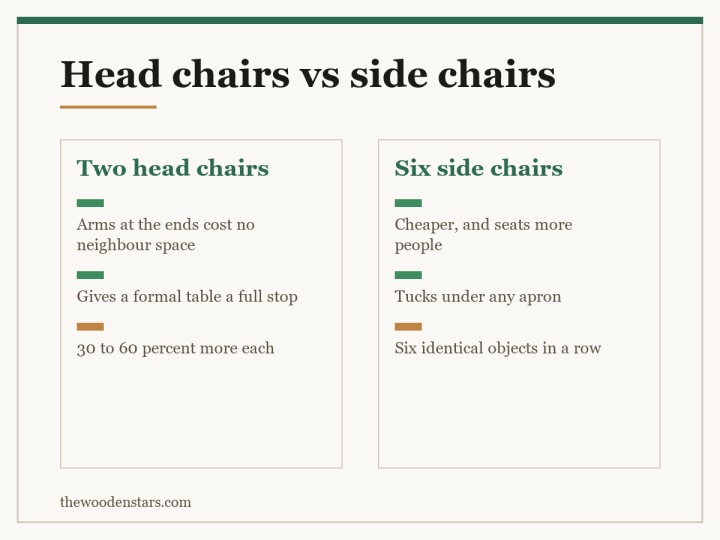
Where one table serves a wide range of people, the practical answer is armchairs at the ends for whoever needs the support and standard side chairs down the long sides — the arrangement worked through in head chairs against side chairs.
The other dimensions follow from the height: how deep a dining chair seat is and how wide a dining chair is. For what the frame has to carry, how much weight a dining chair can hold, and for timber and joints, best wood for furniture and how to reglue a loose joint.
One more check that costs nothing: measure the chairs you already own before replacing them. People usually blame a new table for a set that feels wrong, when in fact the old chairs were 17 inches and the new ones are 19. Write down the seat height, the arm height and the overall depth of whatever you are replacing, and treat those three numbers as the brief. If the old chairs were comfortable, matching them is a safer specification than any published standard, because it already accounts for the people who sit in them.
Getting the height right
- Tape measure Floor to the underside of the apron, not to the tabletop
- Seat pads for dining chairs Two inches of loft compresses to about one in use
- Felt furniture pads Chairs get dragged at every meal; this saves the floor
- Furniture levellers A chair that rocks feels lower on one side than it is
What to buy


For the table it sits at, see how much space around a dining table and how many chairs fit a round table. For the seat itself, upholstered against wood dining chairs.
Questions we get asked
How tall should a dining chair be?
Eighteen inches to the top of the seat, for a standard 30-inch table. The range is 17 to 19.
How much clearance do I need under the table?
Ten to 12 inches between the seat and the underside of the apron — not the tabletop.
Why do my standard chairs feel cramped?
The apron. A 3-inch rail under a 30-inch top leaves 26 inches, so an 18-inch seat gives only 8 inches of thigh room.
Does a cushion change the height?
Yes, by its compressed thickness — usually half to two-thirds of the loft. A 2-inch pad adds about an inch in use.
What seat height for a counter-height table?
Twenty-four to 26 inches, which is a counter stool rather than a dining chair.
What if someone is much shorter or taller?
Shorter sitters want 17 inches or a footrest. Taller sitters need a table with more clearance, not a taller chair.