Desk with drawers vs without — Where the legs go
The Wooden Stars is a participant in the Amazon Services LLC Associates Program. We may earn a commission when you buy through links on our site, at no extra cost to you.
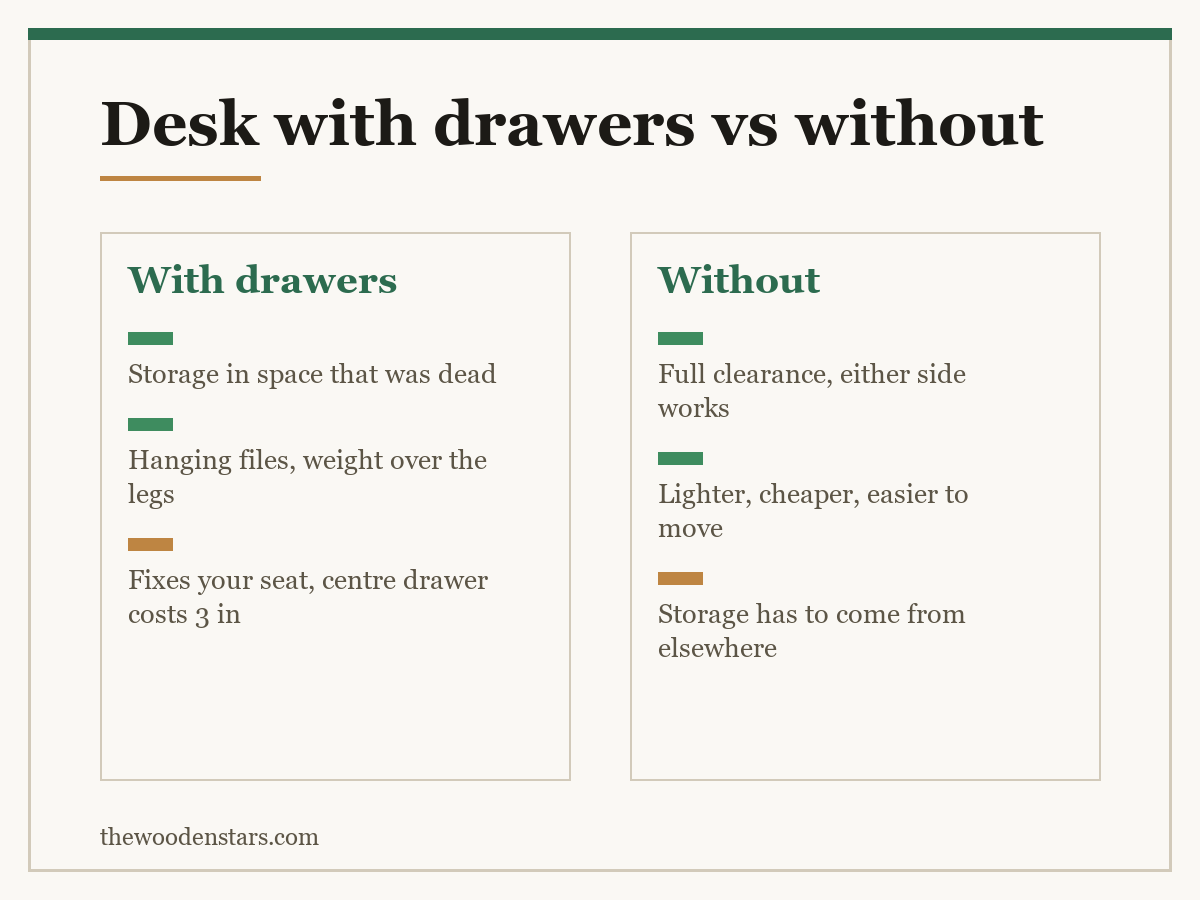
Desk with drawers vs without is a trade you make with your knees. Drawers use space that was dead anyway — unless the pedestal sits where your legs need to go.
The question is not whether you want storage. It is which side the storage is on.
A pedestal desk puts drawers in a box under one or both ends, leaving 20 to 30 inches of clear knee space between. A shallow centre drawer sits directly under the top and costs 2 to 4 inches of knee clearance — which on a 29-inch desk leaves 23 to 25, below the 24 to 27 inches most people need. A desk without drawers gives full clearance, weighs less, works from either side, and pairs with a rolling unit you can put anywhere. Rule: side pedestals are free, centre drawers are not.
Desk with drawers vs without: where the storage sits
- Side pedestal, one or two. A drawer box 14 to 18 inches wide at one or both ends. Costs no knee clearance; costs leg room sideways.
- Shallow centre drawer. Full-width, 2 to 3 inches deep, directly under the top. Costs knee clearance for everyone.
- Hanging file drawer. Deep, 10 to 12 inches, takes suspension files. Only exists in a pedestal.
- No drawers. Full clearance, lighter, cheaper, and the top is usable from both sides.
- Rolling unit, separate. The storage of a pedestal, placed wherever you want it, and it moves when you rearrange.
The knee clearance target is 24 to 27 inches floor to underside, with 20 inches of clear width. Measure it with the drawer in place, not from the tabletop — that number and the desk height it depends on are in how tall a desk should be.
| Type | Knee clearance | Storage | Note |
|---|---|---|---|
| No drawers | 26 to 27 in | None | Usable from both sides |
| Side pedestal | 26 to 27 in | Large, files fit | Blocks one side |
| Two pedestals | 26 to 27 in | Largest | Fixed seating position |
| Shallow centre drawer | 23 to 25 in | Pens, cables | Costs everyone clearance |
| Rolling unit | 26 to 27 in | Pedestal-sized | Moves with the room |
Why the centre drawer is the one to question
It is the drawer people ask for and the one that causes most complaints later.
A 29-inch desk with a 1-inch top has 28 inches to the underside. Add a 3-inch drawer box and you are at 25 inches — under the 26 that a 6-foot adult needs and uncomfortably close for anyone with long thighs. Add a keyboard tray under that and it becomes unusable.
What it actually holds is pens, cables, a notebook and headphones. Useful, but a shallow tray stuck under the desk edge holds the same things and costs an inch instead of three.
So: if you want a centre drawer, check the floor-to-underside figure with the drawer before buying, and prefer a desk built at 30 inches rather than 29 so the drawer fits in the extra inch.
What a pedestal costs you instead
Nothing vertically. Two other things horizontally.
It fixes where you sit. A single pedestal on the right means you sit left of centre, forever. A double pedestal fixes you in the middle with a narrower knee hole — often 20 to 24 inches, which is the minimum rather than comfortable.
It kills one side of the desk. You cannot sit at the pedestal end, so a pedestal desk seats one person in one place. A desk without drawers can be approached from either side, which matters in a shared room or when the desk floats — the same argument as desk against table.
It adds 30 to 60 lb. Relevant if the desk moves, and relevant on a standing frame where the pedestal has to travel with the top or be left behind — standing desk with drawers.
Against that, a pedestal is the only format that takes hanging files, and it puts weight over the leg line rather than mid-span, which helps the top stay flat — how much weight a desk can hold.
The arrangement that suits most rooms
A desk without drawers, plus a rolling unit under one end.
It gives you the pedestal’s storage with none of its permanence: roll it out when two people use the desk, roll it under the other end when you rearrange, take it to a different desk entirely when you replace this one.
Two things to check when buying the pair. The unit has to fit under the top — most are 24 to 26 inches tall against 26 to 27 of clearance, so it is close. And it wants locking castors, or it drifts every time you open a drawer.
Where a built-in pedestal still wins: a dedicated office where the desk never moves, and anywhere hanging files are genuinely used. Where neither applies, the drawers you are paying for mostly hold things you could keep elsewhere.
For the other storage formats, hutch desk with drawers puts it above the top instead, and secretary desk against writing desk covers the closing kind.
One practical check before ordering a pedestal desk: which side the pedestal is on, and whether it can be swapped. Some makers ship a reversible carcass, most do not. A right-hand pedestal in a room where the light comes from the right means you work in your own shadow, and that is not something you can fix later without replacing the desk.
Storage either way
- Rolling drawer unit Pedestal storage that is not bolted to one desk
- Under-desk drawer tray Holds what a centre drawer holds, costs one inch not three
- Tape measure Floor to the underside of the drawer, not the tabletop
- Locking castors Stops a rolling unit drifting every time you open it
What to buy


For clearance, see how tall a desk should be and how deep a desk should be. For the format, desk against table and writing desk against computer desk.
Questions we get asked
Should a desk have drawers?
Side pedestals cost no knee clearance, so they are close to free. A shallow centre drawer costs everyone 2 to 4 inches and is the one to question.
How much knee clearance do I need?
Twenty-four to 27 inches floor to underside, with 20 inches of clear width.
Why does a centre drawer cause problems?
A 29-inch desk has 28 inches to the underside. A 3-inch drawer box leaves 25, which is under what a tall adult needs.
What does a pedestal cost me?
It fixes where you sit, kills one approach side, and adds 30 to 60 lb.
Is a rolling unit as good?
For most people, better. Same storage, moves with the room, and transfers to your next desk.
When is a built-in pedestal worth it?
A dedicated office where the desk never moves, and anywhere you genuinely use hanging files.