Writing desk vs computer desk — Cables decide it
The Wooden Stars is a participant in the Amazon Services LLC Associates Program. We may earn a commission when you buy through links on our site, at no extra cost to you.
Writing desk vs computer desk is decided by cables. Everything else about the two — depth, storage, how they look in a room — follows from whether the desk was designed to have wires coming out of it.
A writing desk is furniture. A computer desk is equipment.
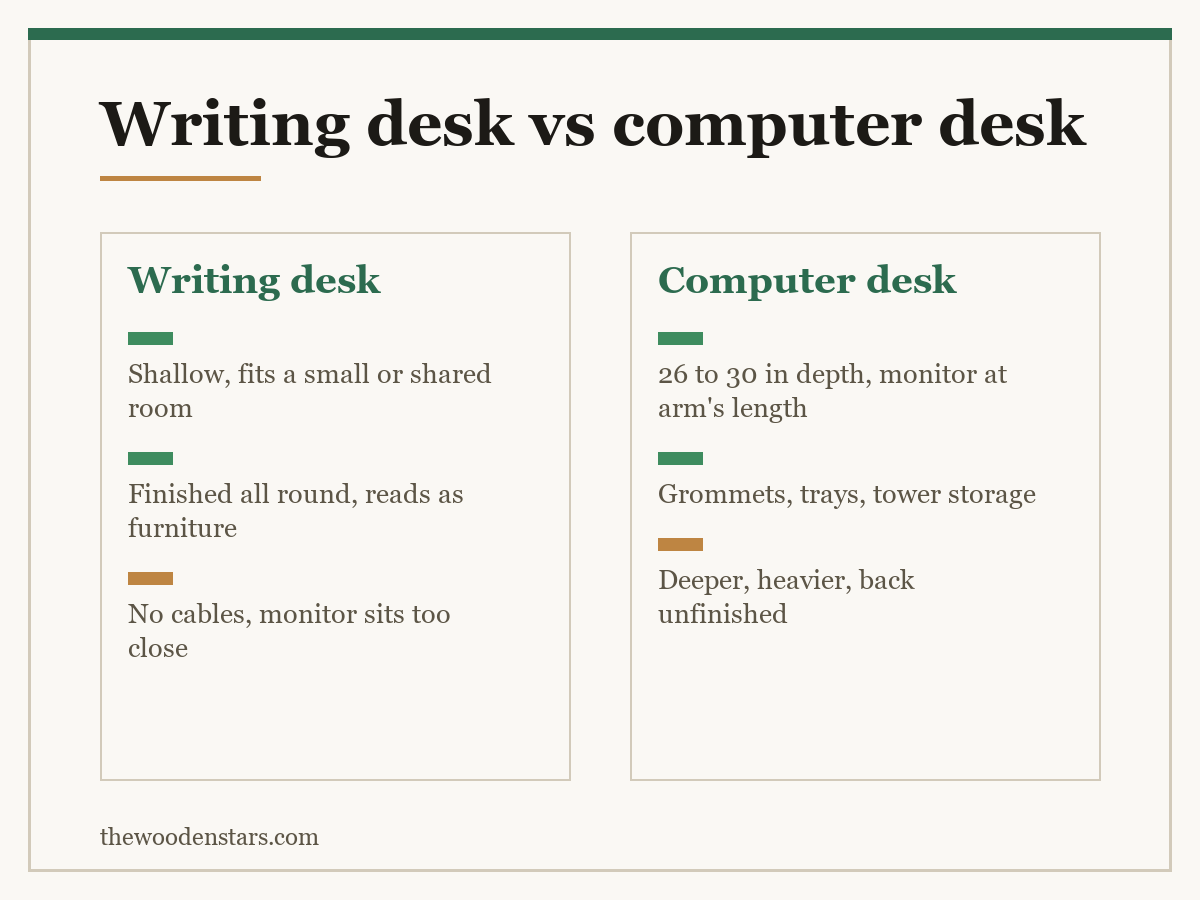
A writing desk is shallow at 20 to 26 inches, usually finished on all four sides, has slim legs and one shallow drawer, and offers no cable management. A computer desk is 26 to 30 inches deep — enough for a monitor at arm’s length — with grommets, a cable tray, a modesty panel and often a keyboard tray or tower shelf. Choose the writing desk for a laptop in a living space; the computer desk for a monitor, a tower and a permanent setup. The one hard limit: a writing desk at 20 inches cannot hold a monitor at a safe viewing distance.
Writing desk vs computer desk: what actually differs
- Depth. 20 to 26 inches against 26 to 30. The single most consequential difference.
- Cable management. None against grommets, trays and a panel to hide the run.
- Finished sides. A writing desk is meant to be seen from behind; a computer desk usually is not.
- Storage. One shallow drawer against a pedestal, a tower shelf or a keyboard tray.
- Weight and legs. Slim tapered legs against a heavier frame built for equipment.
Heights match at 29 to 30 inches, so neither has an ergonomic advantage — that is set by your elbow, per how tall a desk should be.

| Measure | Writing desk | Computer desk |
|---|---|---|
| Depth | 20 to 26 in | 26 to 30 in |
| Height | 29 to 30 in | 29 to 30 in |
| Cable grommet | No | Usually |
| Cable tray | No | Often |
| Modesty panel | Rarely | Usually |
| Storage | One shallow drawer | Pedestal or tower shelf |
| Finished back | Yes | Often not |
| Suits a monitor | Only at 26 in | Yes |
The depth limit, which is not negotiable
A monitor wants to sit 20 to 30 inches from your eyes, and roughly an arm’s length is the usual test. Subtract the space your keyboard and forearms need in front — about 10 inches — and the monitor’s own stand depth of 8 to 10.
On a 28-inch desk that works comfortably. On a 22-inch writing desk the screen ends up 16 inches away, which is close enough to cause eye strain and to force you to sit back from the keyboard.
Two fixes if you already own the shallow desk:
A monitor arm clamps to the back edge and pushes the screen out over the edge, recovering 8 to 10 inches of usable depth. This genuinely solves it.
A smaller screen. A 24-inch monitor is tolerable closer than a 32-inch one, because viewing distance scales with screen size.
The full depth reasoning is in how deep a desk should be.
What cable management is actually worth
It sounds like a minor feature. On a desk that stays in one place with a monitor, a dock, a lamp and a charger, it is the difference between a desk that looks like furniture and one that looks like a server rack.
A grommet is a hole with a cap that takes cables through the top rather than round the back edge. It is the feature that makes a desk usable against a wall — desk grommet covers retrofitting one.
A cable tray under the rear edge holds the power strip and the slack. Without it, everything hangs.
A modesty panel hides the lot from the front. It also stops the desk pushing fully back against a wall, and it blocks your chair at the sides — the trade noted in how much space behind a desk.
All three can be added to a writing desk with stick-on parts for very little. What cannot be added is depth.
Which one the room wants
Buy the writing desk if the desk lives in a bedroom, living room or hallway; you work on a laptop; the piece needs to look like furniture; or it floats rather than sitting against a wall. Add a monitor arm and a stick-on cable tray and it covers more ground than its depth suggests.
Buy the computer desk if there is a monitor, a tower, or a permanent multi-device setup; the desk sits against a wall in a dedicated room; or you need a pedestal — desk with drawers against without.
The middle options. A secretary desk closes over the mess, which suits a living room with a laptop in it. A hutch desk with drawers puts storage above the top so the depth stays free. And a plain table beats both when the work is wide and flat.
Whatever the format, check the top can hold the equipment — how much weight a desk can hold — and that the timber is what the listing claims, per engineered wood against hardwood.
One detail that separates the two more than any spec sheet: the modesty panel. A computer desk usually has one, and it does three jobs — hides cables, stiffens the carcass against racking, and blocks the view under the desk. A writing desk almost never does, which is why it looks lighter in a room and why every cable on it is visible from the doorway.
Making either work
- Monitor arm Recovers 8 to 10 inches of depth on a shallow writing desk
- Stick-on cable tray Adds a computer desk’s tidiest feature to any desk
- Desk grommet Routes cables through the top instead of round the back
- Cable sleeve For the run down to the socket, on a desk that floats
What to buy


For dimensions, see how deep a desk should be, how wide a desk should be and how tall a desk should be. For small rooms, secretary desk for small spaces.
Questions we get asked
What is the difference between a writing desk and a computer desk?
Depth and cables. A writing desk is 20 to 26 inches with no cable management; a computer desk is 26 to 30 with grommets, trays and a panel.
Can I use a writing desk with a monitor?
Only at 26 inches or with a monitor arm. At 22 inches the screen sits about 16 inches from your eyes.
Are they different heights?
No, both are 29 to 30 inches. Neither has an ergonomic advantage.
Can I add cable management to a writing desk?
Yes — a stick-on tray, a sleeve and a retrofit grommet cover it for very little.
Which looks better in a living room?
The writing desk, because it is finished on all four sides and has slimmer legs.
What if I need both?
A secretary desk closes over the setup, or a hutch desk moves storage above the top so the depth stays free.