Engineered Wood vs Hardwood: What You Actually Give Up
The Wooden Stars is a participant in the Amazon Services LLC Associates Program. We may earn a commission when you buy through links on our site, at no extra cost to you.
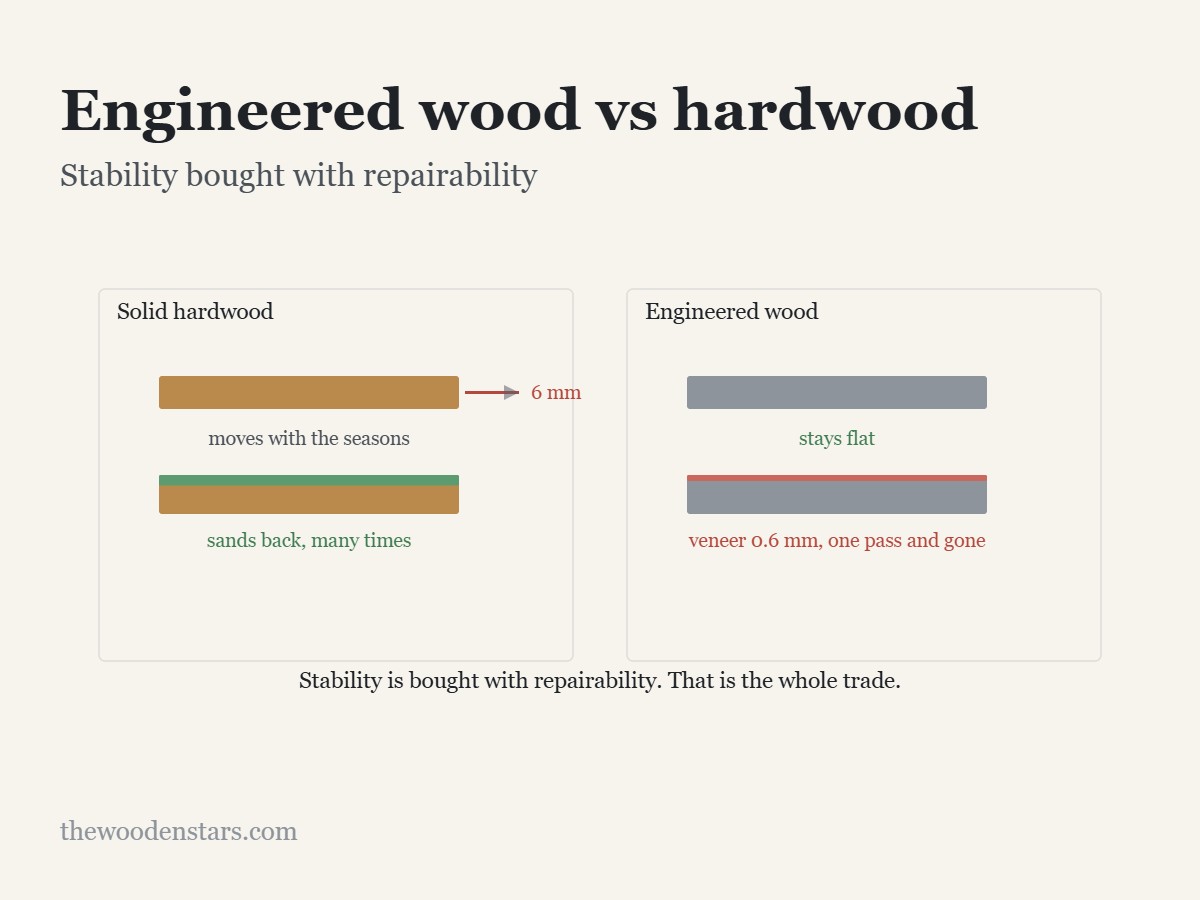
The comparison is usually framed as cheap against expensive, which is the least interesting thing about it. Plenty of engineered furniture costs more than plenty of solid furniture.
The real trade is narrower and more useful: engineered wood buys you flatness and stability, and charges you repairability and lifespan. Everything else follows from those two.
Buy solid hardwood for anything you expect to keep, refinish or hand on — dining tables, bed frames, chairs, and any surface that will collect twenty years of marks. Buy engineered wood for large flat panels that must stay flat, for painted work, and for pieces you accept are consumable. The dividing question is not price but this: when this is damaged, do you want to repair it or replace it? Solid wood can be sanded back; engineered wood cannot, and no amount of money changes that.

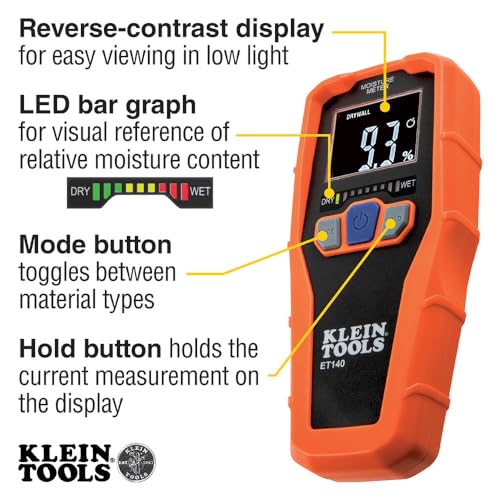
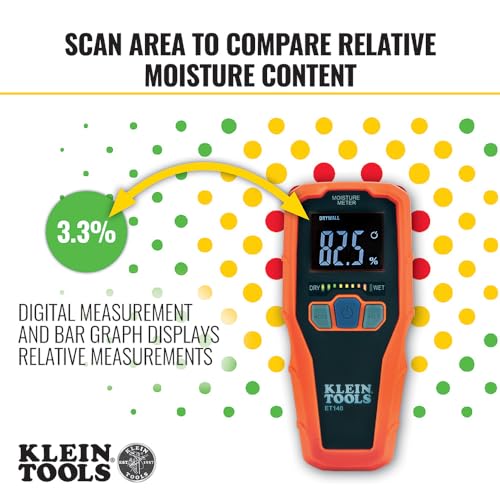
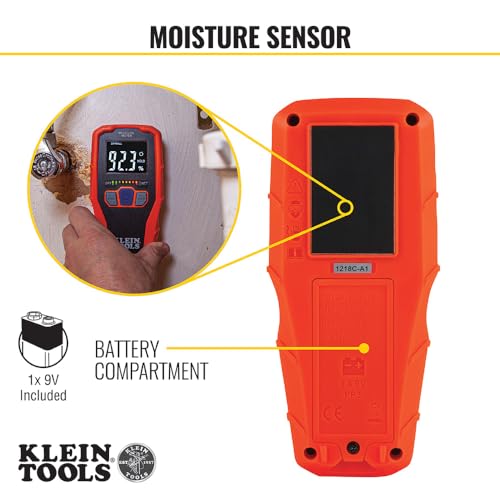
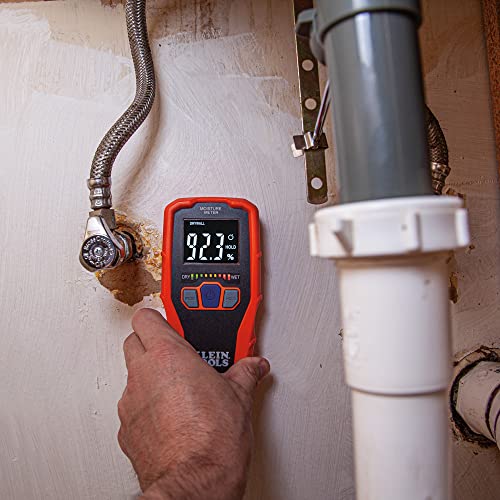
Klein Tools ET140 Pinless Moisture Meter for Non-Destructive Moisture Detection in Drywall, Wood, and Masonry; Detects up to 3/4-Inch Below Surface




As an Amazon Associate we earn from qualifying purchases. Product prices and availability are accurate as of the date/time indicated.
Start here: settle what the piece is made of before comparing anything else. On a finished item the edge and a meter tell you more than the listing does.
The seven axes that actually differ
| Solid hardwood | Engineered wood | |
|---|---|---|
| Seasonal movement | 3–8 mm across a 900 mm top | Almost none |
| Can be refinished | Yes, many times | No |
| Water damage | Recoverable, often invisibly | Permanent swelling |
| Screw holding | Very good, and re-drillable | Poor to fair, fails on reassembly |
| Weight | Heavy | Heavy for its strength |
| Large flat panels | Warps, needs breadboard ends or battens | Stays flat, its main advantage |
| Value after 20 years | Often holds or rises | Near zero |
Read that table as a set of trades rather than a scoreboard. The two rows where engineered wood wins are real wins, and if what you need is a 2-metre flat panel that will not move, solid timber is genuinely the wrong material.
Movement: the one that surprises people
Timber changes width across the grain as humidity changes, and does almost nothing along it. A 900 mm wide solid oak top can move 5 to 8 mm between a damp summer and a heated winter. That is not a defect; it is what wood does.
Consequences run through the whole design. A solid top has to be fixed in a way that lets it slide — slotted holes, figure-8 fasteners, buttons — or it splits. An engineered top can be screwed rigidly at every corner and stays flat forever.
This is why the two materials fail differently. Solid furniture develops cracks at the seams when it is fixed wrongly; engineered furniture develops sagging shelves and loose fixings. Neither is a fault of the material so much as a mismatch between the material and the joint.
Refinishing: what you are actually buying
A solid hardwood table covered in water rings, heat marks and scratches can be sanded to bare timber in an afternoon and refinished. The result is genuinely as good as new, and it can be done again in fifteen years.
On a veneered top the slice is often 0.6 mm. A sander removes that faster than you can react, and there is no repair once the core shows. On MDF and particleboard there is nothing to bring back at all.
So the honest question is not which material is better. It is how long you intend to keep the piece and whether you will maintain it. A dining table used daily by a family for twenty years is a completely different proposition from a desk that will be replaced when the job changes.
Where each one is the right answer
- Dining table: solid. It gets the most damage of anything in the house and refinishing is what saves it.
- Chairs: solid, without much argument. Chairs take side load through joints, and board does not hold a joint under that load.
- Bed frame: solid for the rails and posts, where bolts go in and out. Slats can be anything.
- Wardrobe or sideboard doors: engineered, usually. A large flat panel that must not warp is exactly what board does best.
- Painted furniture: MDF, genuinely. There is no grain to raise and the finish is better than on solid timber.
- Bookcase carcass: plywood is excellent; particleboard sags. This is a case where “engineered wood” as a phrase hides the entire decision.
- Desk top: either. A solid slab if you want it to last; a stable board if you want it dead flat under a monitor arm.
The four kinds of engineered wood behave very differently from each other, and which one a listing means changes the answer completely — that is set out in our guide to what engineered wood actually is.
Price, honestly
Solid hardwood costs more to buy in almost every comparable piece. Over a long enough life it usually costs less, because the solid piece is refinished twice and the board piece is replaced twice. Over a short life the board piece is simply cheaper.
Two caveats worth naming. A cheap solid pine piece is not better than a good plywood one — species matters as much as solid-versus-engineered, and the hardness figures are in our guide to the Janka scale. And a solid top on a particleboard carcass is a common construction that gets described as solid wood; check the carcass, not just the top.
Telling them apart before you buy
- Look at an inside edge. Solid timber shows the grain running over the edge and continuing on the next face. Board does not.
- Look at the end grain. A solid board shows growth rings on the end. Veneer shows a straight line where the slice stops.
- Feel the weight for the size. Particleboard is heavy without being strong; solid hardwood is heavy and rigid.
- Check the underside. Manufacturers finish what shows. An unfinished underside is the most honest view of the material in the whole piece.
The full five-test method, including the two that work through a shop window, is in our guide to solid wood, engineered wood or veneer.
What helps
- Moisture meter Reads whether a board is solid timber, and whether it is wet On Amazon →
- Hard wax oil The finish that makes refinishing solid wood worth doing On Amazon →
- Digital caliper Measures veneer thickness at an exposed corner
- Random-orbit sander Only worth owning if the piece can actually be refinished
What to buy

Questions we get asked
Is engineered wood better than hardwood?
For a large flat panel that must stay flat, yes. For anything you intend to keep and repair, no. The two materials are good at different things, and the choice follows from whether the piece is an heirloom or a consumable.
Is engineered hardwood the same as hardwood?
No. “Engineered hardwood” means a hardwood veneer over an engineered core, so the surface is hardwood and the structure is not. It behaves like engineered wood in every way that matters — movement, refinishing, water — and like hardwood only in how it looks.
Which lasts longer?
Solid hardwood, comfortably, provided it is looked after and the joints are sound. Engineered furniture in a dry room lasts a long time too; what shortens its life is water, house moves and repeated dismantling, none of which trouble solid timber much.
Does engineered wood furniture hold its value?
Generally not. Solid hardwood furniture in good condition retains real second-hand value and antique pieces appreciate; engineered furniture is worth little once it leaves the shop. If resale matters to you, that is a bigger difference than the purchase price.
Can you tell the difference by price?
Not reliably. Well-made engineered furniture from a good brand often costs more than plain solid pine. Price tracks brand, finish and design at least as much as material, which is why the edge test is worth doing.

