How wide is a dining chair? 16 to 22 inches
The Wooden Stars is a participant in the Amazon Services LLC Associates Program. We may earn a commission when you buy through links on our site, at no extra cost to you.
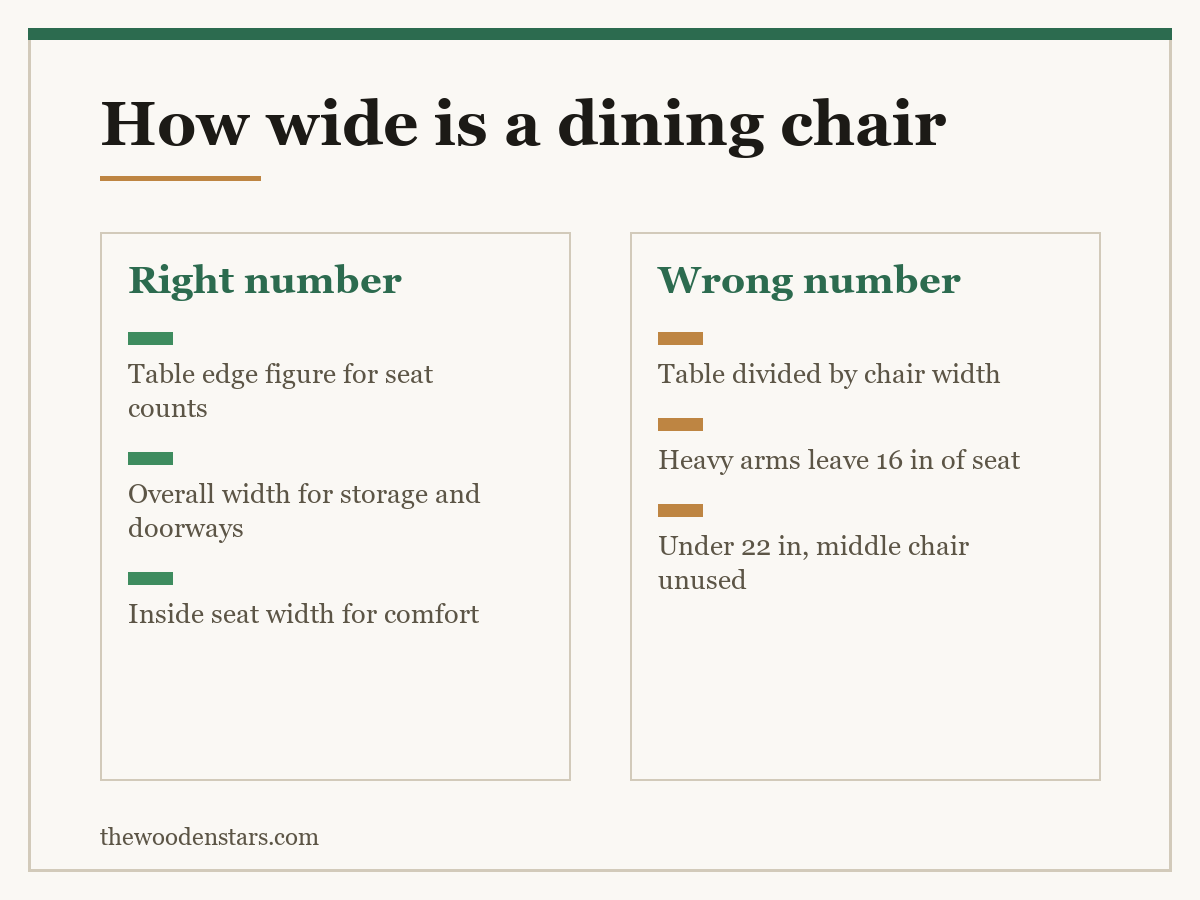
How wide is a dining chair? 16 to 22 inches at its widest point — but the number that decides how many fit at your table is the 24 inches of table edge each person needs, and those two get confused constantly.
That confusion is why six chairs arrive for a table that seats five.
Three widths, three jobs. Overall width is 16 to 18 inches for a slim side chair, 18 to 20 for a standard upholstered one, and 22 to 26 with arms — use it for storage and doorways. Table edge per diner is 24 inches armless and 26 to 28 with arms — use it for seat counts, because people need a gap between them. Inside seat width is 16 to 19 inches between the arms or uprights, and that is what decides comfort. Listings publish the first and you need all three.
How wide is a dining chair, by type
- Slim wooden side chair: 16 to 18 inches overall.
- Standard upholstered side chair: 18 to 20.
- Parsons chair: 19 to 21, because the upholstery is thick.
- Armchair or carver: 22 to 26 overall, 17 to 19 inside the arms.
- Bench, for comparison: 20 to 22 inches per person, with no frames between people.
The overall figure matters for getting the chairs home and storing them. It does not tell you how many fit at a table, because chairs are not placed edge to edge.
| Chair | Overall | Table edge | Inside seat |
|---|---|---|---|
| Slim side chair | 16 to 18 in | 24 in | 16 to 17 in |
| Standard side chair | 18 to 20 in | 24 in | 17 to 18 in |
| Parsons chair | 19 to 21 in | 24 to 26 in | 18 to 19 in |
| Armchair or carver | 22 to 26 in | 26 to 28 in | 17 to 19 in |
| Bench, per person | — | 20 to 22 in | — |
Which number to use for which job
For seat counts, use the table edge figure. Divide the usable perimeter by 24 (or 26 to 28 with arms). A 72 × 36-inch rectangle has 216 inches of edge, but the corners are unusable, so it seats six comfortably rather than the nine the arithmetic suggests. The full method is in how many chairs fit a round table.
For storage and doorways, use overall width. Six chairs at 20 inches is ten feet of wall if you line them up, and a boxed set is wider than the chairs.
For comfort, use the inside seat. It is the figure almost never published, and it is the one you feel. A 24-inch armchair with 3-inch arms gives 18 inches of seat — generous. The same 24 inches with heavy 4-inch arms gives 16, which is tight for many adults.
If the listing does not state it, subtract twice the arm thickness from the overall — and arm thickness is visible in the photographs even when the number is not.
Why the gap between chairs exists
People do not sit shoulder to shoulder at a meal. Shoulder width is 16 to 20 inches, but elbow width in use is 24 to 26, which is exactly where the 24-inch allowance comes from.
The gap also lets the middle person of three leave the table without anyone moving. At a dinner where people get up for plates, drinks and children, that is the difference between a relaxed meal and a fidgety one.
Squeeze below about 22 inches of table edge each and three things happen: chairs touch, the middle seat stops being used, and everyone drags chairs constantly. The same failure pattern at a kitchen island is in how much space between bar stools.
Where the numbers are tight, the honest fixes are armless chairs or a bench on one side, which needs only 20 to 22 inches per person because there are no frames between people — dining bench against chairs.
What else to check before ordering six of them
- Ask for the inside seat width if it is missing. It is the difference between a chair you sit in and one you sit between.
- Multiply properly. Six chairs at 24 inches is 144 inches of usable edge. A 72 × 36 table gives that only if you use both ends.
- Measure the doorway against the boxed width, not the assembled chair.
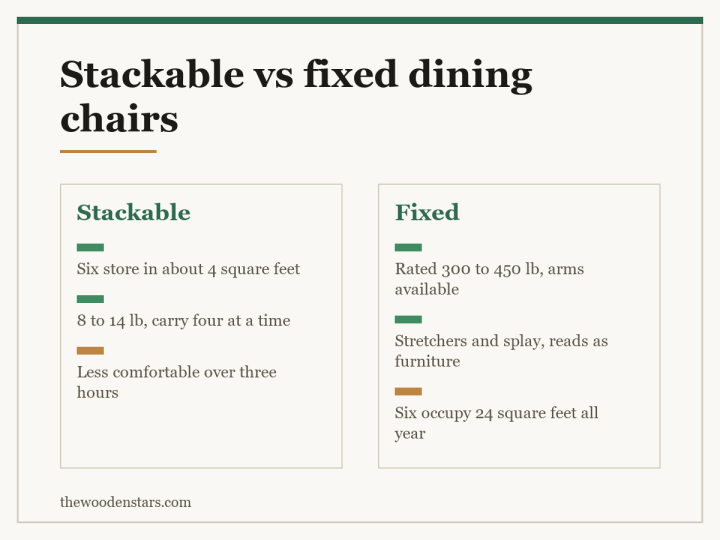
- Check the arms clear the apron, or armchairs will not tuck in — dining chair with arms against without.
- Check seat depth as well, which is a separate figure — how deep a dining chair seat is.
Height is set by the table, per how tall a dining chair should be, and the frame’s capacity is in how much weight a dining chair can hold.
The last thing to look at is the stance at the floor, which is where chairs collide before their seats do. Dining chair legs often splay outward by an inch or two each side, so a chair with an 18-inch seat can measure 21 inches across the feet. Six of those on a table planned at seat width will clash at ankle level while looking perfectly spaced from above. Ask for the widest dimension anywhere on the chair, not the seat width, and plan the centres from that.
Measuring and fitting
- Tape measure Inside seat width is the number listings leave out
- Seat pads for dining chairs An inch of pad makes a narrow seat noticeably kinder
- Felt furniture pads Six chairs dragged three times a day is what marks a floor
- Painter’s tape Mark the chair footprint on the floor before ordering six
What to buy


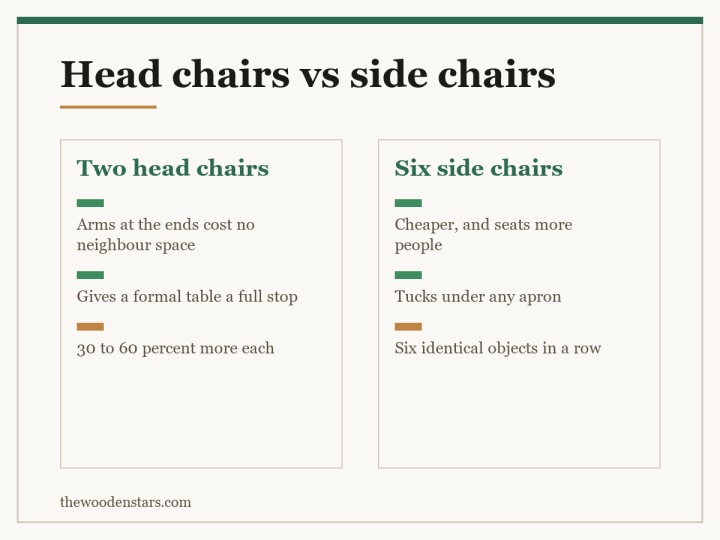
For seat counts, see how many chairs fit a round table and how much space between dining chairs. For the chair type, upholstered against wood and head chairs against side chairs.
Questions we get asked
How wide is a dining chair?
Sixteen to 22 inches overall for a side chair, and 22 to 26 with arms.
Which width do I use for seat counts?
The table edge figure — 24 inches per diner armless, 26 to 28 with arms. Not the chair’s overall width.
What is the inside seat width?
Sixteen to 19 inches between the arms or back uprights. Rarely published, and it is what decides comfort.
Why is the allowance wider than the chair?
Because elbow width in use is 24 to 26 inches, and people need to get out without moving a neighbour’s chair.
How do I find the inside width if it is not listed?
Subtract twice the arm thickness from the overall width. Arm thickness is visible in the photographs.
What if the numbers do not fit?
Use armless chairs, or put a bench on one side — a bench needs only 20 to 22 inches per person.