Bookcase with doors vs open — Dust, light and span
The Wooden Stars is a participant in the Amazon Services LLC Associates Program. We may earn a commission when you buy through links on our site, at no extra cost to you.
Bookcase with doors vs open is a decision about dust, light and how often you actually take the books off the shelf.
Doors solve two real problems and create one. Which way you go depends almost entirely on what is going on the shelves.
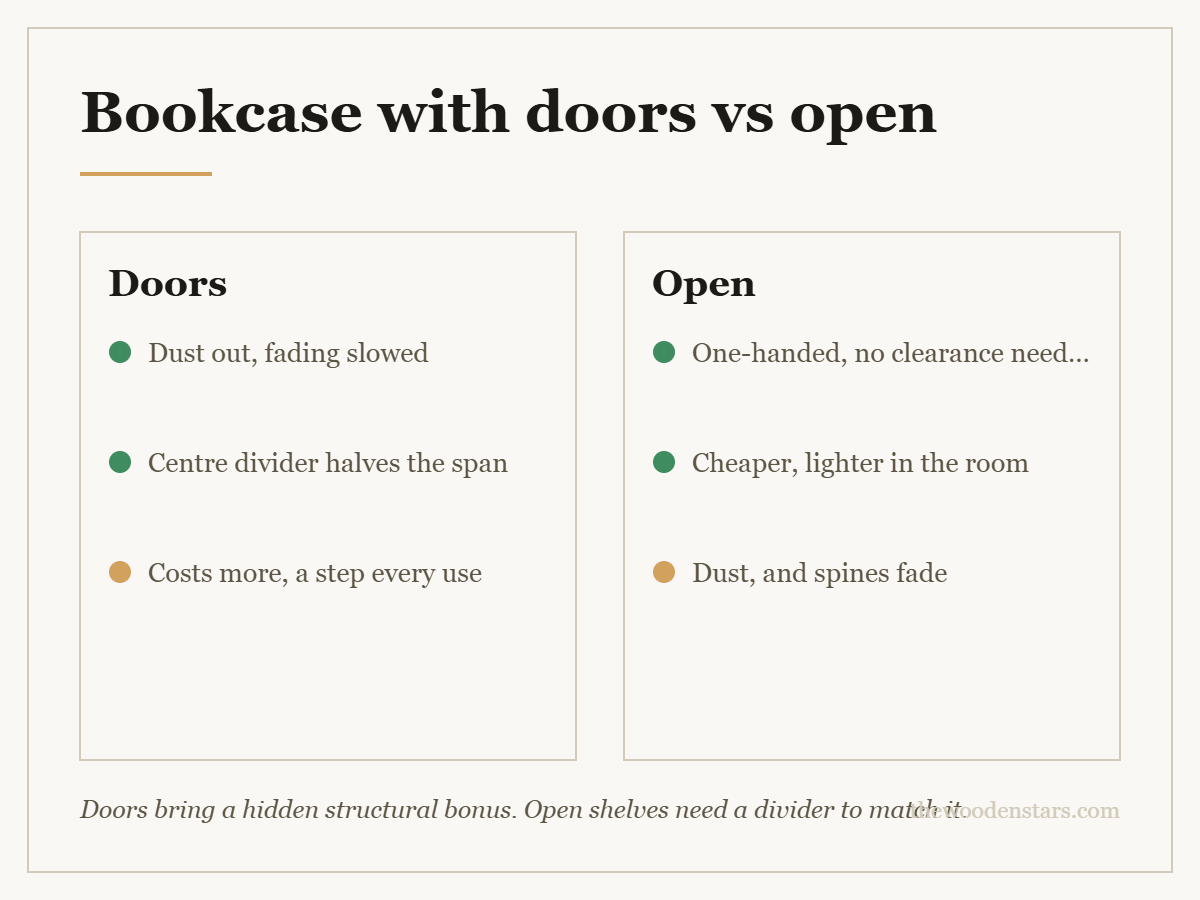
Doors keep dust off — the reason libraries use them — and glazed doors slow the fading that daylight does to spines and paper. They cost 2 to 3 inches of depth, need clearance to swing, and add a step every time you reach for something. Open shelves cost nothing, weigh less visually, and let you pull a book one-handed. The honest split: doors for things you look at and rarely touch — collections, china, records, paperwork — and open for a working library you use weekly. Glass doors give you the look without hiding the contents.
Bookcase with doors vs open: what the doors are actually for
Dust. This is the main one. An open shelf collects a visible film in weeks and books held upright collect it along the top edge, where it is hardest to remove. A closed case reduces that to a fraction, and it is why every serious book collection ends up behind glass.
Light. Daylight fades spines, and the damage is cumulative and irreversible. Glass does not stop it, but it slows it, and a solid door stops it entirely. If a bookcase faces a south window, this matters more than the dust.
Visual calm. Books are colourful and irregular. Solid doors turn a busy wall into a quiet one, which is the usual reason a bookcase with doors ends up in a sitting room rather than a study.
What they cost is immediacy. A door is a small tax on every single use, and over a working library that tax is what makes people take the doors off.
| Measure | With doors | Open |
|---|---|---|
| Dust | Largely excluded | Visible film in weeks |
| Fading from daylight | Slowed by glass, stopped by solid | Cumulative and permanent |
| Added depth | 2 to 3 in | None |
| Floor needed in front | Door width, to swing | None |
| Cost | Noticeably higher | Lower |
| Visual weight | Heavier, quieter | Lighter, busier |
| Suits | Collections, china, records, files | A working library |
Glass, solid or a mix
Glazed doors are the usual answer. You keep the dust out and still read the spines, which is how you find a book. Look for glass in a rebated frame rather than pinned in with beading — beading rattles as the door shuts.
Solid doors hide the contents completely. Right for paperwork, board games, router boxes and anything that looks like clutter; wrong for books you browse.
The mix — glazed above, solid below — is the traditional arrangement and it is traditional because it works. Display at eye level, the ugly things underneath, and the solid lower doors give the piece a visual base so it does not look like it is floating.
The same logic applies one room over: buffet against hutch and hutches with storage.
What doors do to the shelf span
Here is the practical benefit nobody mentions: a cabinet with doors usually has a vertical divider in the middle, because two doors need a place to meet.
That divider halves the shelf span — and span is what decides whether a shelf sags.
- A 36-inch open shelf in 0.75-inch timber, loaded with books, will deflect visibly within a year or two.
- The same 36-inch case with a centre divider gives two 17-inch spans, which will not move.
So a doored bookcase is often structurally better as a side effect. On an open case you get the same result by adding a divider or by keeping spans under about 30 inches — the full sag arithmetic is in bookcase dimensions and the repair in how to fix a sagging bookshelf.
The clearance question
A hinged door needs its own width of floor in front. On a 36-inch case with two doors that is 18 inches each — but you will open both, so plan on 24 inches of clear floor.
In a hallway or behind a sofa that may not exist. The alternatives:
- Sliding doors — no swing, but you only ever see half the case.
- Flap-up or tambour — rare on bookcases, common on cabinets.
- Doors on the lower half only, which is where the clearance usually does exist.
What to check either way
- Shelf span and thickness. Under 30 inches of span for 0.75-inch shelves loaded with books; add a divider or go thicker beyond that — bookcase dimensions.
- Adjustable shelves. Fixed pitch wastes more capacity than any other single decision — shelf pins and support sizes.
- Depth. Paperbacks want 7 inches, hardbacks 10, art books 14. Doors add 2 to 3 on top — bookshelf depth.
- A back panel let into a groove. It is what stops the whole case racking into a parallelogram, and it matters more once doors are hung on it.
- An anti-tip strap into a stud. Non-negotiable on anything over about 4 feet. Books are heavy and shelves are climbable — the reasoning is the same as anti-tip kits for dressers.
Material terms are in what engineered wood actually is; hinges screwed into particleboard edges are the joint that fails first on a doored case.
Either style
- Furniture anti-tip strap Non-negotiable above four feet, doors or not
- Shelf pins and supports Adjustable pitch recovers more capacity than extra depth
- Soft-close hinge dampers Stops glazed doors from being slammed shut
- Shelf support brackets The cheap fix for a span that has started to bow
What to buy


For sizing, see bookcase dimensions and bookshelf depth. For the structural distinction, bookcase against bookshelf. For small rooms, space saving bookshelves. For drawers instead of doors, bookcases with drawers. For sagging, how to fix a sagging bookshelf.
Questions we get asked
Are bookcases with doors better?
For collections, china, records and paperwork, yes — they keep dust off and slow fading. For a library you use weekly, open shelves are better.
Do glass doors stop books fading?
They slow it. Only a solid door stops it. If the case faces a south window, that is the deciding factor.
How much extra depth do doors add?
Two to 3 inches, plus the floor to swing them — plan on 24 inches of clear space in front.
Do doors make the bookcase stronger?
Usually, as a side effect. Two doors need a centre divider, and that halves the shelf span that causes sagging.
What about glazed above and solid below?
It is the traditional arrangement and it works — display at eye level, clutter hidden underneath, and a visual base to the piece.
Does a doored bookcase still need anchoring?
Yes. Anything over about 4 feet, into a stud. Doors add weight high up rather than reducing the risk.