Shelf Pins and Supports: 5 mm vs 1/4 in, and Which One Your Bookcase Uses
The Wooden Stars is a participant in the Amazon Services LLC Associates Program. We may earn a commission when you buy through links on our site, at no extra cost to you.
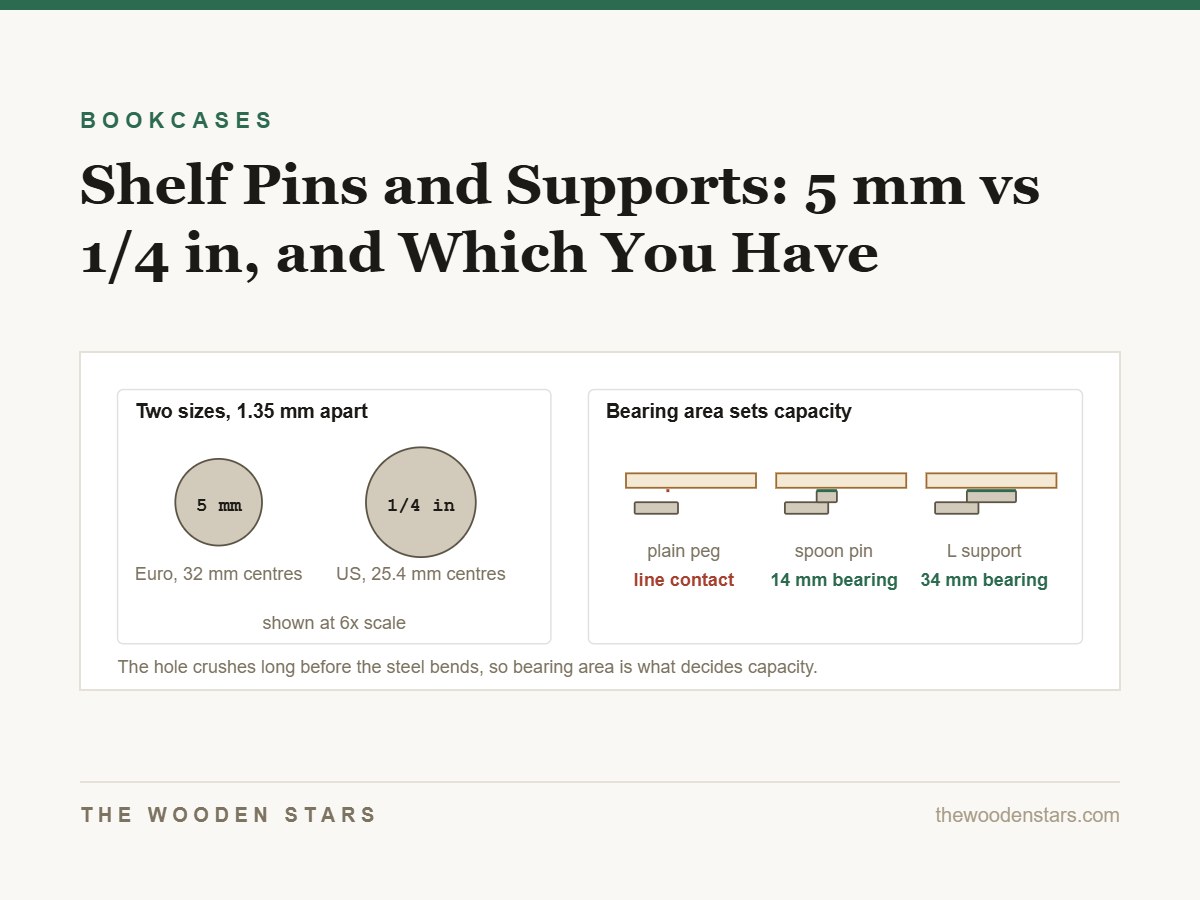
There are two shelf pin diameters in general circulation, they differ by about a third of a millimetre, and they are visually indistinguishable in a photograph. Buy the wrong one and the pins either rattle in the holes or will not go in at all.
The two are 5 mm and 1/4 inch (6.35 mm). That is a 1.35 mm difference — obvious with a caliper, invisible by eye.
Measure a hole or an existing pin with a caliper. 5 mm is the European standard and is used by almost all flat-pack and imported furniture. 1/4 in (6.35 mm) is the North American cabinet standard. If you have no pin to measure, try a 5 mm drill bit shank in the hole: if it drops in loosely, the hole is 1/4 in; if it is a close fit, it is 5 mm.
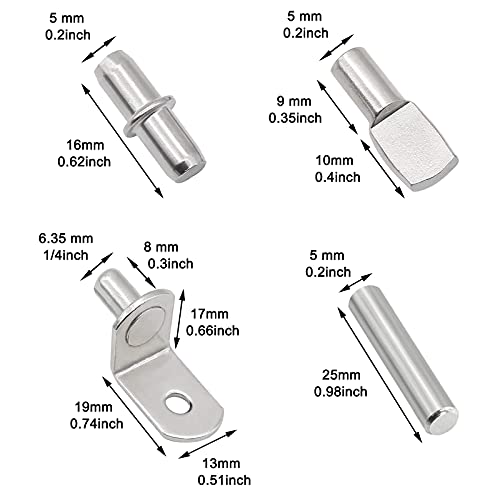
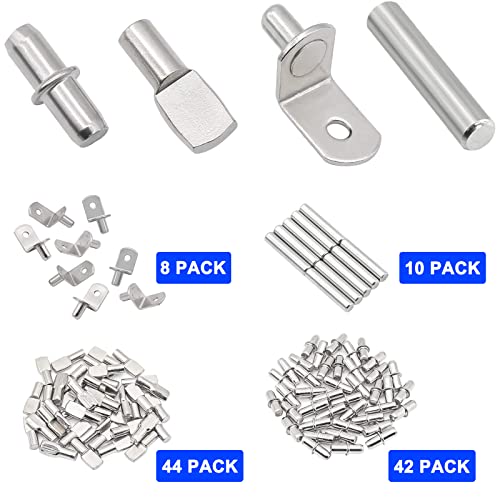
Start here: a four-style kit covers both diameters, which removes the one thing that gets shelf pins returned.

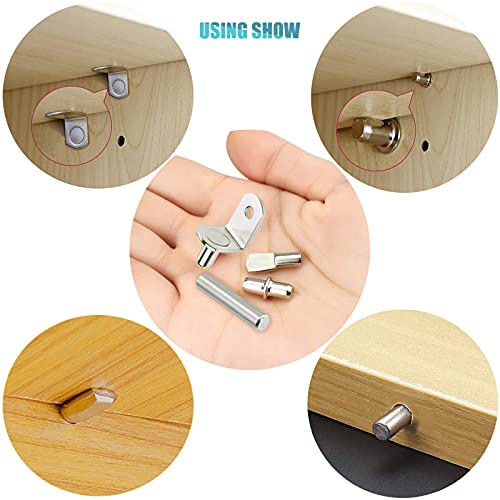
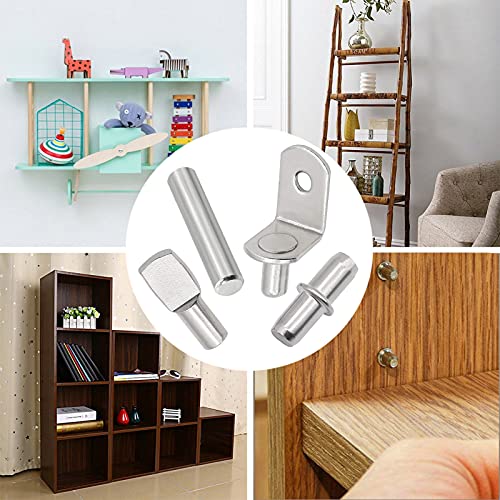
Prime 104Pcs Shelf Pins Kit,4 Styles Nickel Plated Shelf Support Pegs,Bookshelf Pegs for Shelves,Cabinet Shelf Bracket Pegs Shelf Pins Holders for Kitchen Furniture & Closet ( 5mm & 1/4inch )


Identifying what you have
| Size | Also called | Found on | Hole spacing |
|---|---|---|---|
| 5 mm | Euro, 5 mm system | IKEA and most flat-pack, European and Asian furniture | 32 mm centres |
| 6.35 mm | 1/4 in | North American cabinets, older US furniture | 25.4 mm (1 in) centres |
| 3 mm | — | Small display cabinets, glass shelving | Varies |
| 7 mm | — | Some heavy commercial shelving | 32 mm centres |
The hole spacing is a useful second clue. The 32 mm system — holes at 32 mm centres — goes with 5 mm pins and is near-universal on modern furniture. Holes at exactly one inch apart point to 1/4 in pins.
If you have neither a caliper nor a spare pin, the drill-bit trick above is reliable. A digital caliper is worth owning anyway — it is the same tool that settles the thread on levelling feet and the opening width for drawer slides.
The five types of support, and what each carries
Plain peg
A straight cylinder, sometimes with a shoulder. Cheapest, and the weakest — all the load bears on the small area where the shelf sits on the peg. Fine for a light shelf, poor under books.
Spoon or shelf-support pin
A peg with a flattened, spoon-shaped top. The flat gives the shelf a bearing surface instead of a line contact, which meaningfully increases how much it will carry before the hole crushes. The best general-purpose choice.
L-shaped support
A peg with a right-angle arm running under the shelf. Distributes load along the shelf’s underside rather than at one point, so it carries substantially more and is much less likely to crush a particleboard hole.
Pin with a locking screw
A support with a small screw that goes up into the shelf, locking it down. The right choice for a shelf that must not be lifted out — a shelf carrying a hazard, or one that stops a cabinet racking.
Sleeved pin
A metal sleeve is fitted into the hole first, and the pin locates in the sleeve. Essential for repairing crushed holes in MDF or particleboard, and worth fitting from new in any board material carrying serious weight.
| Support type | Capacity per shelf | Best use |
|---|---|---|
| Plain peg, 5 mm | 10–15 kg | Display, light objects |
| Spoon pin, 5 mm | 15–25 kg | General shelving, paperbacks |
| Spoon pin, 1/4 in | 25–35 kg | Hardbacks |
| L-shaped support | 35–50 kg | Reference books, records |
| Sleeved pin | As the sleeve allows, often 40 kg+ | Board material under load |
| Full-length cleat | Limited by the shelf, not the support | Heaviest shelves |
Those figures are limited by the hole, not the metal — a steel pin will not bend before a particleboard hole crushes. Which is why upgrading the support type helps and upgrading only the metal often does not.
Common failures and their fixes
- Hole crushed oval. The board has failed locally. Fit a metal sleeve into the hole, or drill a fresh hole at a different height and reinforce with a cleat. Filling with wood filler and re-drilling rarely holds — filler has no compressive strength in a small area.
- Pin bending. Under-sized support. Move up to a spoon pin or an L-shaped support, or add two more pins per shelf.
- Only two pins per shelf. Four minimum, one at each corner. Two turns the shelf into a see-saw and puts double load on each hole.
- Pin will not go in. Almost always a 1/4 in pin in a 5 mm hole. Do not force it — you will split the board.
- Shelf rocks on its pins. The four holes are not at the same height. Count hole positions rather than measuring, and count from the same end on both sides.
Drilling new holes
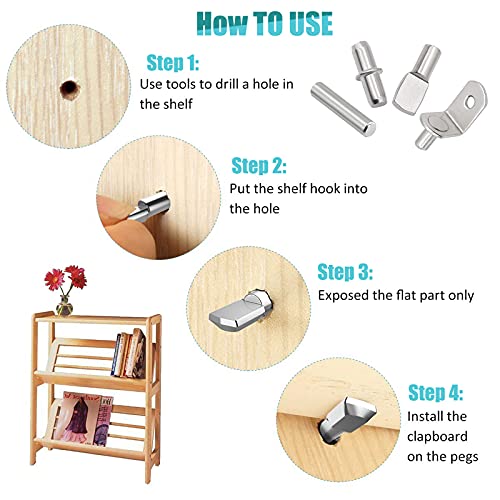
If you need extra positions, three rules save the job:
- Use a drilling jig or a shelf-pin template. Free-hand holes are never at matching heights, and a shelf on mismatched pins rocks forever.
- Use a brad-point or Forstner bit, not a twist drill. Twist drills wander and tear in board material.
- Set a depth stop. A hole drilled through the side of a cabinet is visible from the outside and unfixable. 12 to 14 mm deep is plenty for a 5 mm pin.
Drill both sides from the same reference edge, not from the bottom of the cabinet, because the bottom is not necessarily square to the sides.
What to buy
- Shelf pins kit, 4 styles Covers both sizes and several support types On Amazon →
- Shelf support pegs, 1/4 in, 40 pack The North American cabinet standard On Amazon →
- Prime-Line shelf supports, 1/4 in Small pack for a single repair On Amazon →
- Digital caliper Settles 5 mm vs 1/4 in in two seconds On Amazon →
- Brad-point bit and a depth stop Only if you are drilling new positions
What to buy
If you have not measured, buy the four-style kit. If you know it is 1/4 in, the 40-pack is cheaper per pin.


When pins are the wrong system entirely
Adjustable pins are a compromise: they trade load capacity for flexibility. There are cases where a fixed support is the better answer.
- A shelf carrying records, textbooks or tools. A full-length cleat screwed to the side panel carries far more, because the load is spread along the whole depth rather than concentrated at four points.
- A shelf that has to stiffen the carcass. A fixed shelf, glued and screwed, acts as a structural member and stops the case racking. A shelf on pins does nothing for the case.
- Particleboard bookcases that keep crushing their holes. At some point the honest answer is cleats, or a new bookcase in a better material.
And if the shelf itself is bending rather than the supports failing, pins are not your problem at all — that is span, and the limits are in our guide to fixing a sagging bookshelf.
Questions we get asked
Are 5 mm and 1/4 in interchangeable if I force it?
No. A 1/4 in pin in a 5 mm hole splits the board — particleboard and MDF have very little resistance to being wedged apart. A 5 mm pin in a 1/4 in hole rattles and rocks, and the rocking crushes the hole over time. Buy the right size; they cost the same.
How many pins per shelf?
Four, one at each corner, always. Six on a shelf over about a metre wide, if the hole pattern allows a middle pair. Two is not a shelf support system, it is a hinge.
My pins keep falling out when I remove the shelf. Is that normal?
Yes, and it is why pins with a shoulder or a slight friction fit exist. If it bothers you, a spot of hot glue in the hole holds the pin without preventing removal later. Do not use superglue — you will never get the pin out.
Can I use nails or dowels instead of pins?
Wooden dowels work and look neat in a solid wood bookcase; they carry less than steel because wood crushes across the grain. Nails are a bad idea — the head bears on almost no area and the shank bends. If you are improvising, cut short lengths of hardwood dowel to a snug fit.
Do metal sleeves fit any hole?
They are sold to suit specific hole diameters, so check the outer diameter against your hole and the inner diameter against your pin. Fitting a sleeve into a crushed oval hole usually means drilling the hole slightly larger and true first, which is exactly what the sleeve then fixes permanently.