Standing desks with drawers — The drawer is the hard part
The Wooden Stars is a participant in the Amazon Services LLC Associates Program. We may earn a commission when you buy through links on our site, at no extra cost to you.
Every other desk can have drawers because the top never moves. A standing desk raises and lowers through fifteen inches or more, and anything hanging underneath goes with it — including, at the bottom of the range, into your knees.
That is the whole problem. Manufacturers solve it three different ways, and the three are not equally good.
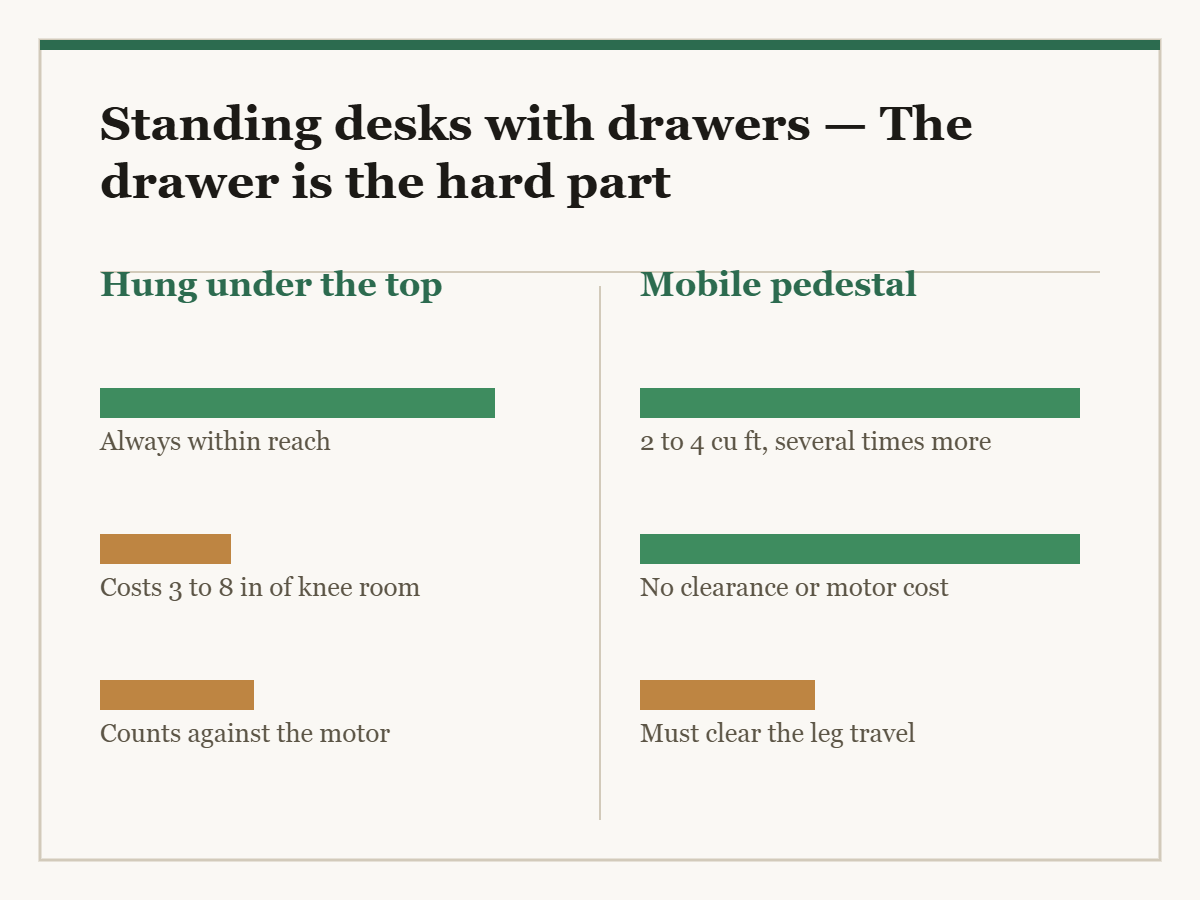
A sit-stand desk travels from about 25 to 50 inches. A drawer hung under the top rides with it, so at the seated end it eats your knee clearance — you want 24 to 26 inches free and a drawer box takes 3 to 5 of it. Three solutions exist: a slim under-mounted drawer (2 to 3 inches deep, the usual compromise), a pedestal on castors that stands on the floor and does not move with the desk (most storage, no clearance cost, but it must sit outside the leg travel), and a side-hung shallow cabinet. Also check the weight capacity: drawers and their contents count against the motor’s rating, which is typically 150 to 350 lb.
The three ways it gets done
A slim under-mounted drawer
A shallow tray fixed to the underside of the top, usually 2 to 3 inches deep and the width of a keyboard. It rides with the desk.
Because it is shallow, it costs you 3 to 4 inches of knee clearance rather than eight. It holds pens, cables, a notebook and a keyboard — genuinely useful, and not where you put files.
A mobile pedestal
A small chest of two or three drawers on castors, standing on the floor beside or under the desk. It does not move with the top, so it costs nothing in clearance.
This is the most storage by a wide margin, and it is what most offices actually use. The constraint is footprint: it must sit where the desk legs are not, because the legs move through the frame’s travel.
A hung side cabinet
A shallow cabinet bolted to one end of the frame, outside the knee zone. Rides with the desk, does not affect clearance, and adds noticeably to the load the motor lifts.
Knee clearance, measured properly
Sitting at a 29-inch desk with a 1-inch top and an 18-inch chair, you want 24 to 26 inches from the floor to the lowest thing under the desk — and taller people want the upper end.
Subtract in this order: top thickness, then the drawer box depth, then the runner hardware, then any crossbar on the frame. A 2-inch tray on 1-inch runners under a 1-inch top on a desk at its 29-inch setting leaves 25. A 5-inch drawer box in the same place leaves 22, and you will knock it.
The other end matters less but is worth a thought: at standing height the drawer is at chest level, which is fine for a pen tray and awkward for anything you need to look into.
| Type | Capacity | Clearance cost | Counts against the motor |
|---|---|---|---|
| Slim under-mounted tray | Pens, cables, keyboard | 3 to 4 in | Yes, but a few pounds |
| Deep under-mounted drawer | A ream of paper | 6 to 8 in | Yes |
| Mobile pedestal on castors | 2 to 4 cu ft | None | No |
| Hung side cabinet | 1 to 2 cu ft | None | Yes, noticeably |
| Shelf on the frame crossbar | Low, shallow | Shin height | Yes |
Weight capacity, which drawers eat into
An electric frame is rated for what it can lift — commonly 150 lb on a single-motor desk and 250 to 350 on a dual-motor one. That figure includes the top.
A solid timber top for a 55-inch desk is 40 to 60 lb on its own. Two monitors and an arm add 25 to 40. A hung drawer unit with files in it can add 30. You can reach a single-motor limit without trying.
Going over does not usually break anything immediately; it makes the desk slow, makes it stall at the top of the travel, and shortens the motor’s life. If you want drawers on the desk, buy the dual-motor frame.
Cables, which a moving desk makes worse
Everything plugged in has to tolerate fifteen inches of travel, several times a day. This is the second most common regret in the category after the drawer clearance.
- A power strip fixed to the underside of the top, so only one cable runs to the wall and everything else moves with the desk.
- Enough slack in that one cable for full travel, with the slack managed so it does not loop into the leg mechanism.
- A grommet through the top rather than cables over the back edge — sizes and fitting are in desk grommets.
A drawer unit hung under the desk usually sits exactly where the cable tray wants to be, so plan the two together rather than in sequence.
The top, and whether you can fit drawers to it yourself
Most frames are sold separately from tops, and the drawer question is often easier to solve after the fact.
A slim under-mounted tray screws into the underside of the top. On a solid timber or butcher-block top that is a five-minute job with short screws and it holds forever. On a particleboard top the screws are into the core, and a drawer that gets pulled hard will eventually strip them — the fix is threaded inserts, the same solution as for legs.
If you are building the desk from parts, mounting a butcher block desktop covers fixing the top down while allowing for seasonal movement, and wooden desk legs covers the fixed-height alternative. Material terms are in what engineered wood actually is.
Two things that are not the desk’s fault
Wobble at standing height. Every column desk is less stable fully extended, because the columns are telescopes. A crossbar between the legs helps more than anything else; so does putting the monitor arm’s clamp at the back rather than the side. Floors are the other half — most perceived wobble is the floor, and levelling feet and glides fix it in minutes.
A drawer that sticks after a few months. Usually the runner rather than the drawer, and usually because the box has racked. The diagnosis order is the same as for any drawer — see when a drawer will not slide and how to measure drawer slides.
Fitting it out
- Under-desk slim drawer Two to three inches deep, the compromise that keeps knee room
- Mobile pedestal The version that costs no clearance and holds several times more
- Under-desk power strip One cable to the wall, everything else travels with the top
- Threaded inserts For fixing a drawer into a particleboard top so it never strips
What to buy


For a fixed-height desk where drawers are simple, see desks with a hutch and drawers. If the room is the constraint rather than the storage, corner desks for small spaces and secretary desks solve it differently. Wobble diagnosis is in how to fix a wobbly desk.
Questions we get asked
Can a standing desk have drawers?
Yes, but a hung drawer travels with the top and eats knee clearance at the seated end. A slim 2 to 3 inch tray is the usual compromise.
How much knee clearance do I need?
Twenty-four to 26 inches from the floor to the lowest thing under the desk, measured at the seated setting.
Is a mobile pedestal better than a fitted drawer?
For volume, yes — several times more, with no clearance cost and no load on the motor. It just needs floor space clear of the leg travel.
Do drawers count against the desk’s weight limit?
Anything fixed to the top does, contents included. On a 150 lb single-motor frame a solid top plus monitors plus a loaded drawer can reach the limit.
Why does my desk wobble when it is raised?
Telescopic columns are always less rigid extended. A crossbar helps, and levelling feet fix the share of it that is actually the floor.
Can I add a drawer to a desk I already own?
Yes. Into a solid or butcher-block top it screws straight on. Into particleboard, use threaded inserts or the screws will strip.