How to Fix a Sagging Bookshelf, and the Span That Caused It
The Wooden Stars is a participant in the Amazon Services LLC Associates Program. We may earn a commission when you buy through links on our site, at no extra cost to you.
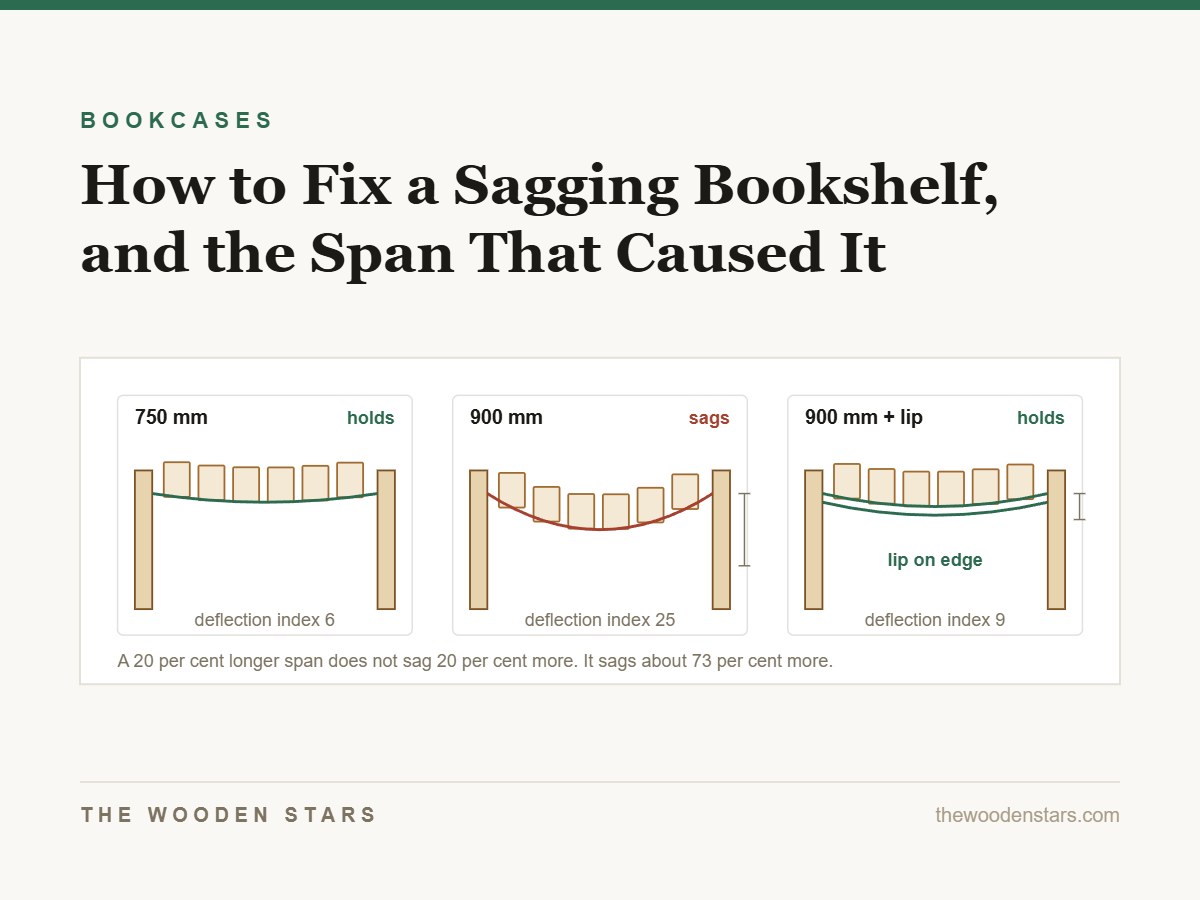
A sagging bookshelf is not a sign of a badly made bookcase. It is a sign of a shelf asked to span further than its material allows, and it is the most predictable failure in furniture because it obeys a simple rule: deflection rises with the cube of the span.
That relationship is worth understanding before you buy anything, because it explains why a shelf that is fine at 750 mm sags at 900 mm. Increasing the span by 20 per cent does not add 20 per cent more sag — it adds about 73 per cent.
Practical span limits for a fully loaded shelf of books, at 19 mm thick: solid hardwood 800 mm, plywood 750 mm, MDF 600 mm, particleboard 450 mm. Beyond those, you need a centre support, a stiffening edge, or a thicker shelf. Adding a 19 mm hardwood lip to the front edge of a sagging shelf is the cheapest effective fix and roughly halves the deflection.
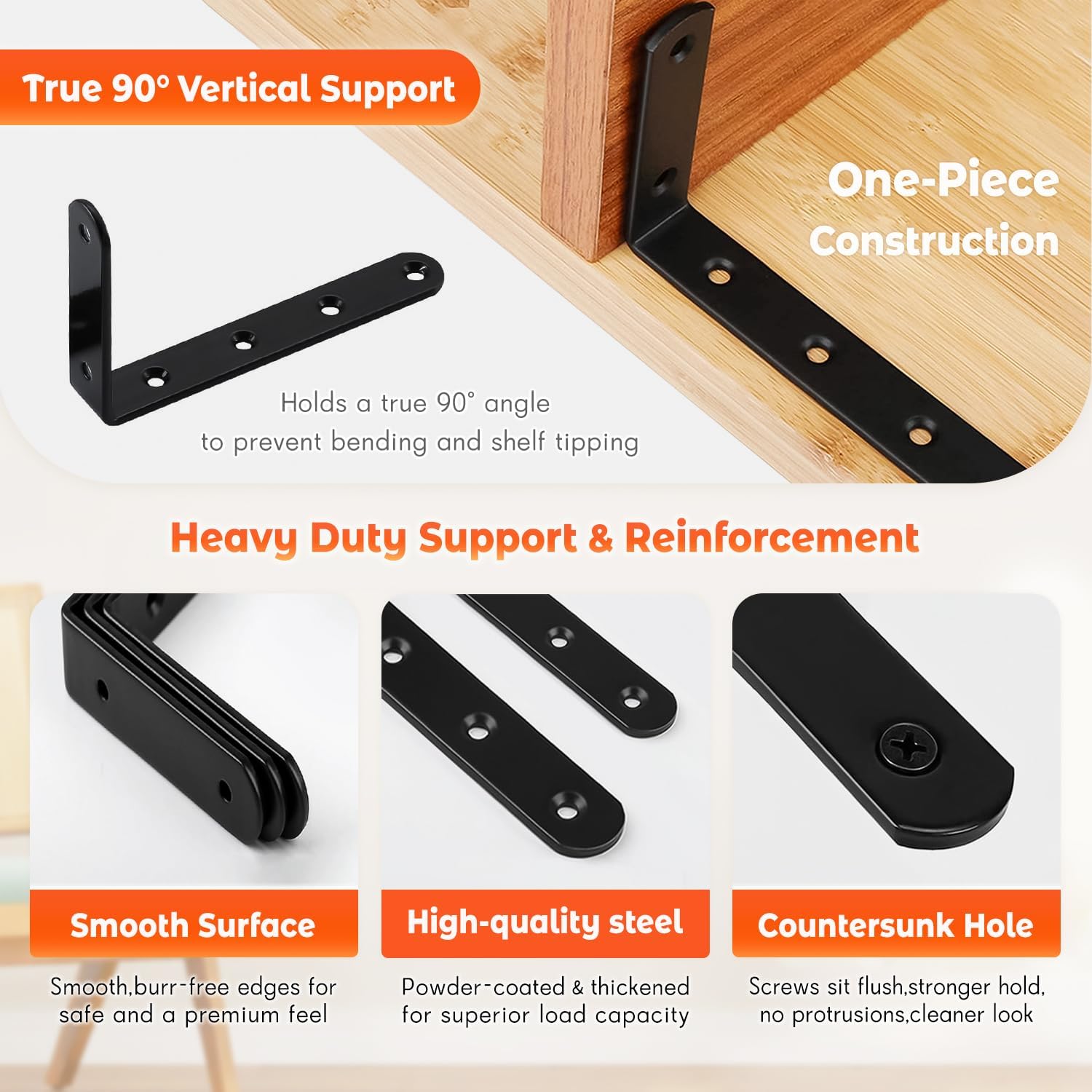
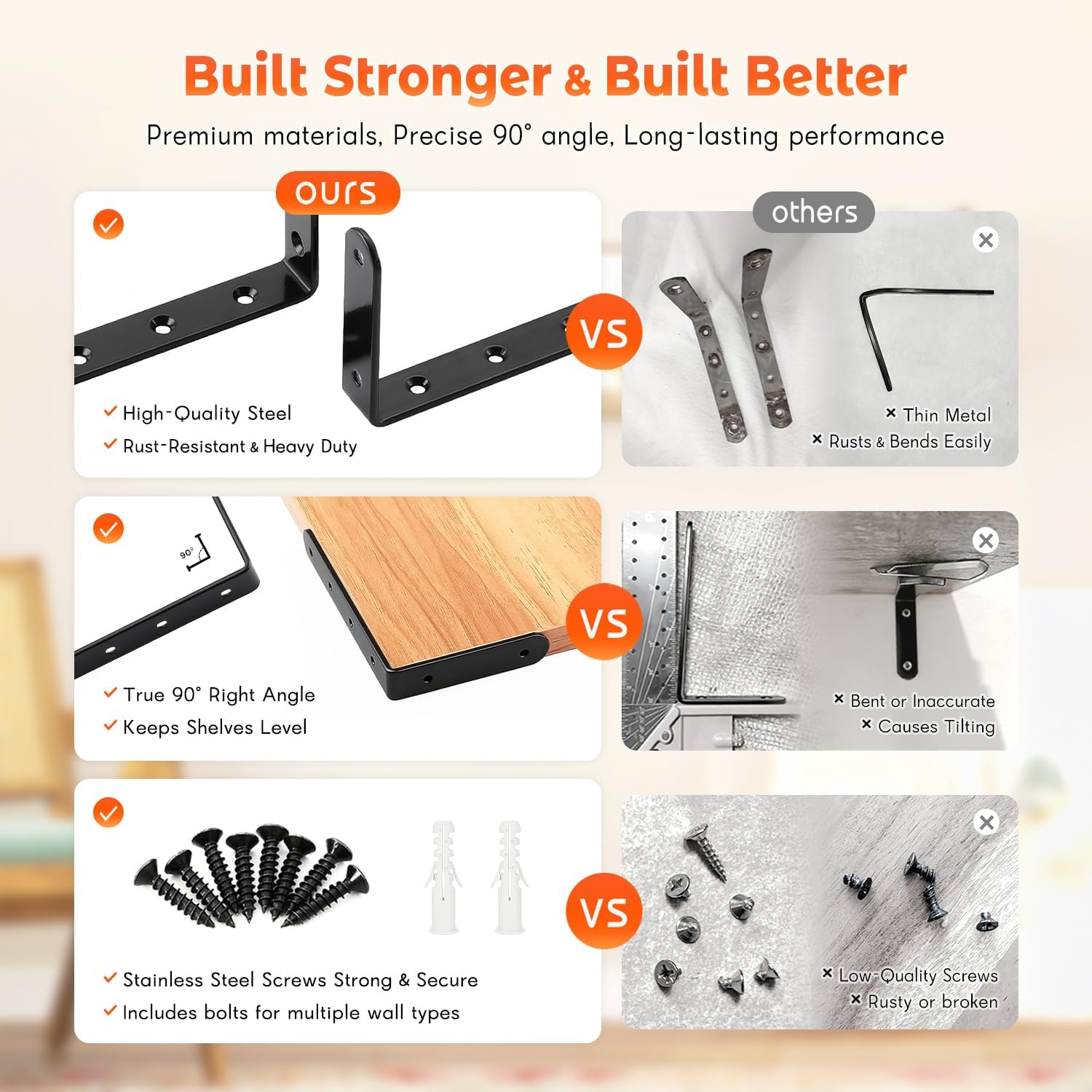
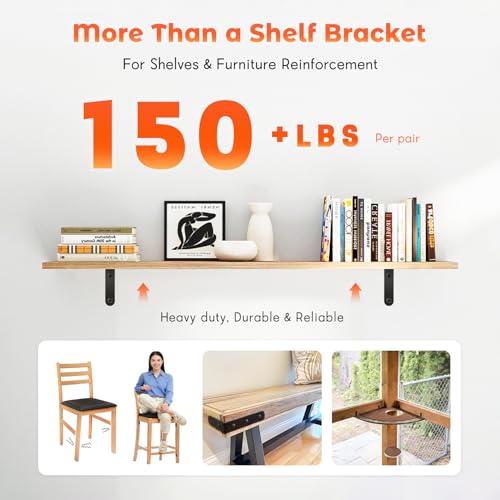
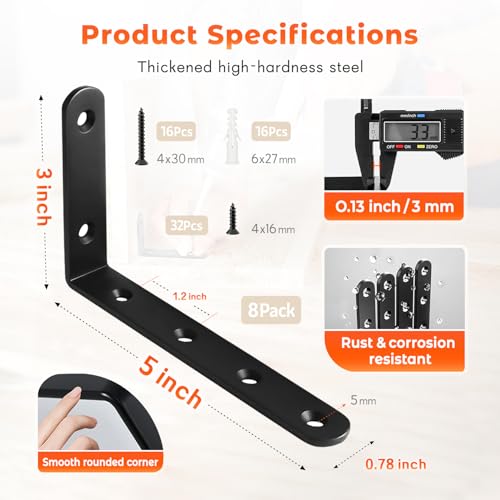
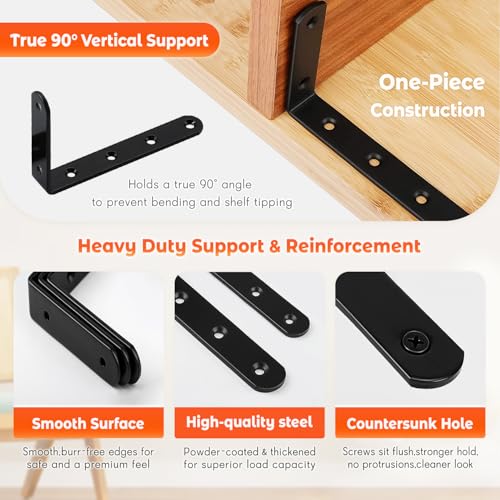
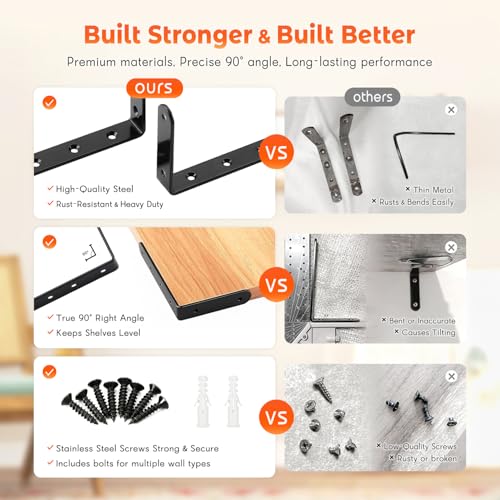
Start here: an eight-pack of heavy L brackets is the fix that needs no woodworking and holds a shelf that has already taken a set.

Prime Shelf Bracket 8 Pack 5" Lx3 H 5mm Thick Heavy Duty Black L Brackets







The span table
| Material | 19 mm thick | 25 mm thick | With a 19 mm front lip |
|---|---|---|---|
| Solid hardwood (oak, maple) | 800 mm | 1,000 mm | 1,100 mm |
| Solid softwood (pine) | 700 mm | 900 mm | 950 mm |
| Birch plywood | 750 mm | 950 mm | 1,050 mm |
| MDF | 600 mm | 750 mm | 900 mm |
| Particleboard / melamine | 450 mm | 600 mm | 750 mm |
| Glass (10 mm) | 700 mm | — | — |
These are working limits, not failure points — a shelf will hold more than this without breaking, it will simply visibly sag. The convention in the trade is to allow deflection of no more than about 1/180 of the span, which is roughly the point at which the eye starts to notice.
Two things multiply the load in ways people underestimate:
- Books are heavy. A metre of hardbacks is 20 to 30 kg. A metre of paperbacks is 15 to 20. A metre of vinyl records is 45 to 60 kg, which is why record shelves sag first.
- Sag is permanent. Wood and especially MDF take a set under sustained load — a phenomenon called creep. A shelf that has been loaded for five years will not come back flat when you empty it.
Diagnose before you fix
- Empty the shelf and look at it off the bookcase. If it is still curved, it has taken a permanent set and it will need reinforcing or replacing, not just supporting.
- Measure the span between supports, not the width of the bookcase.
- Identify the material. Look at the edge: solid wood shows continuous grain, plywood shows layers, MDF shows a fine uniform brown core, particleboard shows visible chips. This changes the answer more than anything else.
- Check the supports themselves. Sometimes the shelf is fine and the pins are pulling out, or the pin holes have crushed.
- Check whether the case has racked. A bookcase that has gone out of square lets shelves twist as well as bend — and that is a back-panel problem, the same one that causes binding drawers.
The four fixes, cheapest first
1. A front lip — the best value by a distance
Glue and screw a strip of hardwood, 19 to 25 mm deep, along the front edge of the shelf, on edge. You have just turned a flat board into an L-shaped beam, and the depth of a beam is what resists bending — the same cube relationship, now working for you. A 19 mm lip roughly halves deflection; a 40 mm lip does far better than that.
It looks deliberate, it costs almost nothing, and it is the standard trick in built-in shelving. On an existing sagging shelf, clamp the shelf flat (or slightly over-flat) while the glue cures.
2. A centre support
Halving the span reduces deflection to about one eighth. Nothing else on this list comes close. A vertical divider, a single centre bracket, or a steel pin under the middle — all of them work, and all of them cost you the visual continuity of the shelf.
On a wide bookcase, a vertical divider is the honest answer. It is what the case should have had.
3. A stiffer or thicker shelf
Going from 19 to 25 mm reduces deflection by roughly half, because thickness enters the same cubic relationship. Replacing MDF with birch plywood at the same thickness is a substantial improvement, and replacing it with solid hardwood more so.
4. Brackets underneath
Steel L brackets under the shelf at the back wall, or a full-length steel bar let into a groove in the underside. Visually intrusive but very effective, and the only option when the shelf cannot be removed. A steel bar in a routed groove is invisible and stiffens dramatically.
When the supports are the problem
Sometimes the shelf is sound and the shelf pins are failing. Symptoms and fixes:
- Pins bending or pulling out. The pins are under-sized for the load. Move up from 5 mm to 6.35 mm (1/4 in) if the holes allow, or switch to a pin with a larger bearing surface — a shelf-support with a small L-shaped shoulder distributes load far better than a plain peg.
- Pin holes crushed oval in MDF or particleboard. The board has failed locally. Fit a metal sleeve, or move to a different hole and reinforce with a full-length cleat instead of pins.
- Only two pins per shelf. Four is the minimum — one at each corner. Two makes the shelf a see-saw.
Shelf pin sizes and how to tell which your bookcase uses are covered in our guide to shelf pins and supports, which matters because 5 mm and 1/4 in look identical and are not.
What this repair actually takes
- Heavy-duty L shelf brackets, 5 in Under-shelf support at the back wall On Amazon →
- Shelf brackets, 7 in heavy duty For deeper shelves needing real support On Amazon →
- Shelf pins kit, 4 styles When the pins, not the shelf, are giving way On Amazon →
- Hardwood strip, 19 x 40 mm The front lip — the best value fix on this list
- Clamps and PVA glue For gluing the lip on while the shelf is held flat
What to buy
Brackets if the shelf cannot come out; a front lip if it can, since that halves the sag for the price of one hardwood strip.


Shelf depth: the number people get wrong when buying
Depth does not affect sag much — span does — but it decides whether the bookcase is useful at all.
| Contents | Depth needed |
|---|---|
| Paperbacks | 180 mm |
| Hardbacks, general fiction | 230 mm |
| Textbooks and reference | 280 mm |
| Art and photography books | 330 mm+ |
| LP records | 330 mm |
| Box files | 340 mm |
| Display / objects | 250 mm and up |
A 200 mm deep bookcase sold as a bookcase will not take hardbacks, and that is the single most common disappointment in this category. Measure your own tallest and deepest books before buying anything.
Questions we get asked
Will a sagged shelf straighten out if I empty it?
Partly, and only if the load was recent. Wood and MDF creep under sustained load and take a permanent set — a shelf loaded for years keeps most of its curve. You can sometimes reverse a mild set by clamping it flat, or slightly beyond flat, for a few weeks, but the reliable answer is to reinforce or replace.
Can I turn a sagged shelf upside down?
It works, once, and it is a genuinely useful trick — the shelf will sag back the other way over time, but you get years out of it. Check that the shelf is symmetrical first: many have a finished face and an unfinished one, and some have a front edge banding that will now be at the back.
Is solid wood always better than plywood for shelves?
Not always. Good birch plywood is close to hardwood in stiffness, does not move seasonally, and does not cup — for long spans in a humid room it can be the better engineering choice. Solid wood wins on looks and on the ability to take a machined edge. Both comfortably beat MDF and particleboard. There is more on the comparison on our wood types hub.
How do I stop a tall bookcase leaning forward?
Two things, both necessary. Level it — a bookcase on a floor sloping toward the room leans, and levelling feet fix it. And strap it to the wall: a loaded tall bookcase is a serious tipping hazard, and the fixing method matters. Our guide to anti-tip kits applies directly, including what to use in plasterboard.
What about floating shelves?
Same span rules, harder support conditions — a floating shelf is a cantilever, so all the load goes into the wall fixings and the concealed bracket. The failure is usually at the wall, not in the shelf. Keep spans short, fix into studs, and treat the manufacturer’s load rating as an absolute ceiling rather than a target.