Stackable vs fixed dining chairs — Storing the spares
The Wooden Stars is a participant in the Amazon Services LLC Associates Program. We may earn a commission when you buy through links on our site, at no extra cost to you.
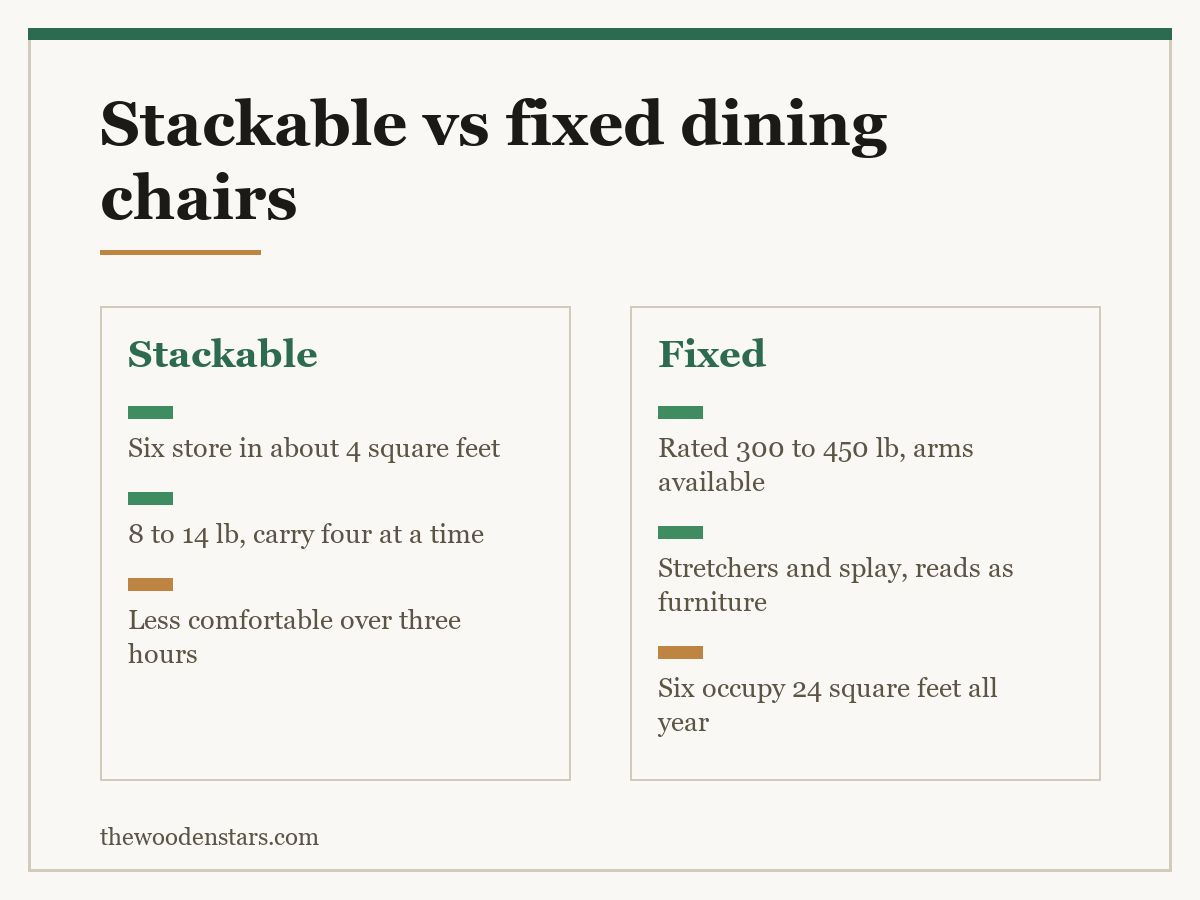
Stackable vs fixed dining chairs is a trade of everyday comfort against stored floor space — six stackable chairs occupy about 4 square feet in a corner, and six fixed ones occupy about 24.
The question is how often you actually need all six.
A stackable chair nests four to eight high in a footprint of roughly 20 × 24 inches, which is why a stack of six lives in a cupboard. It buys that by being armless, straight-legged and lighter — typically 8 to 14 lb and rated 250 to 300 lb. A fixed chair has splayed legs, stretchers and often arms, weighs 12 to 22 lb and is rated 300 to 450 lb. Stackables suit spare seating and small rooms. Fixed chairs suit the four you use every day. The usual right answer is both: four fixed, four stacked in a cupboard.
Stackable vs fixed dining chairs: what stacking costs
A chair only stacks if its geometry allows one to drop into the next. That rules out three things at once.
- Arms — they collide. Almost no stacking chair has them.
- Splayed legs — the stance must be near-vertical, which is structurally the weaker arrangement.
- Full stretchers — an H-frame blocks the nest, so most stackables use corner blocks alone.
Those three are exactly the features that make a chair strong and comfortable, which is why the ratings differ. A stackable at 250 to 300 lb against a fixed chair at 300 to 450 is not a manufacturing shortcut; it is the geometry of nesting — the underlying construction argument is in how much weight a dining chair can hold.

| Measure | Stackable | Fixed |
|---|---|---|
| Weight | 8 to 14 lb | 12 to 22 lb |
| Rating | 250 to 300 lb | 300 to 450 lb |
| Stack height | 4 to 8 high | Does not stack |
| Stored footprint, six chairs | About 4 sq ft | About 24 sq ft |
| Arms | Almost never | Often available |
| Stretchers | Rare | Usual |
| Comfort for a long dinner | Adequate | Better |
When stackables are the right buy
Spare seating for guests. Four chairs used twice a year should not occupy a corner for the other 363 days. This is the case where stackables are obviously correct and no trade-off is being made.
Small rooms where the table folds or drops. A drop-leaf table plus stacked chairs turns a dining area back into a room, which is the entire point of having one.
Rooms that get rearranged. Light, armless chairs that carry four at a time are simply easier to live with.
Outdoor or covered use, where chairs come in for winter. Aluminium and moulded polypropylene stackables are built for exactly this — folding against stacking patio chairs.
What you give up honestly: a stackable is fine for an hour and less good for three. No arms, less padding, a straighter back and a lighter frame all point the same way.
When fixed chairs earn their floor space
The chairs you sit in every day. A family eating three meals a day at the same four seats should buy four good fixed chairs. Stacking capability is worth nothing to a chair that never gets stacked.
Anywhere weight matters. The 250 to 300 lb ratings on light stackables are static figures, and dropping into a chair applies two to three times body weight momentarily — so the working margin is thinner than it reads.
Where you want arms. Head chairs essentially never stack, which is discussed in head chairs against side chairs.
Where the chairs are part of the room. A fixed timber chair with a stretcher and a shaped back is furniture. A stackable is equipment, and it looks like equipment.
The mixed set, which is what most people should do
Buy four fixed chairs for the seats used daily, and four stackables in a cupboard for the twice-a-year table of eight.
Making that look deliberate rather than improvised:
- Match the seat height. Everything must be 18 inches, or the guest chairs feel wrong — how tall a dining chair should be.
- Match the tone, not the model. Two timber tones at one table looks intentional; two whites that are slightly different does not.
- Put the stackables in the middle of the sides, where they are least visible, and the fixed chairs at the ends.
- Check the spacing still works at 24-inch centres — how much space between dining chairs.
- Measure the cupboard. Six stacked chairs is roughly 20 × 24 inches on the floor and 4 to 5 feet tall, which is taller than people expect.
The alternative for the everyday seats is a bench, which pushes fully under the table and stores nothing because it never leaves — dining bench against chairs.
One thing stacking does that nobody warns you about: chairs mark each other. Every time one nests into the next, the foot of the upper chair lands on the seat or the frame rail of the lower one, and after a couple of years of that the contact points are visibly worn. Felt pads on the feet fix it for a few cents a chair, and they are worth fitting before the first stack rather than after. Cloth between the seats does the same job on upholstered stackables.
Living with a stack
- Felt furniture pads Stacked chairs scuff each other; pads on the feet stop it
- Furniture dolly Moving a stack of six by hand is how backs get hurt
- Chair stack cover Keeps dust off chairs stored for months at a time
- Furniture levellers Vertical legs show a floor’s unevenness more than splayed ones
What to buy


For daily-use chairs, see how much weight a dining chair can hold and upholstered against wood dining chairs.
Questions we get asked
Are stackable dining chairs less sturdy?
Generally yes — 250 to 300 lb against 300 to 450. Nesting requires vertical legs and no stretchers, which are the strong features.
How many chairs stack safely?
Four to eight, depending on the model. Past that the stack gets top-heavy before it gets structurally unsafe.
How much space does a stack of six need?
About 20 × 24 inches on the floor and 4 to 5 feet of height.
Can stacking chairs have arms?
Very rarely. Arms collide when nesting, so almost all stackables are armless.
Should I buy a whole set of stackables?
Only if the room needs clearing regularly. For the four seats used daily, fixed chairs are more comfortable.
Do mixed sets look odd?
Not if the seat heights match at 18 inches and the tones are clearly different rather than nearly the same.