Head chairs vs side chairs — Where arms belong
The Wooden Stars is a participant in the Amazon Services LLC Associates Program. We may earn a commission when you buy through links on our site, at no extra cost to you.
Head chairs vs side chairs is the decision about whether two of your six chairs should have arms — and it costs you 4 to 6 inches of table width at each end if you say yes.
Most dining sets sell you two of one and four of the other without explaining why.
A head chair (also called a carver or host chair) sits at the ends of a rectangular table, usually has arms, and is 22 to 26 inches wide. A side chair is armless, 16 to 20 inches wide, and lines the long sides. The reason head chairs have arms is that nothing is beside you at the end of a table, so an arm costs no neighbouring space. The reason side chairs do not is that arms turn 24-inch spacing into 26 to 28, which loses you a seat on a 72-inch table. Head chairs also tend to be 1 to 2 inches taller in the back, which is deliberate.
Head chairs vs side chairs: the differences that matter
- Arms: usually yes on a head chair, almost never on a side chair.
- Width: 22 to 26 inches against 16 to 20.
- Back height: often 1 to 2 inches taller on the head chair.
- Seat: frequently a little deeper and better padded, because the person sitting there stays longest.
- Price: a head chair typically costs 30 to 60% more than the matching side chair.
Everything else — seat height at 18 inches, the frame construction, the finish — is normally identical within a set, which is why the two read as a family rather than as different chairs.
| Measure | Head chair | Side chair |
|---|---|---|
| Width | 22 to 26 in | 16 to 20 in |
| Arms | Usually | Rarely |
| Back height | 1 to 2 in taller | Standard |
| Seat height | 18 in | 18 in |
| Centres needed | 26 to 28 in | 24 in |
| Typical price | 30 to 60% more | Baseline |
| Tucks under an apron | Often not | Yes |
Why the ends get the arms
It is a spacing argument before it is a status one.
At the end of a rectangular table there is no chair beside you. An arm therefore costs nothing — it projects into empty floor. You get somewhere to rest your forearms between courses at no cost to anyone else.
Along the side, every inch of arm eats into the neighbour’s gap. Armless chairs plan at 24-inch centres; armchairs need 26 to 28. On a 72-inch table side that is the difference between three comfortable places and two — the arithmetic is in how much space between dining chairs.
There is a second reason, and it is the apron. Arms sit 24 to 27 inches high, and a table apron drops the clearance to 25 or 26, so armchairs frequently will not tuck in — which matters far more along a walkway than at the end of a table. See how far a dining chair should be from the table and dining chair with arms against without.
The taller back, and whether it is worth paying for
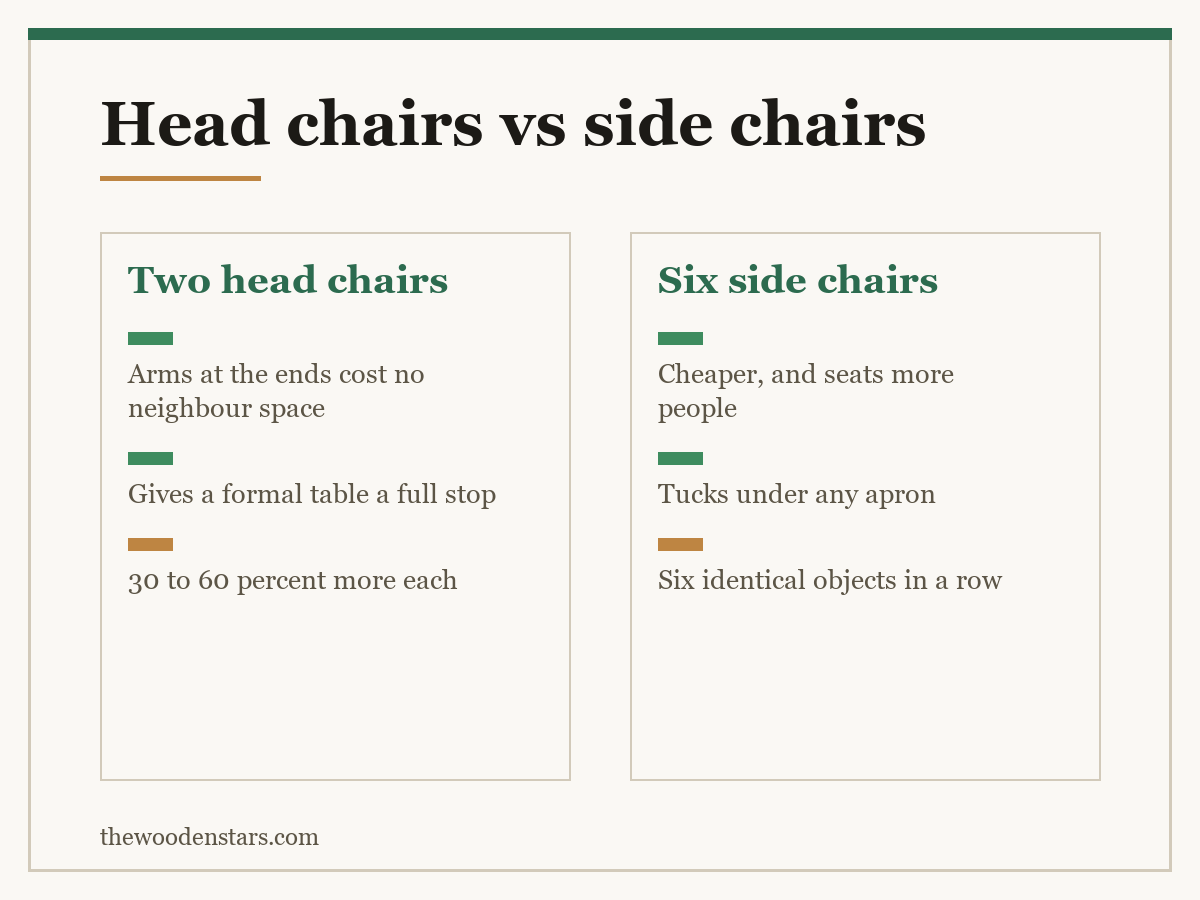
Head chairs are often built 1 to 2 inches taller in the back. This is a visual device: it gives the ends of the table a full stop, so a set of six reads as composed rather than as six identical objects in a row.
Whether that is worth a 30 to 60% premium per chair depends on the room.
Worth it in a dining room you eat in formally, where the table is the room’s centrepiece and it is usually seen fully set.
Not worth it in a kitchen-diner where the table is pushed against a wall, because then one end has no chair at all and the other is a walkway.
The honest alternative many people land on: buy six side chairs and skip head chairs entirely. You lose the visual full stop, you gain two more usable seats when everyone visits, and you save real money. A set of six matching armless chairs is not a compromise — it is what most well-used family tables actually are.
Buying them
- Measure the end of your table first. A 36-inch-wide table takes a 26-inch head chair comfortably; a 30-inch one does not.
- Check arm height against the apron if you want the head chairs to tuck in. Under 25 inches usually clears.
- Count the usable ends. Against a wall, buy one head chair, not two.
- Buy them together. Adding head chairs to an existing set two years later rarely matches, because finishes drift between production runs.
- Consider deliberate mismatch instead. Two genuinely different chairs at the ends — a different wood, an upholstered pair — does the same visual job without the set premium.
On a round table the whole question disappears: there are no ends, so everybody gets the same chair. Seat counts for round tables are in how many chairs fit a round table.
For the rest of the sizing, see how wide a dining chair is, how tall a dining chair should be and how deep a dining chair seat is.
Before you commit
- Tape measure Table end width, and arm height against the apron underside
- Painter’s tape Mark a 26-inch head chair footprint at each end and walk past it
- Felt furniture pads Head chairs are heavier and mark floors faster
- Furniture levellers An armchair that rocks racks its arm joints first
What to buy


For the arms question in general, see dining chair with arms against without. For spacing, how much space between dining chairs.
Questions we get asked
What is the difference between a head chair and a side chair?
A head chair has arms and is 22 to 26 inches wide; a side chair is armless at 16 to 20. Head chairs go at the ends.
Why do only the end chairs have arms?
Because nothing is beside you at the end, so an arm costs no space. Along the sides, arms push centres from 24 inches to 26 or 28.
Do I need head chairs at all?
No. Six matching side chairs is a perfectly normal set, seats more people and costs less.
Are head chairs taller?
Usually 1 to 2 inches taller in the back. The seat height is the same 18 inches.
Will a head chair tuck under my table?
Often not. Arm height is 24 to 27 inches and an apron drops the clearance to 25 or 26.
Can I add head chairs to a set later?
You can, but finishes drift between production runs, so they rarely match exactly.