Media consoles with storage — Ventilation, cables and shelf height
The Wooden Stars is a participant in the Amazon Services LLC Associates Program. We may earn a commission when you buy through links on our site, at no extra cost to you.
A media console has to do something no other cabinet does: hold electronics that get hot, hide cables that need to reach a wall socket, and put a screen at the right height for someone lying on a sofa. Most of them are designed for the first job only.
The result is a category where the attractive cabinets are often the ones that cook the equipment and make the cables impossible.
Two numbers decide a media console. Height: the middle of the screen should sit at eye level when seated, which is 40 to 45 inches from the floor — so with a TV whose centre is about 15 inches above its feet, the console wants to be 24 to 30 inches tall. Length: at least as wide as the screen, ideally 6 inches wider each side. Then check ventilation — closed compartments holding an amplifier need a rear cut-out or a vented back, because an AV receiver puts out real heat — and internal shelf height, which needs 7 to 9 inches for a receiver and only 3 for a streaming box.
Height, worked from the sofa
The comfortable viewing position puts the centre of the screen at roughly eye level, or slightly below. Seated on a sofa with an 18-inch seat, eye level is about 40 to 45 inches from the floor.
A television standing on its own feet has its centre about 13 to 17 inches above the surface it stands on, depending on size. So:
- A 55-inch TV has its centre about 14 inches up. Console at 26 to 30 inches.
- A 65-inch TV has its centre about 16 inches up. Console at 24 to 28.
- A 75-inch TV has its centre about 19 inches up. Console at 21 to 26.
The pattern is the one people get wrong: the bigger the television, the lower the console. A 75-inch screen on a 32-inch sideboard puts the centre at 51 inches, and everybody watches with their chin up.
Ventilation, the thing that is genuinely a fault
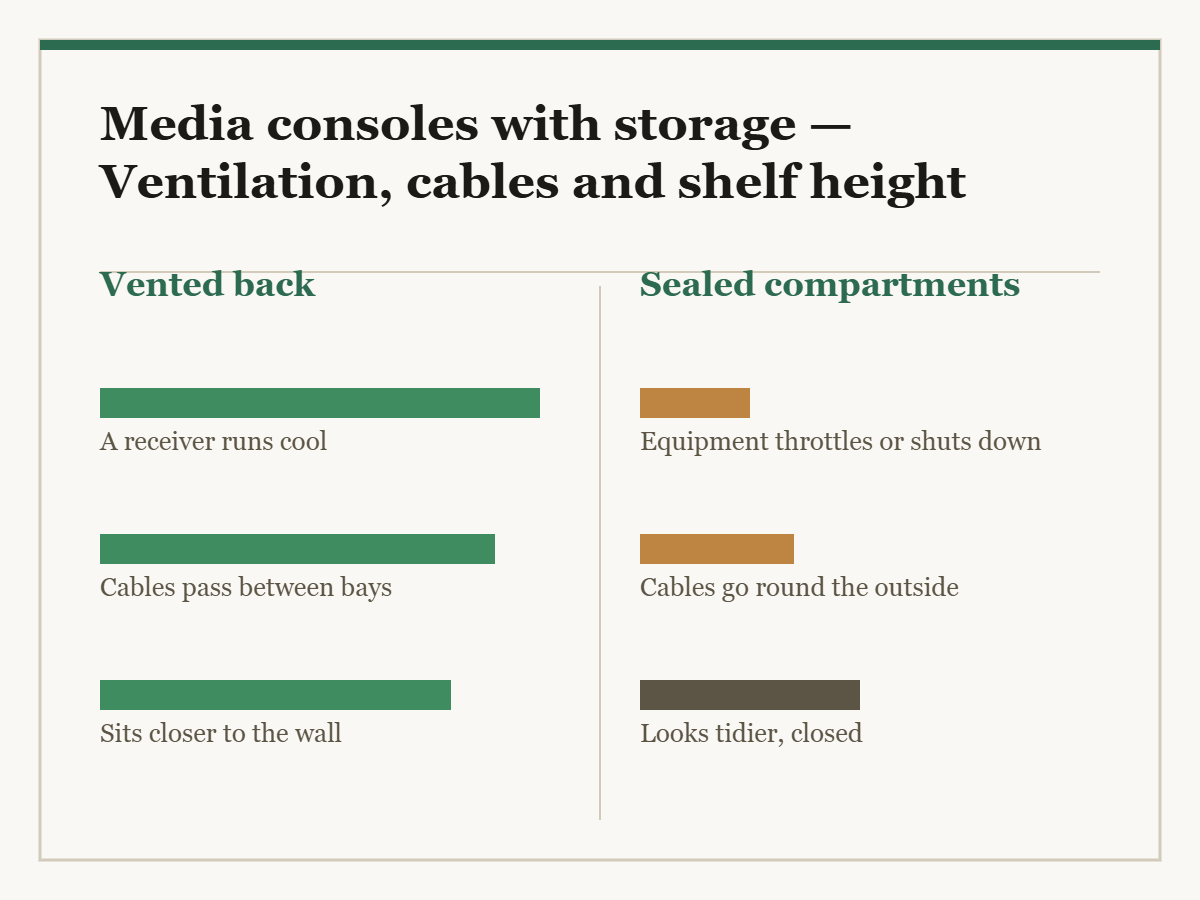
An AV receiver dissipates 50 to 200 watts as heat. A games console is 100 to 200 under load. Put either in a closed compartment with a solid back and the temperature climbs until the device throttles itself or shuts down.
What to look for, in order:
- A cut-out or open back on every compartment that will hold powered equipment. This is the one that matters, and it is visible in the listing photographs if you look at the rear view.
- Glass doors that open or lift rather than fixed panels, if the doors are glass at all.
- At least 2 inches of clear air above a receiver, which is why internal shelf height matters as much as shelf depth.
- Room at the sides. A receiver wedged into a bay exactly its width has nowhere to shed heat.
A console with sealed compartments is fine for a soundbar, a streaming box and a games console that is rarely on. It is not fine for a receiver.
| Measure | Range | What decides it |
|---|---|---|
| Height | 20 to 32 in | Screen centre at 40 to 45 in seated |
| Length | 48 to 80 in | Screen width plus 6 in each side |
| Depth | 15 to 20 in | TV foot spread, plus cable room behind |
| Internal shelf height | 3 to 10 in | A receiver needs 7 to 9 plus air |
| Cable cut-out | Required | Every powered compartment |
| Weight rating on top | 80 to 150 lb | A 75-inch TV is 70 to 90 lb |
Length and depth
A console narrower than the screen looks wrong and, more practically, gives the TV feet nowhere to land. Modern televisions often have feet at the extreme corners rather than a central pedestal, and those feet can be within 2 inches of the screen’s full width.
So check two things: the console is at least as long as the screen, and the foot spread fits on the top. A 65-inch TV with corner feet needs about 56 inches of usable top, and a console with a raised lip or a recessed top may have less than it appears.
Depth of 15 to 20 inches suits the feet and leaves room behind for cables. Shallower than 15 and a large TV’s feet overhang.
Cables, which is where the design shows
Every device in the cabinet needs power and a signal cable to the television above it. That is six to twelve cables converging on one small area.
A cut-out in the back panel of each bay lets cables pass between compartments without going round the outside.
A gap at the back rather than a flush panel lets the console stand closer to the wall, because the cables live in the cabinet rather than behind it.
A power strip fixed inside means one cable to the wall. This is worth doing on the day it is assembled rather than after everything is connected.
If the console has no cable route, one can be cut — grommet sizes and the method are in desk grommets, which is the same fitting.
What goes in the drawers
Drawers on a media console are usually 4 to 7 inches inside — deeper than a coffee table drawer, shallower than a sideboard’s.
They suit remote controls, game controllers and cases, spare cables, and the small boxes that come with every device. What they do not suit is a games console itself, which needs air and a signal path — that belongs on an open or vented shelf.
Runners matter here because these drawers are wide: side-mounted ball-bearing runners keep a 30-inch drawer square, and bottom rollers let it tilt. Replacing them is in how to measure drawer slides.
What it is made of
The top carries a television that can weigh 70 to 90 lb across a long span, and it sits in a room where the surface gets used.
Solid timber or plywood carries that without creep. Particleboard under a 65-inch screen on a 60-inch span, over years, bows — the same slow permanent deflection described in how to fix a sagging bookshelf. Check the stated top weight rating and compare it against your screen.
Material terms are in what engineered wood actually is. For the naming overlap with sideboards and credenzas, see credenza against console table and credenza against sideboard against buffet.
Setting it up
- Cable grommet Cut a route through a back panel that has none
- Power strip One cable to the wall instead of eight
- Anti-tip strap A television on a console is the classic tipping accident
- Cable ties Twelve cables converging on one bay needs managing once, properly
What to buy


In a small room, see TV stands for small spaces. For the dining-room version of the same cabinet, sideboards with storage and buffets with drawers. Behind the sofa, console tables with drawers.
Questions we get asked
How tall should a media console be?
Whatever puts the screen centre at 40 to 45 inches when you are seated — usually 24 to 30 inches, and lower for a bigger screen.
How long should it be?
At least as long as the television, ideally 6 inches wider each side. Check the foot spread fits the usable top.
Does the cabinet need ventilation?
If anything powered lives inside, yes. An AV receiver in a sealed compartment will throttle or shut down.
How much internal height do I need?
Seven to 9 inches for a receiver plus 2 of clear air above it. A streaming box needs 3.
Can I put a games console in a drawer?
No. It needs air and a signal path. Drawers are for controllers, cables and cases.
Will the top take a 65-inch television?
Check the stated weight rating — a 65-inch screen is 50 to 70 lb and a 75-inch is 70 to 90 — and prefer solid timber or plywood over particleboard on a long span.