Secretary desk vs writing desk — The front decides
The Wooden Stars is a participant in the Amazon Services LLC Associates Program. We may earn a commission when you buy through links on our site, at no extra cost to you.
Secretary desk vs writing desk comes down to one feature: the secretary has a hinged front that closes over the work surface, and the writing desk does not.
Everything else — the depth, the drawers, the price, the reason you would choose one — follows from that fall-front.
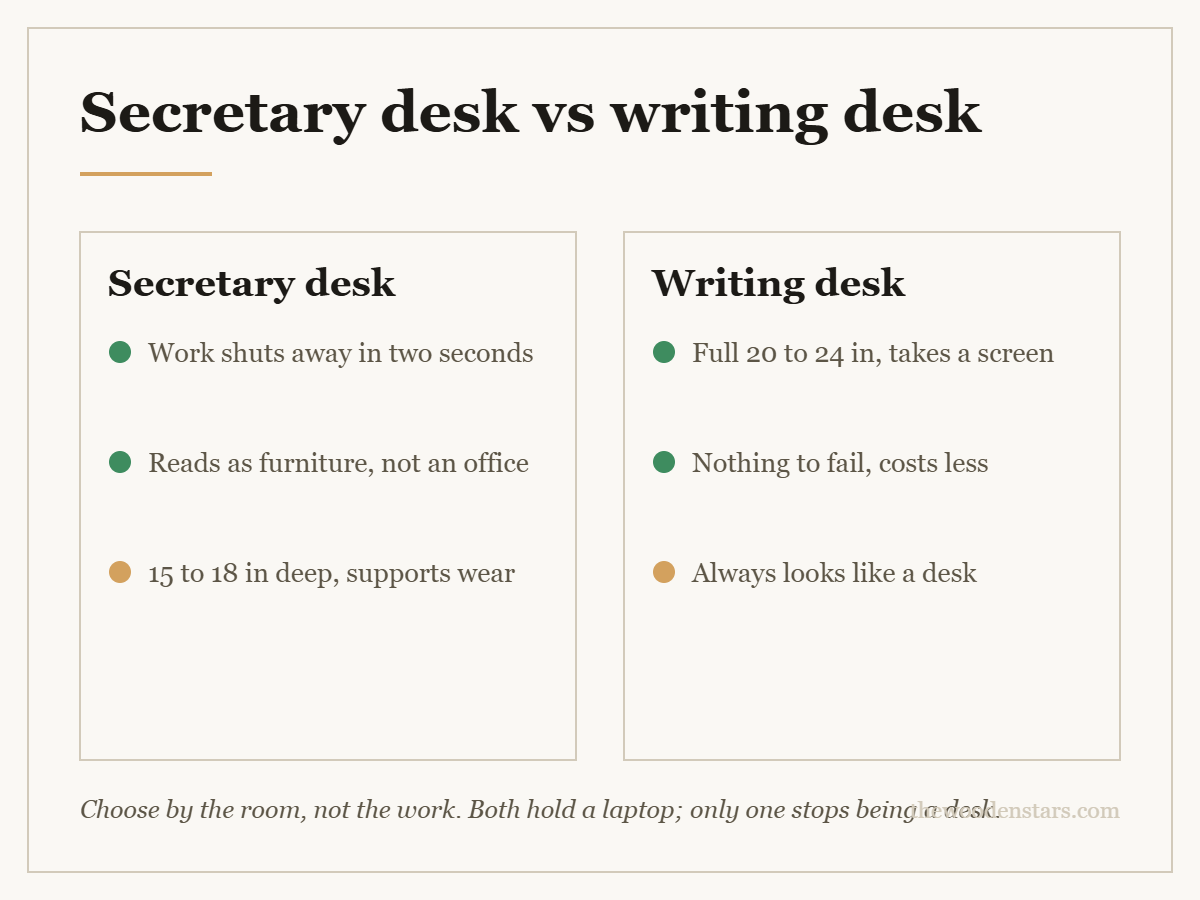
A writing desk is an open table with a top at 29 to 30 inches, usually 20 to 24 inches deep, with one or two shallow drawers. A secretary desk adds a hinged fall-front that drops down to become the work surface and closes to hide everything behind it, plus pigeonholes and often a cabinet or drawers below. The secretary is deeper closed than open is usable — the writing area is typically only 15 to 18 inches — and its supports are the part that fails. Buy the secretary if the desk lives in a room that is not an office.
Secretary desk vs writing desk: what the fall-front changes
A writing desk is a table. You sit at it, there is nothing above the surface, and the whole top is usable.
A secretary desk is a cabinet with a lid. The lid drops on hinges, is held by two supports, and becomes the desk. Above it sit pigeonholes and small drawers; below it, a chest or cupboard.
So:
- Writing desk: more usable surface, nothing to shut, always looks like a desk.
- Secretary desk: less surface, but the work disappears in two seconds and the piece reads as furniture.
That second point is the whole purchase. A secretary exists so a desk can live in a sitting room, a bedroom or a hallway without the room looking like an office. Small-space detail is in secretary desks for small spaces.
| Measure | Secretary desk | Writing desk |
|---|---|---|
| Work surface depth | 15 to 18 in | 20 to 24 in |
| Closed depth | 16 to 20 in | Same as open |
| Height | 42 to 84 in overall | 29 to 30 in |
| Storage | Pigeonholes plus a cabinet | One or two shallow drawers |
| Shuts away | Yes, in two seconds | No |
| Fits a laptop | Yes | Yes |
| Fits two monitors | No | Yes |
| Tipping risk | Real when the front is down | None |
The usable depth, which is the honest limitation
A secretary’s open front gives 15 to 18 inches between the hinge and the front edge. That is enough for a laptop and a notebook, and it is not enough for a monitor at a comfortable viewing distance.
A screen wants 20 to 30 inches from your eyes. On a secretary the pigeonhole wall sits right behind the surface, so the monitor ends up too close or does not fit. Some designs solve this by having a shallow gallery instead of a full pigeonhole stack — worth looking for if a screen is involved.
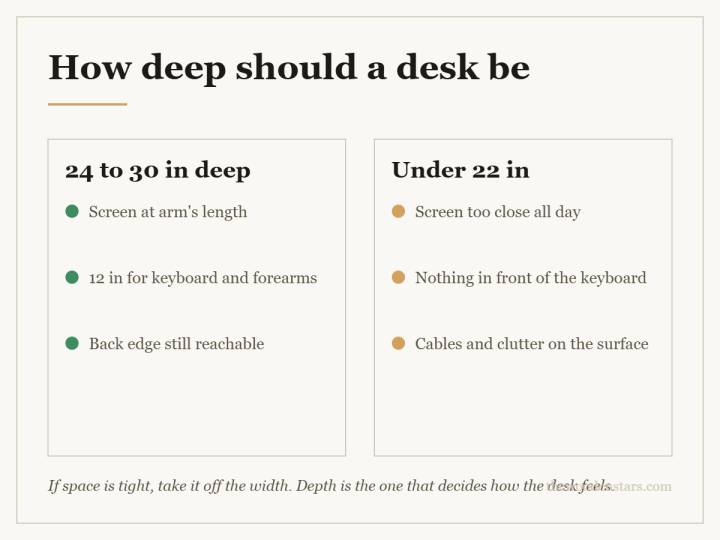
A writing desk at 24 inches deep clears a laptop and a single monitor comfortably. The full reasoning is in how deep a desk should be.
The supports, which are what actually fail
The fall-front is a panel held horizontal by two supports — either wooden lopers that pull out from the carcass, or metal quadrant stays.
This joint takes the whole load of the desk plus your forearms, repeatedly, on a lever.
- Wooden lopers are the traditional answer and the better one. They spread load into the carcass sides and can be re-waxed when they stiffen.
- Metal stays are cheaper and concentrate the load at two screw points. On a particleboard carcass those screws pull out.
- Check the front is flush and level when open. A front that sits a few degrees below horizontal is a support already sagging.
Material matters more here than on a writing desk: what engineered wood actually is.
Height, and the number people get wrong
A writing desk top sits at 29 to 30 inches, which suits a chair seat at 17 to 19.
A secretary’s fall-front is often lower — 28 to 30 — because it has to clear the drawer or cabinet beneath it. Check it, because a surface at 27 inches makes you stoop, and unlike a table you cannot pack the legs up.
And check the knee clearance: a secretary with a deep drawer under the front can leave under 24 inches of thigh room, which is the figure that decides whether you can actually sit at it. Twenty-five to 27 inches is comfortable.
Tipping, which only one of them does
A tall secretary with its front down has a loaded lever sticking out at desk height. Lean on it and the whole cabinet wants to come forward.
Anything over about 50 inches tall should be strapped to a stud. It is the same reasoning as anti-tip kits for dressers, and it matters more here because the lever is longer.
A writing desk has no equivalent failure. Its weakness is racking — a four-legged table with no stretcher wobbles diagonally, which is fixed with a back panel, a stretcher or corner blocks. See how to fix a wobbly desk and wooden desk legs.
For either desk
- Furniture anti-tip strap Non-negotiable on a tall secretary with the front down
- Paste wax What frees a wooden loper that has started to bind
- Desk grommet The cable route a secretary rarely comes with
- Felt floor glides A writing desk gets pushed back every time you stand up
What to buy


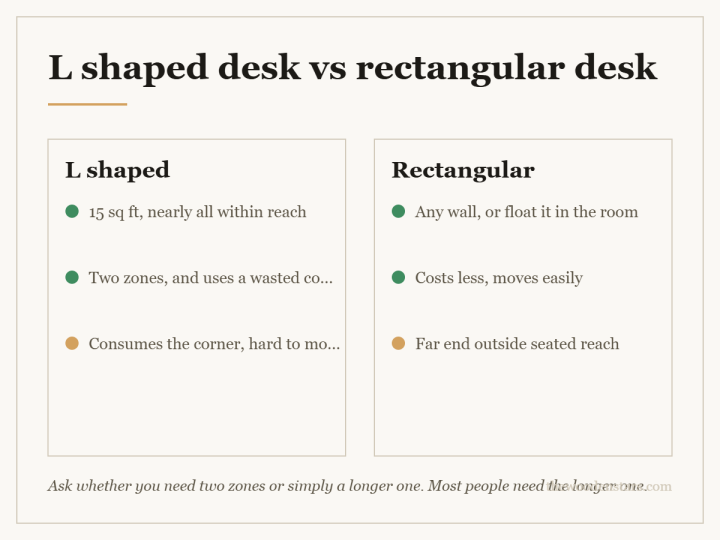
For the small-space case, see secretary desks for small spaces and corner desks for small spaces. For desks with storage, hutch desks with drawers and standing desks with drawers. For sizing, how deep a desk should be and L shaped against rectangular desks.
Questions we get asked
What is the difference between a secretary desk and a writing desk?
The secretary has a hinged fall-front that closes over the work surface. A writing desk is an open table with nothing to shut.
How deep is a secretary desk’s work surface?
Fifteen to 18 inches, against 20 to 24 on a writing desk. That is the real cost of the fall-front.
Can you use a monitor on a secretary desk?
Usually not comfortably. The pigeonhole wall sits right behind the surface, so a screen ends up too close or will not fit.
What holds the front up?
Two supports — wooden lopers that pull out from the carcass, or metal stays. The lopers are the better and more repairable answer.
Does a secretary desk need to be anchored?
Anything over about 50 inches tall, yes. With the front down it has a loaded lever at desk height.
Which is better for daily work?
The writing desk, on surface alone. The secretary wins when the desk has to stop being a desk at the end of the day.