Storage bench vs ottoman — Shape, lid and what fits
The Wooden Stars is a participant in the Amazon Services LLC Associates Program. We may earn a commission when you buy through links on our site, at no extra cost to you.
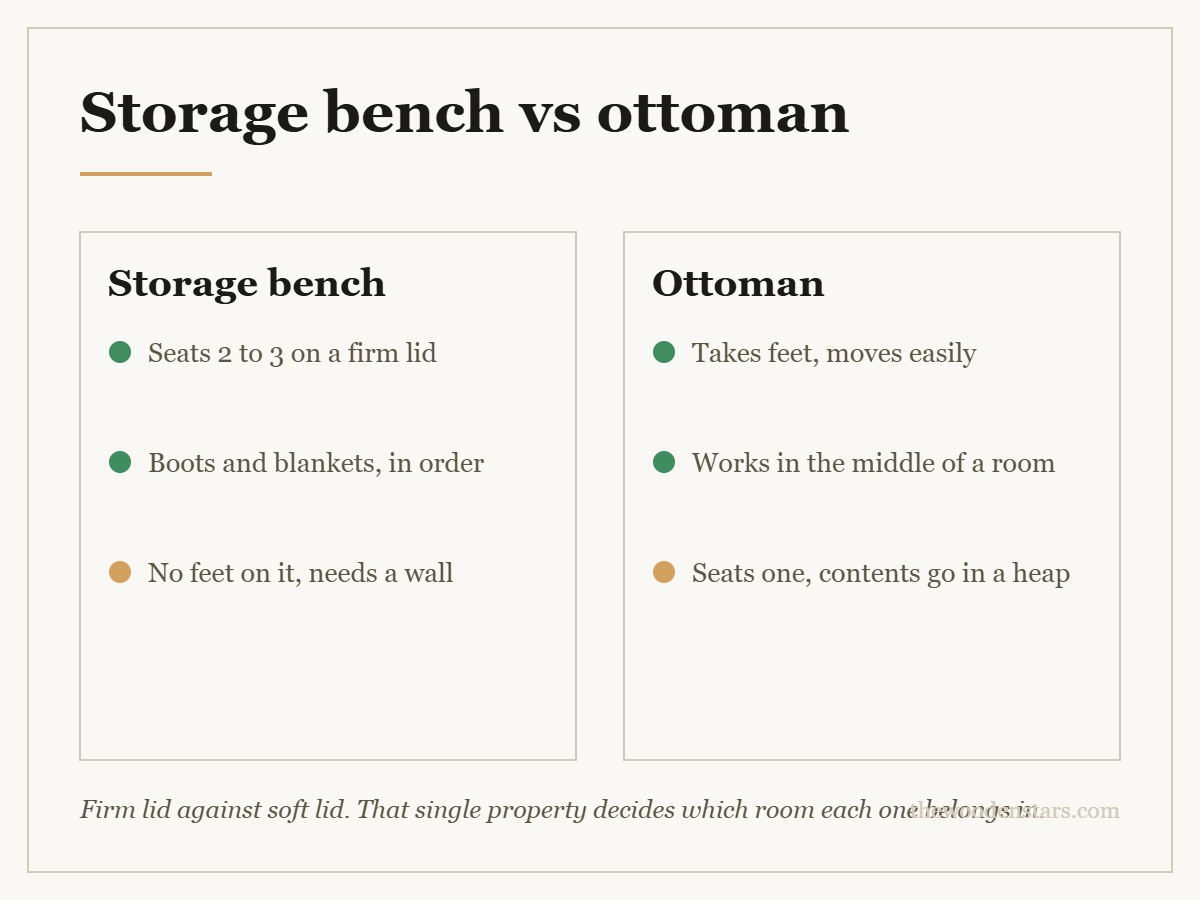
Storage bench vs ottoman looks like a style question and is really a question about two numbers: how long the thing is, and whether its lid is soft.
A bench is long, firm and sits against a wall. An ottoman is compact, upholstered and sits in the middle of a room. What they hold, and how easily you get at it, follows from that.
A storage bench runs 36 to 60 inches long, 15 to 18 inches deep, with a firm lid at seat height. It goes against a wall or at the foot of a bed, seats two or three, and its long shallow void suits boots, blankets and sports kit. An ottoman is 18 to 36 inches square or round, upholstered, and works as a footstool, an occasional seat or a tray table in the middle of a room. Its deeper, boxier void suits throws and toys. The practical difference: a bench lid is firm enough to sit on all evening; an ottoman lid is soft enough to put your feet on.
Storage bench vs ottoman: shape decides the use
The two pieces store roughly the same volume — 3 to 6 cubic feet — in completely different shapes.
The bench’s void is long and shallow. Typically 34 × 13 × 12 inches internally. That takes boots standing up, folded blankets in a row, tennis racquets, a rolled yoga mat. It does not take anything tall.
The ottoman’s void is compact and deep. Typically 24 × 16 × 14. That takes a pile of throws, a heap of toys, spare cushions — things that go in loose rather than in order.
So: things you want laid out, bench. Things you want swallowed, ottoman.
| Measure | Storage bench | Ottoman |
|---|---|---|
| Length | 36 to 60 in | 18 to 36 in |
| Depth | 15 to 18 in | 18 to 36 in |
| Seat height | 17 to 19 in | 15 to 18 in |
| Lid | Firm, often timber | Upholstered, soft |
| Feet on it | No | Yes, that is the point |
| Seats | 2 to 3 | 1, perched |
| Position | Against a wall | Middle of the room |
| Void shape | Long and shallow | Compact and deep |
The lid is the real difference
Everything else follows from this and people notice it only after buying.
A bench lid is firm, often a timber panel with a thin pad. It is a seat you can sit on for an evening — and you cannot comfortably put your feet on it.
An ottoman lid is upholstered, sometimes only a padded board on a frame. It takes feet happily, works as a tray table with a hard tray on it, and is a poor seat for more than a few minutes because there is no back and the surface gives.
If the piece is going in front of a sofa, you want the soft one. If it is going in a hallway where people put boots on, you want the firm one.
The hinge, which is where both fail
The lid opens dozens of times a week and it is where the money is saved on cheap examples.
- Soft-close or friction hinges. Without them the lid drops, which is loud, damaging and — on a toy box a child opens — the reason safety hinges exist at all. This is worth paying for.
- Hinges into a solid rail, not into a particleboard edge. A screw in board edge pulls out within a year or two of daily use — what engineered wood actually is.
- A lid that is supported at the edges, not only hinged at the back. A long bench lid unsupported in the middle bows under a sitter.
- Ventilation if bedding or damp boots go in. A sealed box with wet kit in it grows mould.
On a bench the lid problem is worse because the lid is longer — a 60-inch lid on two hinges racks. Look for three hinges or a split lid.
Where each one goes
The entryway. Bench, clearly — somewhere to sit and put shoes on, and the long shallow void is exactly boot-shaped. Depth of 15 to 16 inches so it does not narrow the hall.
The foot of the bed. Bench. Length should be a little under the bed’s width — a 60-inch bench under a queen reads correctly, a 72-inch one overhangs.
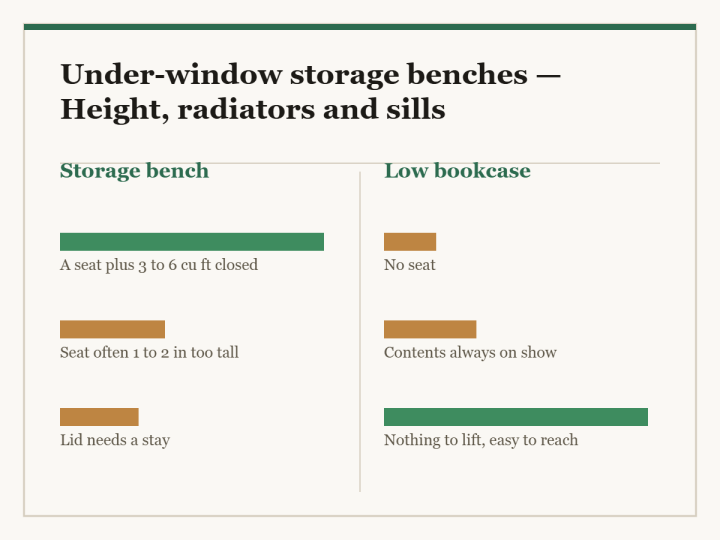
Under a window. Bench, and here the depth is set by the sill and the radiator rather than by you — under-window storage benches.
In front of a sofa. Ottoman. Leave 14 to 18 inches between it and the sofa, which is what a coffee table wants too.
At a dining table. A bench, but a different one — no lid, because a lift-lid bench cannot be opened with the table in front of it. That mistake is common enough to be worth stating: dining benches with storage and dining bench against chairs.
Height, which should match what it serves
A bench for sitting on wants 17 to 19 inches, the same as a dining chair.
An ottoman used as a footstool wants to match the sofa’s seat height or sit an inch below — 15 to 18 inches. Higher than the sofa seat and it is uncomfortable to use.
An ottoman used as a table wants to be within 2 inches of the sofa’s seat height, same as a coffee table. And it needs a hard tray, because a soft top holds nothing.
Both want levelling feet or felt glides — a storage piece that gets dragged rather than lifted marks a floor quickly.
Either one
- Soft-close lid hinges The single upgrade that makes a lift-lid last
- Serving tray with handles What turns an upholstered ottoman into a usable table
- Felt floor glides Storage pieces get dragged rather than lifted
- Cedar blocks For a bench holding blankets or seasonal clothing
What to buy


For benches by position, see under-window storage benches and dining benches with storage. For the bedroom, bed frames with drawers underneath. For hallway storage generally, entryway console tables with drawers.
Questions we get asked
What is the difference between a storage bench and an ottoman?
A bench is long, firm-lidded and sits against a wall; an ottoman is compact, upholstered and works in the middle of a room. The lid stiffness is the practical difference.
Which holds more?
Roughly the same — 3 to 6 cubic feet. The bench’s void is long and shallow, the ottoman’s is compact and deep.
Can you sit on an ottoman?
Perched, briefly. The soft lid and lack of a back make it a poor seat for an evening, which is what the bench is for.
What height should a storage bench be?
Seventeen to 19 inches, the same as a dining chair, if anyone is going to sit on it properly.
Will a storage bench work at a dining table?
Only a non-lifting one. A lift-lid bench cannot be opened with the table in front of it.
What should I check on the lid?
Soft-close or friction hinges, fixed into a solid rail rather than a particleboard edge, and a long lid supported at the edges rather than hinged alone.