Dining chair with arms vs without — Four inches each
The Wooden Stars is a participant in the Amazon Services LLC Associates Program. We may earn a commission when you buy through links on our site, at no extra cost to you.
Dining chair with arms vs without costs you about four inches per chair — and around a six-seat table that is a whole place setting you no longer have.
Arms are worth those inches for some people and nobody else. The useful thing is knowing which group you are buying for.
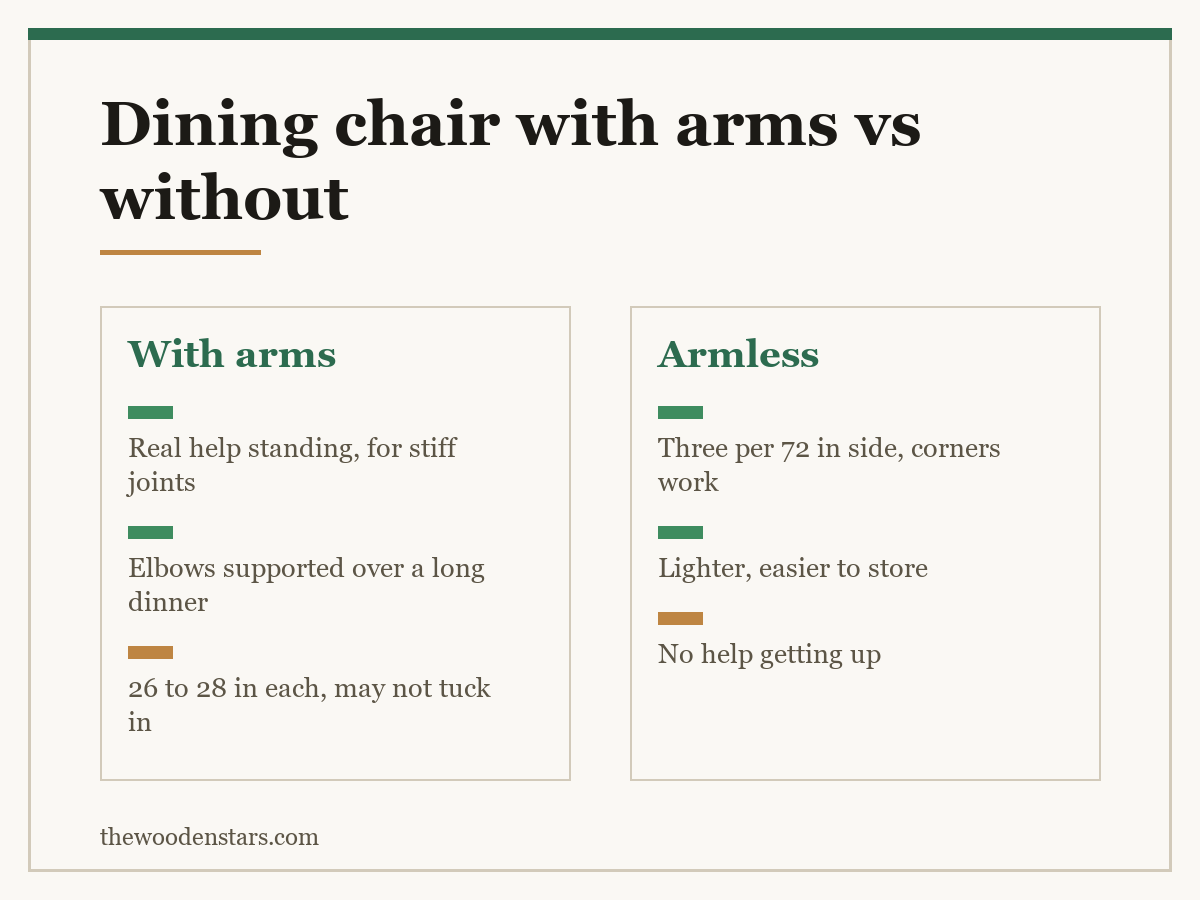
An armchair needs 26 to 28 inches of table edge; a side chair needs 24. Over six seats that is 12 to 24 inches of table — one more diner, or a table one size smaller. Arms matter most for older people and anyone with a knee or hip problem, because you push up on them to stand. The hard constraint is the apron: arm height is typically 24 to 27 inches and a 30-inch table’s apron underside sits at 25 to 26, so many armchairs will not tuck in at all. Measure before buying. The usual answer: arms at the ends, armless down the sides.
Dining chair with arms vs without: the four inches
A dining chair arm adds 2 to 4 inches of width each side once you count the arm itself and the support below it.
So the table edge each chair needs:
- Side chair, armless: 24 inches.
- Armchair or carver: 26 to 28 inches.
On a 72-inch rectangle that is three armless chairs per long side comfortably, or two armchairs plus a squeeze. On a 60-inch round — 188 inches of circumference — it is seven or eight armless places against five or six with arms.
The width arithmetic is in how wide a dining chair is, and the seat-count method in how many chairs fit a round table.
| Measure | With arms | Armless |
|---|---|---|
| Table edge needed | 26 to 28 in | 24 in |
| Seats on a 72 in side | 2 | 3 |
| Seats at a 60 in round | 5 to 6 | 7 to 8 |
| Helps you stand up | Yes, significantly | No |
| Tucks under a 30 in table | Often not | Yes |
| Stack or store | Rarely | Often |
| Weight each | 14 to 22 lb | 10 to 18 lb |
The apron, which decides it more often than width
This is the check people skip and then regret.
A dining armchair’s arm top sits at 24 to 27 inches from the floor. A 30-inch table with a 3 to 4-inch apron has its underside at 25 to 26 inches.
If the arm is taller than the apron underside, the chair stops short and sits 6 to 10 inches proud of the table permanently — not just when in use. That eats the walkway you measured in how much space around a dining table, and it looks unresolved.
What to do before ordering:
- Measure floor to apron underside on your table. Not to the tabletop.
- Find the arm height in the chair spec — listed as “arm height” or readable from the dimensions diagram.
- Leave an inch. Arm height at least 1 inch below the apron underside, so the chair clears without scraping.
Two table types dodge the problem entirely: trestle and pedestal tables, which have no apron across the seating positions. If you want armchairs and have not bought the table yet, that is the move.
Who actually needs arms
Worth being plain about, because this is an accessibility question rather than a style preference.
Anyone who pushes up to stand. With a stiff knee or hip, rising from an 18-inch seat without arms means using the table edge or someone’s hand. Arms turn that into an ordinary movement. For an older guest it is the difference between joining a long dinner and leaving early.
Anyone sitting for hours. Arms give you somewhere to put your elbows between courses, and they change how long a hard timber chair stays tolerable — the comfort side of upholstered against wood dining chairs.
Nobody else, really. For a family with children, six armless chairs is straightforwardly the better buy: more seats, easier to get in and out, easier to store.
The mix that suits most tables
Armchairs at the two ends, armless down the sides.
It is the traditional arrangement and it is traditional because it works. The ends are where you can afford the width — a 36-inch table end takes one chair whatever its arms do — and the sides are where every inch costs a seat.
It also solves the guest problem quietly: whoever needs arms takes an end, without anyone having to arrange it.
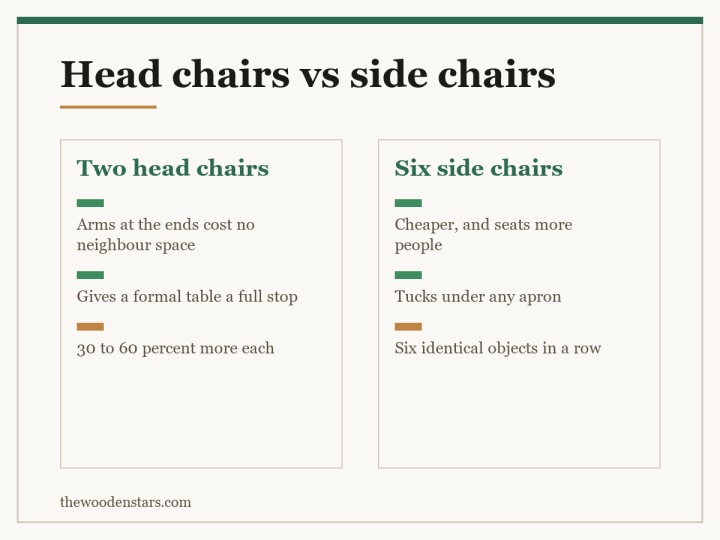
Two things to match if you buy them separately: seat height to the inch, and the timber tone, which varies between ranges. Buying both from one range solves both, and the full case is in head chairs against side chairs.
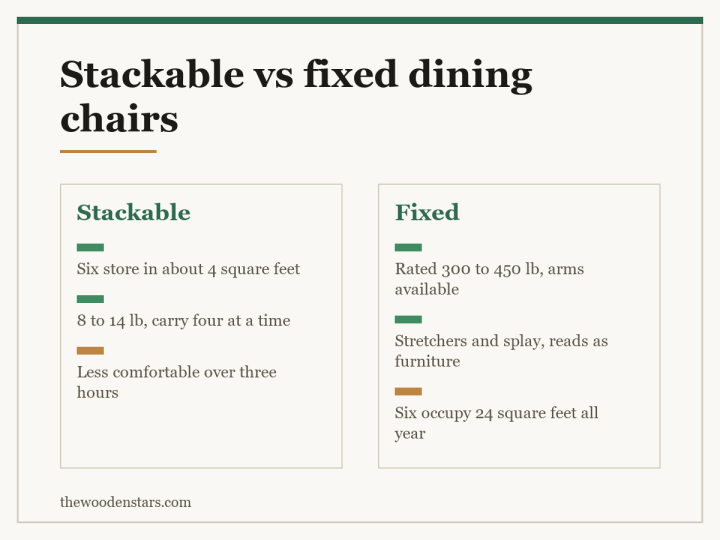
The bench variant of the same idea — bench on the wall side, chairs on the open side — is in dining bench against chairs. And where storage matters, stackable against fixed dining chairs.
There is a resale point worth knowing as well. Armless side chairs are far easier to sell or re-home than armchairs, because they fit almost any table and any room. Carvers are sized to a particular table and a particular apron height, which narrows the pool of buyers considerably. If you change furniture every few years, or expect to move to a smaller place, that difference in liquidity is worth more than the small premium the armchairs cost in the first place.
For either chair
- Tape measure Arm height against the apron underside, before ordering
- Seat pads for dining chairs What makes a hard timber seat last a long dinner
- Wood glue for loose joints The arm-to-frame joint is the one that loosens first
- Felt furniture pads Armchairs are heavier and drag harder on a floor
What to buy


For seat counts, see how wide a dining chair is and how much space between dining chairs. For height, how tall a dining chair should be.
Questions we get asked
Should dining chairs have arms?
Arms help anyone who pushes up to stand and anyone sitting for hours. They cost 2 to 4 inches of table edge per chair.
How much table edge does each need?
Twenty-six to 28 inches with arms, 24 without. Over six seats that is 12 to 24 inches of table.
Why will my armchairs not tuck in?
The arm is taller than the underside of the table’s apron. Arm height is 24 to 27 inches; a 30-inch table’s apron sits at 25 to 26.
Which tables suit armchairs?
Trestle and pedestal tables, because they have no apron across the seating positions.
How many armchairs fit a 60-inch round table?
Five or six, against seven or eight armless.
What is the best arrangement?
Armchairs at the two ends, armless down the sides. The ends can afford the width; the sides cannot.