How deep should a desk be? Screen distance sets it
The Wooden Stars is a participant in the Amazon Services LLC Associates Program. We may earn a commission when you buy through links on our site, at no extra cost to you.
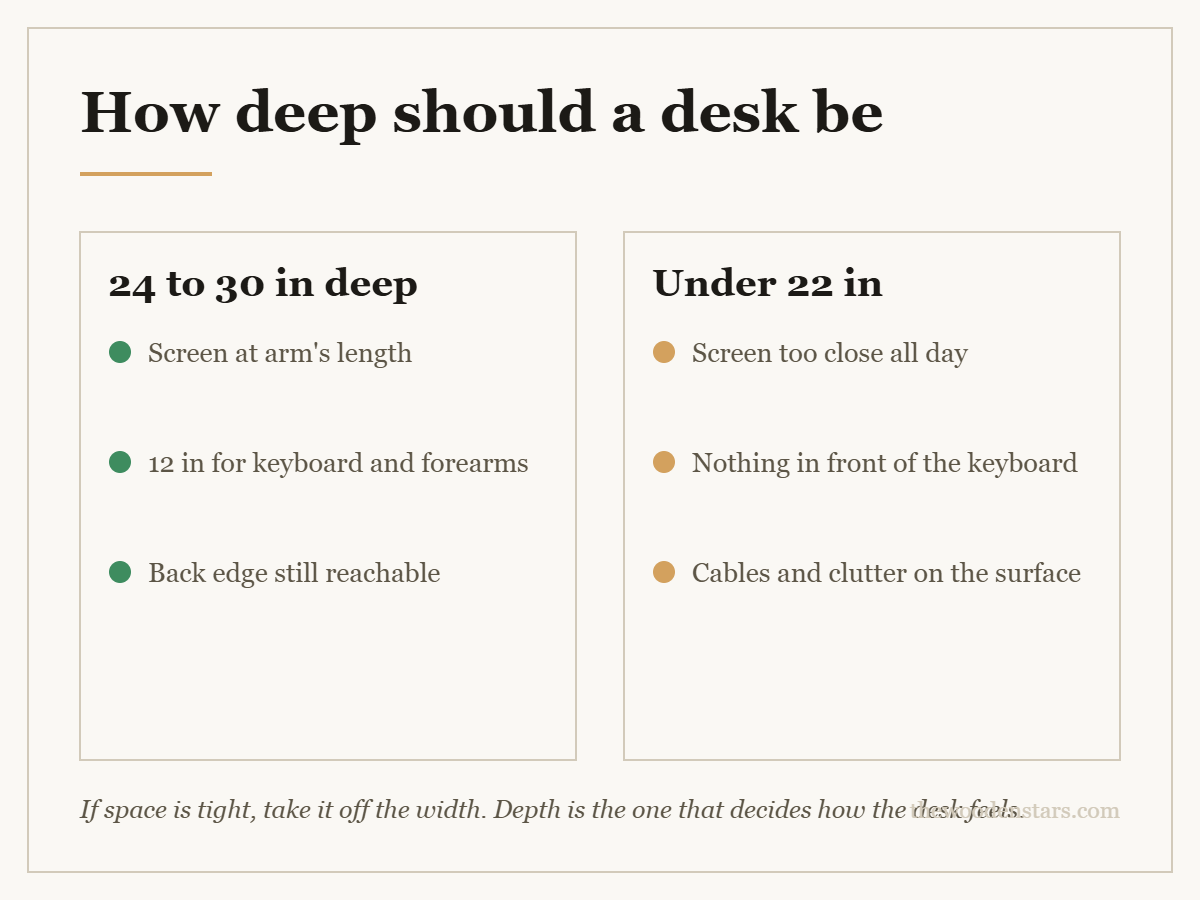
How deep should a desk be? Between 24 and 30 inches, and the figure is set by how far your eyes need to be from a screen — not by how much stuff you own.
Get it wrong in the shallow direction and you spend years looking at a monitor from too close. That is the part nobody warns you about.
A desk should be 24 to 30 inches deep. The driver is screen distance: a monitor wants to sit 20 to 30 inches from your eyes, and its stand takes 8 to 10 inches of that depth. So a 24-inch desk works for a laptop or a single 24-inch monitor; a 30-inch desk is what a 27-inch or larger screen actually needs. Below 22 inches nothing sits in front of the keyboard. Above 30 you cannot reach the back, and the desk starts eating the room. Depth matters more than width for comfort.
How deep should a desk be for a screen
Work backwards from your eyes.
- Comfortable viewing distance is roughly an arm’s length — 20 to 30 inches, and larger screens want the far end.
- A monitor stand occupies 8 to 10 inches of desk depth behind the screen.
- Your keyboard and forearms need 10 to 12 inches in front.
Add those and the arithmetic is clear:
- Laptop or 24-inch screen: 24 inches of desk is enough.
- 27-inch screen: 28 to 30 inches.
- 32-inch or ultrawide: 30 inches, or a monitor arm.
A monitor arm is the cheat code. It clamps to the back edge and removes the stand’s footprint entirely, which effectively buys you 8 inches of depth. On a 24-inch desk with a large screen it is the single best thing you can add.
| Setup | Depth | Note |
|---|---|---|
| Laptop only | 20 to 24 in | Add a stand and a separate keyboard |
| Single 24 in monitor | 24 in | On its own stand |
| Single 27 in monitor | 28 to 30 in | Or 24 in with a monitor arm |
| Two monitors side by side | 30 in | Width matters more here |
| Ultrawide | 30 in | A monitor arm is close to essential |
| Writing, no screen | 20 to 24 in | A4 landscape plus a notebook |
The other two numbers, which are not depth
Height: 29 to 30 inches. This is fixed convention and it suits a chair seat at 17 to 19. If you are much taller or shorter than average, the chair is the adjustment, not the desk.
Knee clearance: 24 inches minimum, 25 to 27 comfortable. This is the measurement that quietly ruins desks. A desk with a drawer under the top can leave 22 inches, which means your thighs hit it. Measure from the floor to the underside of whatever is lowest — the apron, the drawer box, the stretcher.
Knee depth matters too: you want 20 inches of clear space front to back under the desk, so a back panel or a modesty board set too far forward is a problem. Desks with a rear cabinet are where this bites.
Where the width comes in
Depth is about comfort; width is about how much you can have open at once.
- 40 inches: a laptop and a notebook. The practical minimum.
- 48 inches: one monitor with room beside it. The most common size.
- 60 inches: two monitors, or one plus real paper space.
- 72 inches: two people, or a monitor plus a work area.
If the room is tight, cut width before depth. A 40 × 28-inch desk is far more comfortable than a 60 × 20-inch one, because the shallow desk puts a screen too close and leaves nowhere for your forearms.
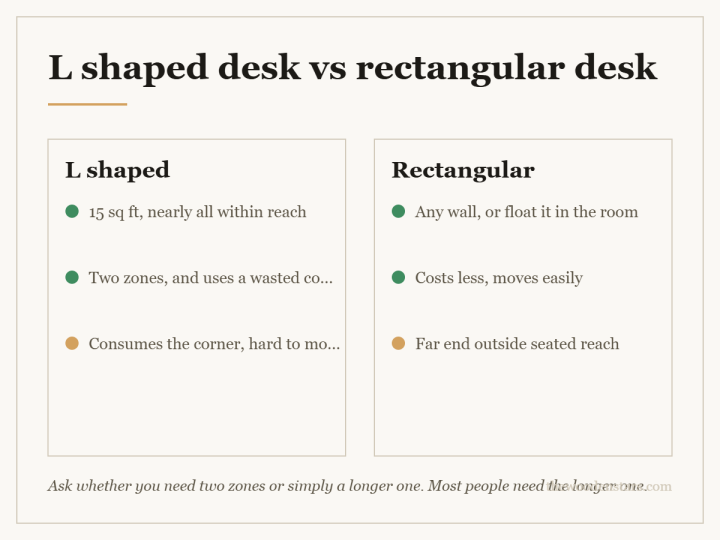
Where width genuinely will not fit, an L-shape turns two walls into one desk — L shaped against rectangular desks and corner desks for small spaces.
What deeper than 30 inches costs
Reach. Comfortable seated reach across a desk is about 26 inches. Beyond that the back strip becomes a shelf you have to stand up to use, which is where mugs and cables accumulate.
Room. A desk against a wall takes its depth plus the chair’s push-back — 36 inches minimum, 48 if anyone walks behind you. A 36-inch-deep desk in a small bedroom takes six feet of the room.
Cost and delivery. Deep solid tops are heavier, dearer and harder to get up a stair.
The exception is a desk used for drawing, model-making or sewing, where the work itself is large. There, depth is the point.
Construction at depth
A deep top with no apron and legs at the corners will sag in the middle of the back edge if you lean on it, and will rack diagonally.
- Top thickness of 1 inch or more in solid timber at 30 inches deep, or a stiff apron.
- A back stretcher, panel or cross brace. This is what stops racking; four legs and a top alone is the wobbliest possible arrangement — how to fix a wobbly desk.
- Cable route. At 30 inches deep, reaching behind for a plug means crawling under. A grommet is worth it — desk grommets.
- Leg style. Corner legs give the most knee room; a trestle or pedestal can intrude — wooden desk legs.
For a top you are mounting yourself, see mounting a butcher block desktop.
Getting the depth to work
- Monitor arm Removes the stand’s footprint and buys back 8 inches of depth
- Desk grommet The cable route a 30-inch-deep desk badly needs
- Keyboard tray Recovers depth on a desk that is already too shallow
- Felt floor glides A desk gets pushed back every time somebody stands up
What to buy


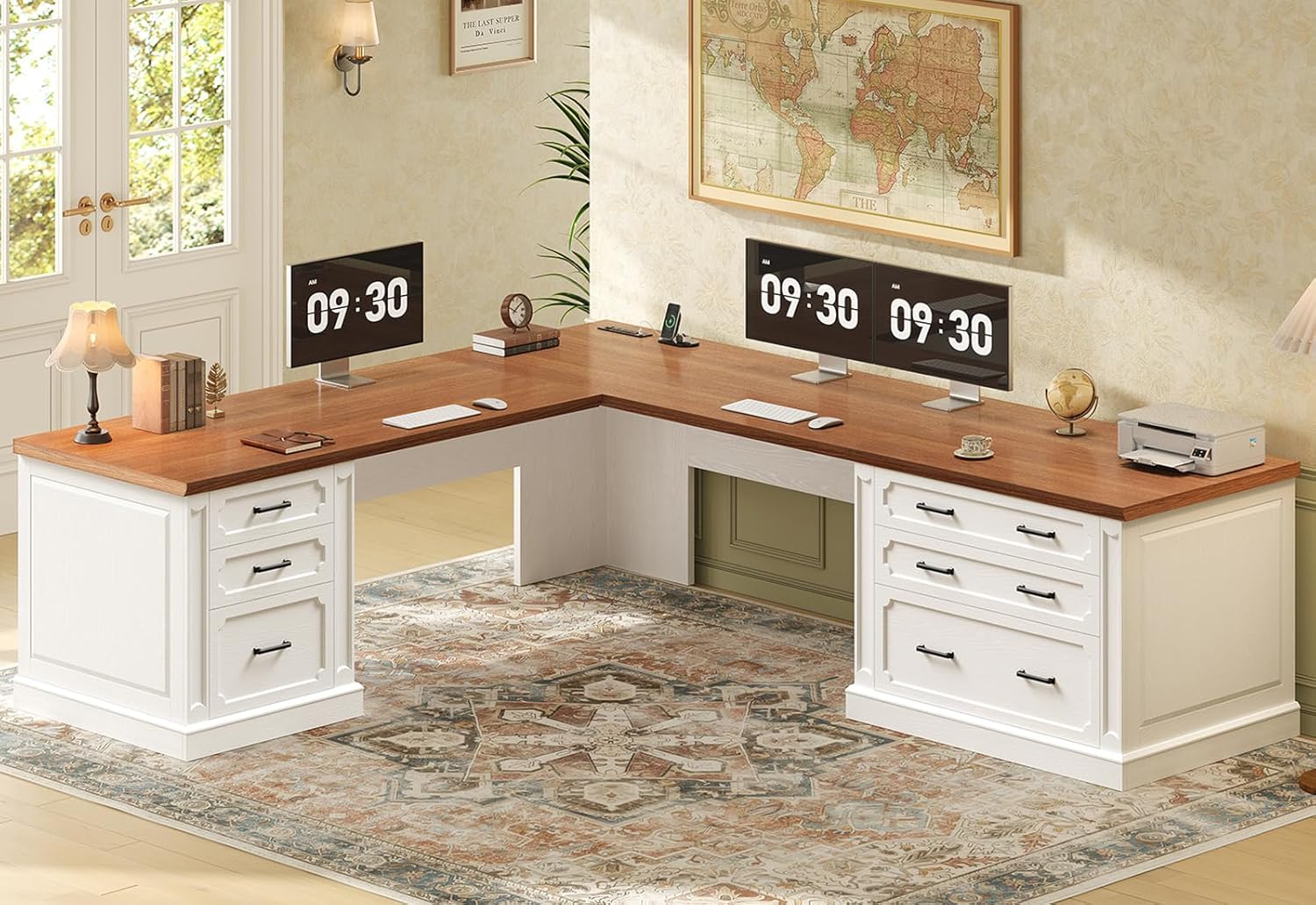
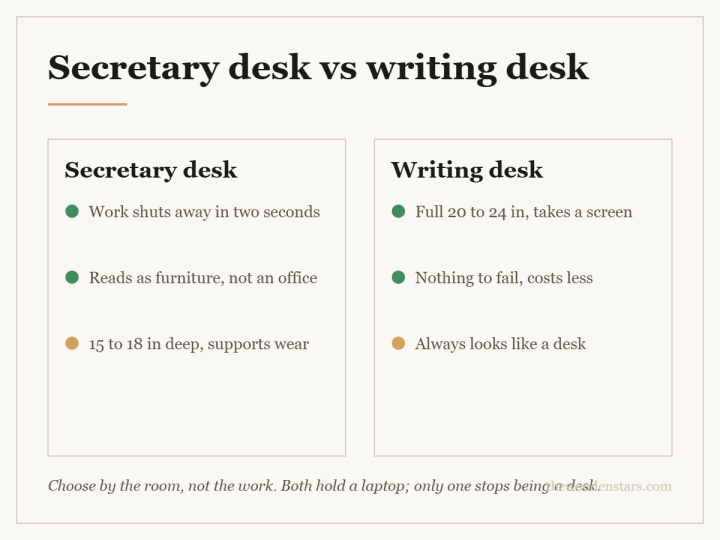
For desks by shape, see L shaped against rectangular, corner desks and secretary against writing desks. For storage, standing desks with drawers and hutch desks with drawers. For a small room, secretary desks for small spaces.
Questions we get asked
How deep should a desk be?
Twenty-four to 30 inches. Twenty-four suits a laptop or a 24-inch monitor; 30 is what a 27-inch or larger screen needs.
Why does screen size change the depth?
Because a larger screen wants to sit further away, and its stand already takes 8 to 10 inches of the desk.
Can I use a shallower desk with a big monitor?
With a monitor arm, yes. Clamping the screen to the back edge removes the stand’s footprint entirely.
What is the minimum knee clearance?
Twenty-four inches from the floor to the lowest thing under the top, and 25 to 27 is comfortable. Measure to the drawer box, not the tabletop.
Should I cut depth or width in a small room?
Width. A 40 × 28-inch desk is far more comfortable than a 60 × 20-inch one.
Is a 36-inch-deep desk better?
Only for drawing or making. Seated reach is about 26 inches, so the back strip becomes a shelf you stand up to use.