Desk vs table — Storage, depth and the knee space
The Wooden Stars is a participant in the Amazon Services LLC Associates Program. We may earn a commission when you buy through links on our site, at no extra cost to you.
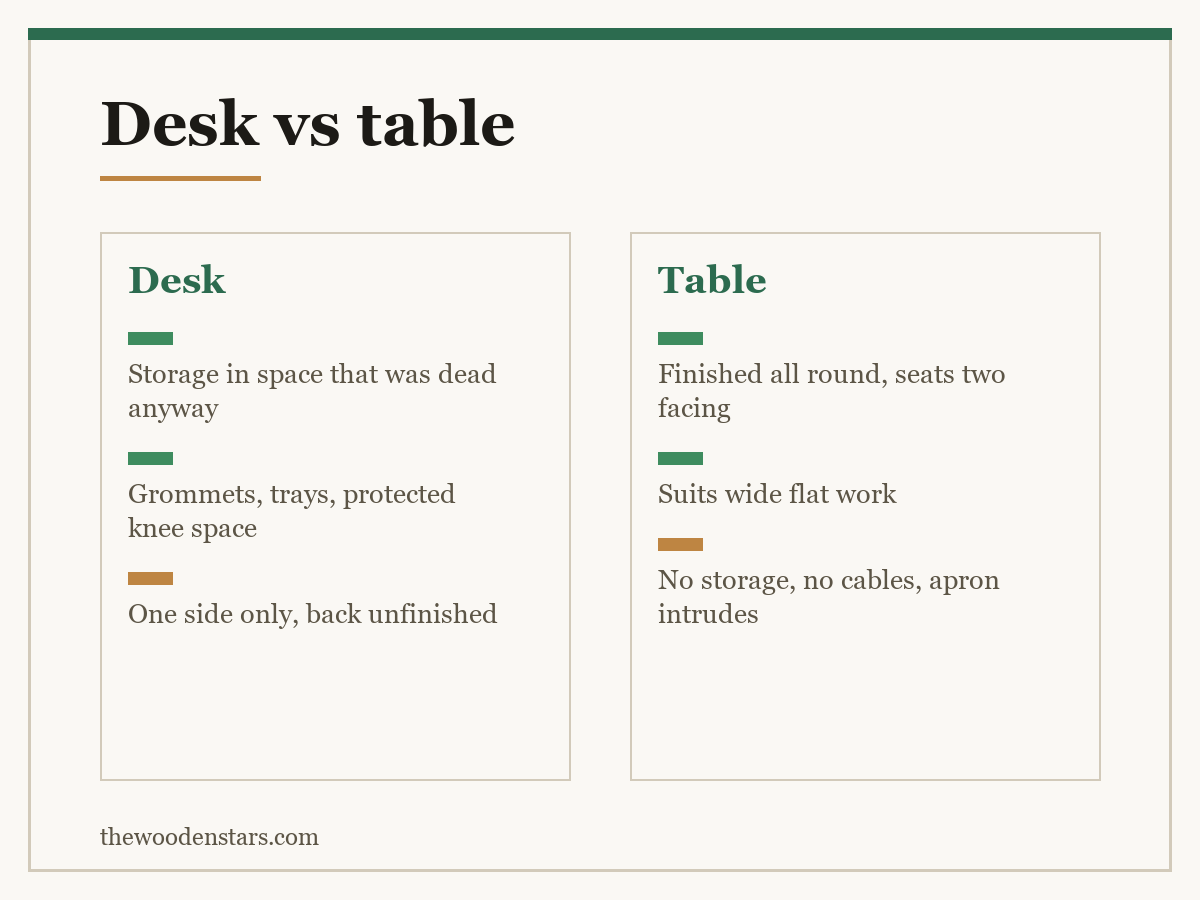
Desk vs table is not a naming argument. A desk has storage, a back you can put against a wall, and a fixed working depth. A table has none of those and gains everything a desk gives up.
Plenty of people work better at a table. Fewer people store anything at one.
A desk is built for one person facing one direction: 24 to 30 inches deep, drawers or a pedestal, a finished front and an unfinished back, and cable management. A table is 36 to 42 inches deep, finished on all four sides, no storage, and usable from any seat. Heights are nearly the same — 29 to 30 inches for both — so either works ergonomically. Choose a desk if you need storage, cable routing, or the piece sits against a wall. Choose a table if the room is shared, the piece floats in the middle, or you spread paper out.
Desk vs table: the real differences
- Depth. Desk 24 to 30 inches, table 36 to 42. A table is deeper than you need for a screen and better than you need for paper.
- Storage. Desks have drawers or a pedestal. Tables have a flat underside and nothing else.
- Finished sides. A table is finished all round because it sits in a room. A desk’s back is often unfinished chipboard, because it was designed to face a wall.
- Cable management. Grommets, trays and a modesty panel are desk features. A table has none — desk grommet.
- Knee space. A desk protects it deliberately. A dining table’s apron often does not — some are only 24 inches to the underside.
Heights are the one thing that genuinely matches: both land at 29 to 30 inches, which is the standard covered in how tall a desk should be.

| Measure | Desk | Table |
|---|---|---|
| Depth | 24 to 30 in | 36 to 42 in |
| Height | 29 to 30 in | 29 to 30 in |
| Storage | Drawers or pedestal | None |
| Finished sides | Front and sides | All four |
| Cable management | Grommet, tray, panel | None |
| Working positions | One | Any side |
| Knee clearance | Protected by design | Apron can intrude |
When the table is genuinely better
The piece floats in the room. A desk’s unfinished back looks like what it is when you can see it. A table is made to be seen from every side.
Two people use it. Facing each other across a 38-inch table works. Facing each other across a 26-inch desk does not — your knees meet.
The work is wide and flat. Drawings, sewing, model-making, spreading out documents. A 38-inch depth is a real gain here, and drawers get in the way rather than helping.
The room is shared. A table becomes a dining table again at six o’clock. A desk with a monitor on it never stops being an office.
You want the top you want. Tables come in solid timber at widths and thicknesses desks rarely do — how thick a dining table top should be and best wood for furniture.
What you give up by using a table
Storage. The obvious one. In practice it means a separate drawer unit, which costs floor space you were not counting — and the pedestal under a desk uses space that was dead anyway.
Cables. No grommet, no tray, no modesty panel. On a table in the middle of a room every cable is visible and runs down a leg to a socket across the floor. This is fixable with a stick-on tray, and it is the single most common regret.
Depth you cannot use. A 38-inch table puts the far 10 inches out of reach, so it collects things. Screen distance only needs 24 to 30 inches — how deep a desk should be.
The apron. Check the floor-to-underside figure before committing. Dining tables commonly have a 3 to 4-inch rail, leaving 25 to 26 inches of knee clearance where a desk gives 27. With a keyboard tray or a thick top it gets tight fast.
The middle options
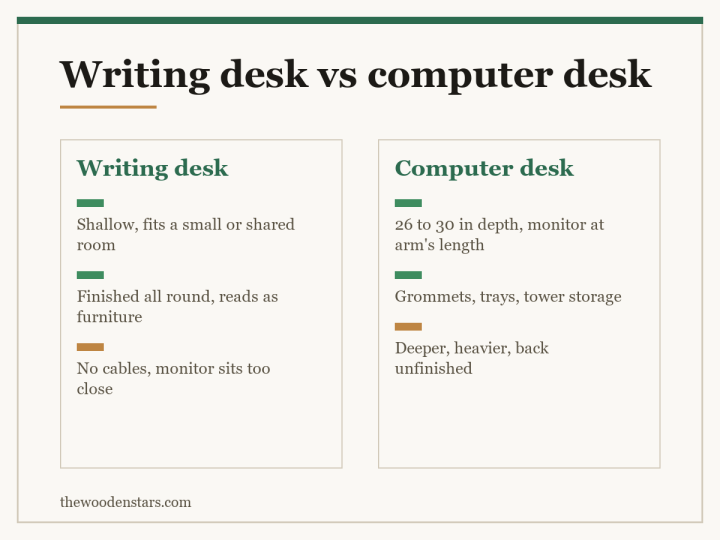
A writing desk is a desk with a table’s honesty: shallow, often finished all round, a single shallow drawer rather than a pedestal. It is what most people actually want when they say they want a table — writing desk against computer desk and secretary desk against writing desk.
A table with a separate drawer unit on castors gives you the table’s flexibility and puts the storage where you want it rather than where the maker put it.
A parsons-style table with no apron solves the knee clearance problem, and its square legs sit out of the way better than turned ones.
Whichever way it goes, the height rule does not change: measure floor to elbow seated, per how tall a desk should be, and check the load if screens and equipment are going on it — how much weight a desk can hold.
One thing worth checking on either: the underside of the top. Desks are finished there because you see it when the piece is against a wall from the side. Tables often are not — a dining table’s underside can be rough-sawn and stapled, which nobody notices at a dining height but which is very visible on a piece you sit at all day with your knees under it.
Turning a table into a workspace
- Stick-on cable tray The single fix that makes a table usable as a desk
- Rolling drawer unit Storage without committing to a pedestal desk
- Monitor arm Clamps to a table edge and recovers the depth a stand wastes
- Desk grommet For when you do drill the top, and want it to look intentional
What to buy


For dimensions either way, see how tall a desk should be, how wide a desk should be and how deep a desk should be. For the storage question, desk with drawers against without.
Questions we get asked
What is the difference between a desk and a table?
A desk has storage, a working depth of 24 to 30 inches, cable management and an unfinished back. A table is 36 to 42 inches deep, finished all round and has none of those.
Are they the same height?
Effectively yes — both land at 29 to 30 inches, so either works ergonomically.
Can I use a dining table as a desk?
Yes, but check the apron. Some leave only 25 inches of knee clearance where a desk gives 27.
When is a table better?
When the piece floats in a room, when two people face each other, when the work is wide and flat, or when the room is shared.
What do I lose with a table?
Storage and cable management. Both are fixable with a rolling drawer unit and a stick-on cable tray.
Is a writing desk the middle ground?
Yes. Shallow, often finished all round, one shallow drawer — it is what most people mean when they say they want a table.