Pottery Barn coffee table alternatives — Same proportions, less money
The Wooden Stars is a participant in the Amazon Services LLC Associates Program. We may earn a commission when you buy through links on our site, at no extra cost to you.

Coffee tables are the easiest furniture category to buy a cheaper version of, because the object is simple: a top, a base, and sometimes a shelf. There is no drawer mechanism to skimp on and no hinge to drop.
Which means the price difference goes almost entirely into two things — the top and the joints — and both are checkable before you order.
The look is: a substantial solid-looking top, often with a visible thick edge; a turned, trestle or plank base rather than thin legs; a lower shelf; and a warm mid-brown or weathered finish. Sizes cluster at 44 to 54 inches long, 24 to 28 deep, 16 to 19 tall. All of that is easy to match cheaply. The two things that are not: a solid timber top that can be refinished repeatedly, and bolted joints at the base rather than screws into end grain. Get the height right against your sofa seat first — that matters more than any of it.
Height and distance first
Brand-independent and more important than the styling.
Height: level with the sofa seat, or up to two inches lower. Most sofas sit at 17 to 19 inches, so most coffee tables should be 16 to 19. A table noticeably taller than the seat means reaching up for a mug.
Distance: 14 to 18 inches between the sofa edge and the table — close enough to reach seated, wide enough to walk past.
Length: about two thirds the length of the sofa. A 78-inch sofa suits a table around 48 to 52 inches.
The full sizing logic, including why a round table wins in a tight room, is in round wood coffee tables.
The top is most of the price
| Top | Looks | Deep scratch | Refinishes |
|---|---|---|---|
| Solid timber, thick edge | Best | Sands out | Many times |
| Solid timber, thin | Good | Sands out | Several times |
| Veneer on plywood | Identical when new | Permanent | Once or twice |
| Veneer on particleboard | Identical when new | Permanent | Rarely |
| Printed foil | Flat under raking light | Permanent | No |
A coffee table takes more abuse per square inch than any other timber surface in a house — feet, mugs without coasters, grit carried in on shoes. So the refinishing column matters more here than on a sideboard or a bedside table.
Two ways to tell what you are looking at without handling it: the edge (on solid timber the grain continues around it and the figure matches; on veneer there is a separate banding strip) and the shipping weight against the size. The terms are decoded in what engineered wood actually is.
The thick-edge trick
Much of the substantial look comes from a deep visible edge on the top — an inch and a half or two inches, rather than three quarters.
On expensive tables that is solid timber all the way through. On cheaper ones it is very often a mitred or built-up edge: a thin panel with a frame underneath, or a folded edge, giving the appearance of thickness over a hollow or thinner core.
That is legitimate construction and it is how a lot of good furniture is made. It only matters in two ways: the table is lighter than it looks, and a knock to the edge can open the mitre. Worth knowing rather than worth avoiding.
The base, and the joint that fails
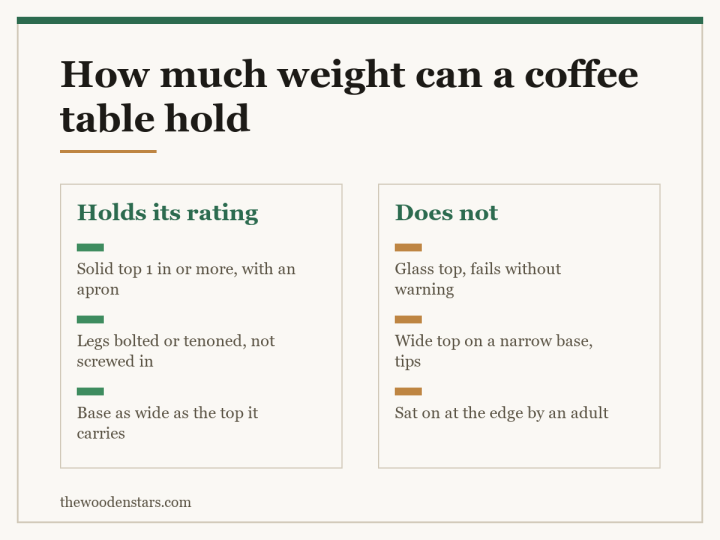
A coffee table gets pushed, sat on, and used as a footrest. Its joints see side loads that a dining table rarely does.
Bolts into threaded metal inserts can be re-tightened for the life of the table. This is what you want, and cheap tables sometimes have it.
Wood screws into end grain hold the first time and loosen thereafter. On a table that will be dragged across a rug regularly, this is the thing that produces a wobble in year two.
A trestle or plank base with a stretcher is inherently more rigid than four separate legs, which is one reason the style uses them. If a table has four independent legs, the joint quality matters much more.
Fixing one that already wobbles is in how to fix a wobbly table.
Finish: the choice that decides your next ten years
Almost every complaint about a coffee table is a complaint about its finish. Water rings, heat marks and light scratches happen in the finish film, not in the wood.
Lacquer resists more damage and cannot be repaired in place. When it fails, the whole top needs stripping.
Oil or hardwax oil marks more readily and can be repaired by anybody with a cloth in ten minutes, invisibly, because there is no film edge to blend.
On a coffee table specifically — the surface least likely to get a coaster — the repairability of oil usually wins. The full argument, with hardness figures, is in hardwood coffee tables.
Lower shelf: useful or clutter?
A lower shelf is standard on this style and worth a moment’s honesty.
It holds books, trays and remotes, and it becomes a permanently visible pile in the middle of the room. In a small living room an open shelf can make the space feel busier rather than tidier — closed storage, or no shelf at all, often reads better.
If the room is tight, the shape question matters more than the shelf: see round wood coffee tables.
Two cheap upgrades
Felt pads under the feet. A coffee table gets nudged constantly, and grit under a foot is a scratch every time.
A coat of hardwax oil, even on a table that arrived lacquered-looking, if it is genuinely oiled. It evens out the colour and re-seals the surface, and it takes ten minutes.
For a coffee table in use
- Coasters The highest-value purchase for any coffee table
- Hardwax oil Yearly on an oiled top; also the repair kit for rings and scuffs
- Felt pads Under the feet; the table gets nudged more than any other
- Threadlocker On base bolts at assembly, before the wobble starts
What to buy


For sizing and shape, see round wood coffee tables and average coffee table dimensions. For hardness and finish, hardwood coffee tables.
Questions we get asked
How tall should a coffee table be?
Level with the sofa seat or up to two inches lower — usually 16 to 19 inches. Measure your own sofa.
How long should a coffee table be?
About two thirds the length of the sofa. A 78-inch sofa suits a table of 48 to 52 inches.
How do I tell if the top is solid or veneer?
Look at the edge: solid timber has grain continuing around it. Veneer has a separate banding strip. Shipping weight confirms it.
Is a thick edge always solid wood?
No. Many are built up from a thinner panel with a frame underneath, which is normal construction — the table is just lighter than it looks.
What finish is best on a coffee table?
Oil, usually. It marks more easily but every mark can be repaired with a cloth, which suits the surface least likely to get a coaster.
Is a lower shelf worth having?
It adds storage and permanent visible clutter in the middle of the room. In a small living room, consider going without.