Lift-top coffee tables — The mechanism is the product
The Wooden Stars is a participant in the Amazon Services LLC Associates Program. We may earn a commission when you buy through links on our site, at no extra cost to you.
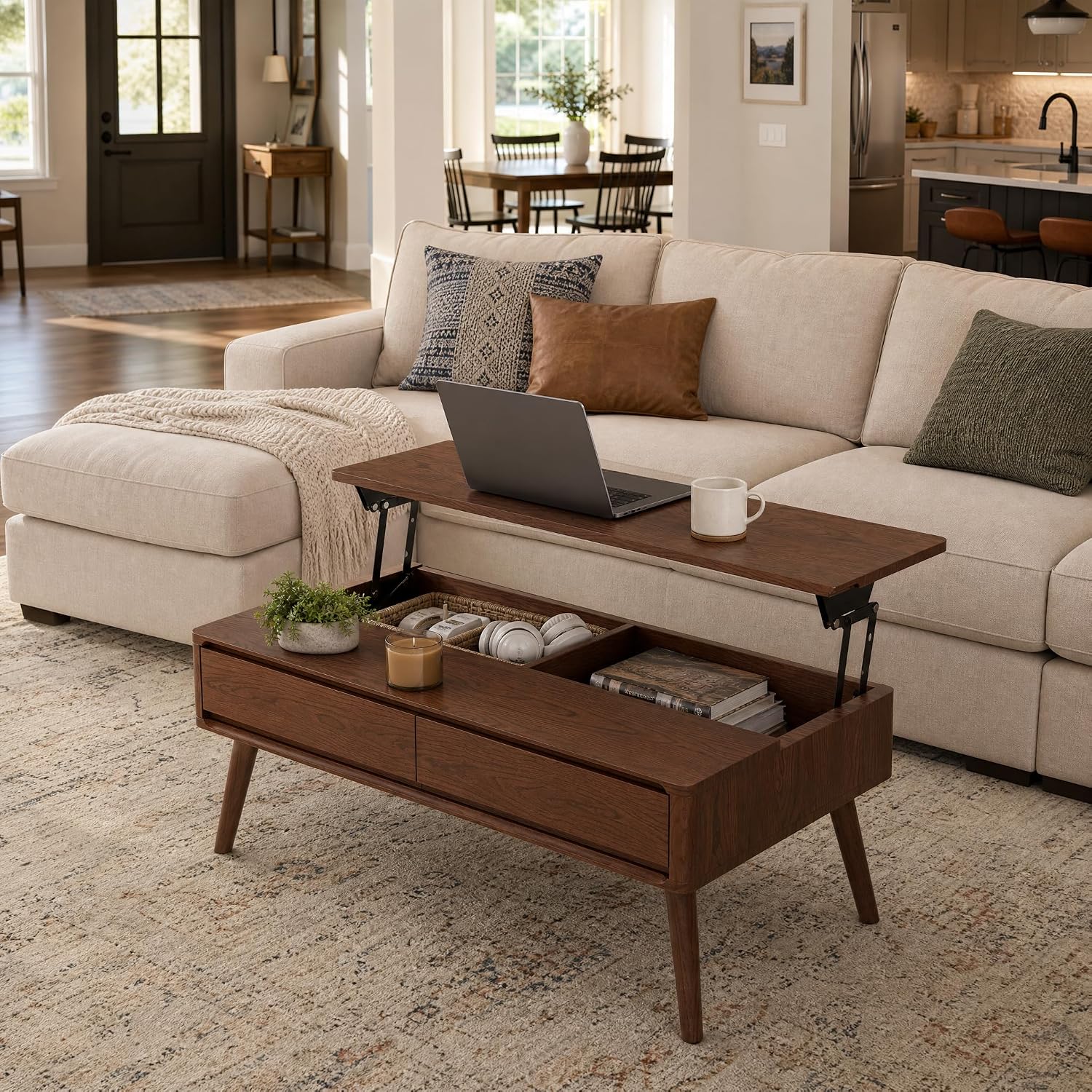
A lift-top coffee table is a normal table until you pull the front edge, at which point the top rises and swings towards you on a folding linkage and becomes a desk at sofa height. Underneath, where the top used to be, there is a tray.
Everything you need to judge about these tables is in that linkage. The timber, the finish and the proportions are ordinary furniture questions. The mechanism is the product.
The top rises 7 to 11 inches and comes forward 8 to 14, landing at 26 to 30 inches from the floor — laptop height when you are sitting on a sofa. Judge it on three things. The linkage type: gas-assisted struts hold the top at any height, plain sprung linkages snap to a fixed position. Whether it has a stop at the top, because a top that keeps travelling hits your knees. And weight rating — usually 25 to 45 lb raised, which is a laptop and a plate, not someone leaning on it. Underneath you get 1.5 to 3 cubic feet, often split by a fixed divider.
How the mechanism works, and the two kinds
Sprung four-bar linkage
Two folding steel arms on each side with a spring to take some of the weight. The top rises along a fixed arc and locks at the top of its travel.
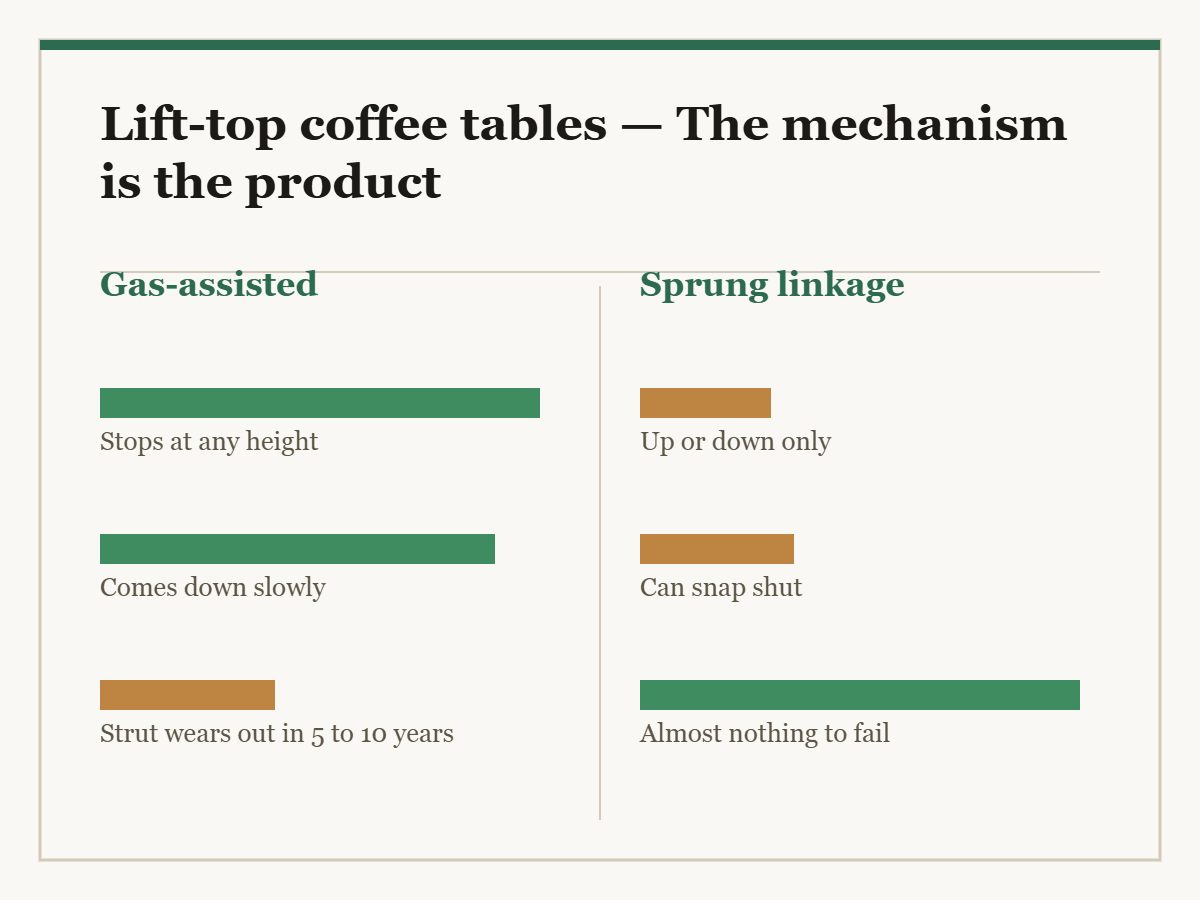
Simple, cheap, and reliable in the sense that there is little to fail. It is either up or down — no intermediate positions — and the spring rate is set for the top alone, so a heavy solid-timber top can feel harsh coming down.
Gas-assisted linkage
The same arms with a gas strut. The top can be stopped anywhere, comes up with less effort and comes down slowly.
This is the better mechanism and it is most of the price difference. The strut is also the part with a service life — five to ten years of daily use — and it is usually replaceable if the arms take a standard fitting.
Where it lands, and whether that suits your sofa
A coffee table top sits at 16 to 19 inches. Raised, it lands at 26 to 30.
The right height to work at is roughly the same as a dining table relative to your seat. A sofa seat is 17 to 19 inches, so a raised top at 27 to 28 gives you about 9 to 10 inches of gap — slightly tight but workable for a laptop, which is what these are for.
The forward travel matters as much. The top comes 8 to 14 inches towards the sofa, which is what puts it within reach — and which means it now overhangs the base with nothing under it but your legs. Two practical checks: the gap between table and sofa should be 14 to 18 inches closed, so that the raised top arrives at the right distance rather than in your shins.
| Measure | Typical | Note |
|---|---|---|
| Closed top height | 16 to 19 in | Standard coffee table height |
| Raised top height | 26 to 30 in | Laptop height from a sofa |
| Rise | 7 to 11 in | — |
| Forward travel | 8 to 14 in | What puts it in reach |
| Weight rating raised | 25 to 45 lb | A laptop and a plate, not a person |
| Storage under the top | 1.5 to 3 cu ft | Often split by a fixed divider |
| Gap to the sofa | 14 to 18 in closed | Less and the raised top hits your shins |
What the storage is actually like
Lifting the top reveals a tray — the full footprint of the table, 4 to 8 inches deep. That is 1.5 to 3 cubic feet, which is a genuine amount.
Two things constrain it. Many tables put a fixed divider across the middle to carry the linkage, so it is two compartments rather than one, and nothing long fits. And the tray is shallow, so it suits remote controls, chargers, magazines, coasters and games, not anything with height.
Worth knowing: whatever is in the tray moves when the top lifts, because the top swings over it. Anything stacked to the top of the tray will catch.
The failure modes
The top no longer stays up. On a gas-strut table this is the strut, and it is usually replaceable — measure the closed length, the extended length and the fitting type. On a sprung linkage it is the lock at the top of travel, which is a bent tab more often than a broken spring.
Side-to-side wobble when raised. The two linkages have gone out of sync, usually because one side’s bolts have loosened. Lower it, tighten everything, raise it again. This is a ten-minute job and it is the most common complaint.
The top scrapes the frame. The table is not level, so the two arms are working at slightly different angles. Levelling feet fix it — see levelling feet and glides.
A creak on the way up. Steel pivots that have run dry. A drop of oil at each pivot, once a year.
What it is made of, and why it matters more here
The top on a lift-top table is carried at two points by the linkage rather than supported across a frame. That is a different load case from an ordinary coffee table top.
Solid timber is stiff enough not to care, and it can be refinished — worth something on a surface that becomes a desk. The methods are in the best finish for a solid wood table top and how to remove water rings.
Veneered plywood is the sensible engineering answer: stiff, stable, and light enough that the spring rate is right.
Laminate over particleboard is heavier than it looks and the linkage bolts go into the panel underside, which is where they eventually pull. If a lift-top table develops play, look at those fixings before blaming the mechanism. Terms are in what engineered wood actually is, and durability generally in how durable a hardwood coffee table is.
Keeping it working
- Replacement gas strut Measure closed length, extended length and fitting type
- Levelling feet Stops the top scraping the frame on an uneven floor
- Threaded inserts For linkage bolts that have pulled out of a particleboard underside
- Felt pads The raised top overhangs, so it gets knocked more than a fixed one
What to buy



For a table with drawers instead of a lifting top, see coffee tables with drawers. For sizing against the sofa, average coffee table dimensions and round wood coffee tables. A console table behind the sofa is covered in console tables with drawers.
Questions we get asked
How high does the top go?
Twenty-six to 30 inches, which is laptop height from a sofa seat at 17 to 19.
How much weight will it hold raised?
Twenty-five to 45 lb. That is a laptop, a plate and a mug. It is not designed to be leaned on.
Gas strut or spring?
Gas, if the budget allows. It stops at any height and comes down slowly. A spring linkage is up or down only.
How much storage is under the top?
One and a half to 3 cubic feet, 4 to 8 inches deep, often split by a fixed divider that carries the linkage.
Why does it wobble when it is up?
Almost always the two side linkages out of sync because bolts have loosened. Lower it, tighten everything and raise it again.
How far should it sit from the sofa?
Fourteen to 18 inches closed. The top comes 8 to 14 inches forward as it rises, so a closer table arrives at your shins.