Round wood coffee tables — Height against the sofa, not the room
The Wooden Stars is a participant in the Amazon Services LLC Associates Program. We may earn a commission when you buy through links on our site, at no extra cost to you.

A coffee table is sized by two things that have nothing to do with the table: how high your sofa seat is, and how much floor is left between the sofa and everything else. Get either wrong and a handsome table becomes a daily nuisance.
A round one changes the second number in your favour, which is the main reason to choose the shape in a room where space is tight.
Height: match the sofa seat height, or go up to 2 inches below it. Most sofas sit at 17 to 19 inches, so most coffee tables should be 16 to 19 inches tall. Distance: leave 14 to 18 inches between the sofa edge and the table — close enough to reach a mug, far enough to get past. Diameter: about two thirds the length of the sofa, so a 78-inch sofa wants a table around 32 to 36 inches. A round table has no corners to walk into and needs less clearance to circulate around, which is why it wins in a tight room.
The three numbers
| Measurement | Rule | Typical figure |
|---|---|---|
| Height | Level with the sofa seat, or up to 2 in lower | 16 to 19 in |
| Distance from the sofa | Close enough to reach, wide enough to pass | 14 to 18 in |
| Diameter | About two thirds the sofa length | 30 to 40 in |
| Clearance to other furniture | Enough to walk | About 30 in |
The height rule is the one people break. A table noticeably higher than the seat means reaching up for a mug, which is awkward and looks wrong. A table far below the seat means bending down. Level, or an inch or two under, is right, and the only way to know is to measure your own sofa.
Why round wins in a small living room
Three reasons, all practical rather than aesthetic.
No corners at shin height. A rectangular coffee table has four corners at exactly the height a moving shin travels, in the part of the room people walk through most. A circle has none. In a room where the walkway is under about 30 inches, this is worth more than anything else about the table.
It needs less clearance to pass. The diagonal of a 36-inch square is 51 inches; a 36-inch circle is 36 inches in every direction. The circle takes less of the walkway at its worst point.
It works with an L-shaped sofa. A rectangle has to align with one arm of an L and ends up wrong to the other. A circle has no orientation, so it sits correctly in the corner of an L without a compromise.
Where a rectangle wins is surface area per square foot of floor and serving a long sofa with several people along it. In a big room with a straight three-seater, a rectangle is usually the better table.
The base, and legroom
On a round table the base decides how usable the space underneath is.
A central pedestal leaves the perimeter clear, so feet, a footstool or a storage basket all fit underneath from any direction. It is the most flexible arrangement, and it needs a foot spanning at least half the diameter so it does not tip when someone leans.
Three legs never rock on an uneven floor, because three points define a plane. Good in an old house with a settled floor.
Four legs are the most stable and the most obstructive, and on a small circle they put timber where a foot wants to go.
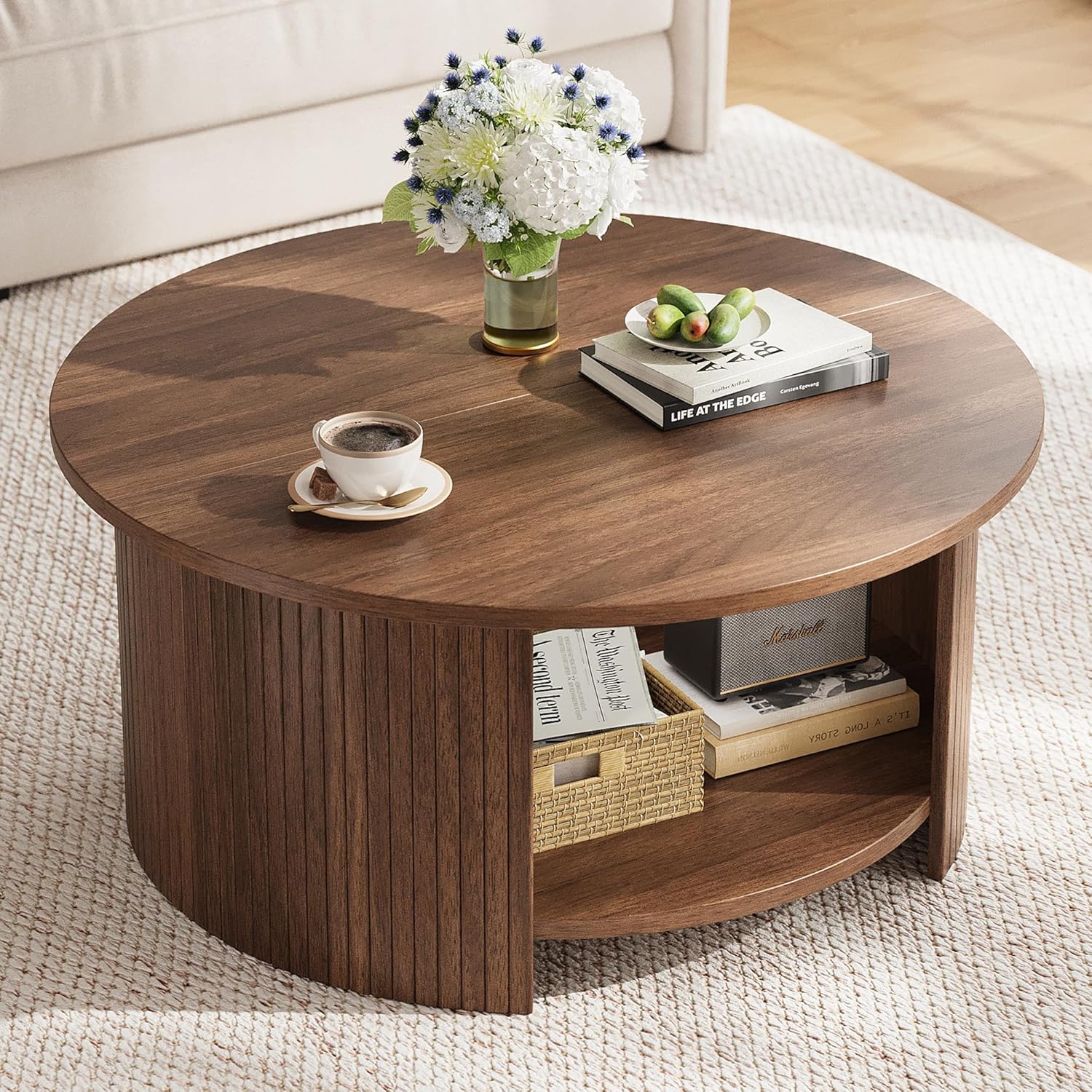
A drum or solid base gives the most visual weight and the least underneath. Fine in a large room; it makes a small one feel fuller.
Storage, and whether you want it
Many round coffee tables have a lower shelf or a second tier. Worth thinking about honestly.
A lower shelf is genuinely useful for books, remotes and a tray — and it becomes a place things accumulate, in the middle of the room, permanently visible. If the room is small, an open lower shelf can make it feel more cluttered rather than less.
A lift-top raises the surface to working height for a laptop or a meal. Useful in a studio, and the mechanism is another thing that can fail — check it feels positive rather than loose.
A closed drum with storage inside hides the clutter, which in a small room is the better trade.
The top, and what it has to survive
A coffee table takes more abuse per square inch than a dining table. Feet go on it, mugs go on it without coasters, and it lives under whatever the room throws.
A solid timber top — usually stave laminated from narrow strips — can be sanded and refinished repeatedly, which over a decade is the property that matters. A veneered top on a stable core stays flatter and can be refinished once or twice. Both are legitimate; the difference is what happens after a deep scratch, and the three constructions are compared in what engineered wood actually is.
On finish: oil marks more easily and can be repaired with a cloth; lacquer resists more and cannot be repaired in place. On a coffee table, where heat rings from mugs are the most common damage, an oiled top that you can fix yourself is usually the better trade. Species and hardness are covered in how hard a coffee table top needs to be.
Getting the placement right
Mark the circle on the floor with tape before ordering. Check three things by walking it:
- Can you get from the doorway to the far seat without turning sideways?
- Can someone sitting at the end of the sofa reach the table without standing up?
- Does a chair or a footstool still fit where you want it?
Ten minutes with masking tape settles all three, and it is the only test that accounts for your actual room rather than an average one.
For a coffee table in use
- Felt pads A pedestal foot concentrates the load into a few points on the floor
- Coasters Heat and water rings are the commonest damage on any coffee table
- Hardwax oil For an oiled top; a yearly refresh removes most accumulated marks
- Painter’s tape Mark the circle on the floor and walk around it before ordering
What to buy



For the hardness and finish question in detail, see hardwood coffee tables and how they wear. The same round-versus-rectangle logic applied to eating is in round dining tables.
Questions we get asked
How tall should a coffee table be?
Level with the sofa seat or up to two inches lower — typically 16 to 19 inches. Measure your own sofa rather than assuming.
How far should a coffee table be from the sofa?
Fourteen to 18 inches. Close enough to reach a mug seated, far enough to walk past without turning sideways.
What size round coffee table for a three-seater sofa?
About two thirds the sofa length. For a 78-inch sofa that is roughly 32 to 36 inches in diameter.
Is a round coffee table better for a small room?
Usually. No corners at shin height, less of the walkway taken at the worst point, and it works with an L-shaped sofa.
Are lower shelves on coffee tables useful?
Useful for storage, and they are permanently visible in the middle of the room. In a small space, closed storage often feels better.
What finish survives a coffee table best?
Lacquer resists marks better; oil can be repaired by you. Given that heat rings are the most common damage, repairability usually wins.