How tall should a TV stand be? Screen centre at eye level
The Wooden Stars is a participant in the Amazon Services LLC Associates Program. We may earn a commission when you buy through links on our site, at no extra cost to you.
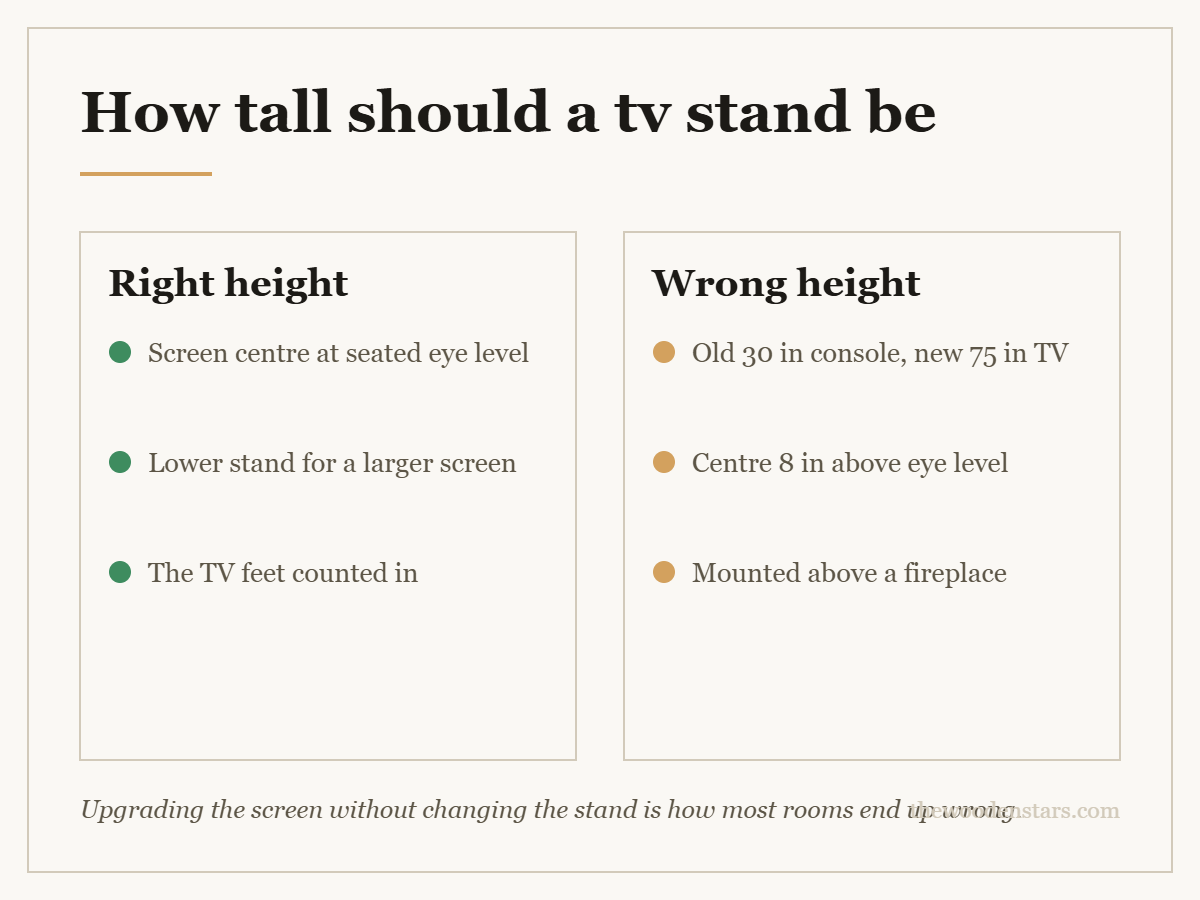
How tall should a TV stand be? Tall enough that the centre of the screen sits at your seated eye level — which for most sofas and most televisions means a stand of 20 to 26 inches.
It is a two-number calculation, and doing it takes about a minute. Skipping it is why so many people watch television at a slight upward angle and never work out why their neck aches.
Seated eye level is 38 to 42 inches from the floor on a normal sofa. The centre of the screen should land there. So: stand height = 40 minus half the screen height. A 55-inch TV is about 27 inches tall, half is 13.5, so the stand wants to be around 26 inches. A 65-inch TV is 32 inches tall, so the stand drops to about 24. Bigger screens need lower stands, which is the opposite of what most people assume. Measure your own seated eye height rather than trusting the average — sofas vary by 6 inches.
How tall should a TV stand be: the two measurements
One: your seated eye height. Sit where you actually watch and measure from the floor to your eyes. A firm sofa gives 40 to 42 inches; a deep, soft one gives 36 to 38. This varies more between sofas than between people, which is why the average is a poor substitute.
Two: the screen height. Not the diagonal. A 16:9 screen’s height is roughly half its diagonal:
- 43 in diagonal ⇒ about 21 inches tall
- 55 in ⇒ about 27
- 65 in ⇒ about 32
- 75 in ⇒ about 37
Then: stand height = seated eye height − (screen height ÷ 2) − the TV’s own feet, which add 2 to 4 inches on most sets.
| TV diagonal | Screen height | Stand height (40 in eye level) |
|---|---|---|
| 43 in | 21 in | 28 to 30 in |
| 50 in | 25 in | 26 to 27 in |
| 55 in | 27 in | 25 to 26 in |
| 65 in | 32 in | 22 to 24 in |
| 75 in | 37 in | 18 to 20 in |
| 85 in | 42 in | 15 to 17 in |
Why bigger screens want lower stands
This is the part that surprises people, and it follows directly from the arithmetic.
The screen’s centre is fixed at eye level. A taller screen extends further above and below that centre — so its bottom edge sits lower, and the stand under it must be shorter.
Which is why a 75-inch television on the 30-inch console that suited a 43-inch set ends up with its centre at 48 inches, eight inches above eye level. Everyone in the room tilts their head back slightly for two hours.
If you are upgrading the television, the stand is part of the upgrade. That is the practical point of this whole calculation.
When to ignore the rule
Three situations where a different height is right.
A bedroom. Watching from bed means eye level at 44 to 50 inches sitting up against a headboard. That calls for a taller stand or a dresser top — the opposite of the living room answer.
A kitchen or a standing space. Standing eye level is 60 to 65 inches; a wall mount usually makes more sense than a stand.
Above a fireplace. Common and comfortable for nobody. If it is unavoidable, a tilting mount recovers some of it, but the honest answer is that it puts the screen 15 to 25 inches above where it should be.
Width and depth, while you are at it
Width. The stand should be at least as wide as the television, and the convention is 2 to 6 inches wider each side. A TV overhanging its stand looks unstable and is unstable — pedestal feet on modern sets are often set close to the edges.
Check the foot span, not the diagonal. Many 65-inch sets have feet 48 inches apart; some have them at the extreme corners. A 50-inch-wide stand fails the second kind. This is the single most common return in the category.
Depth: 16 to 18 inches. Enough for the feet plus a console or a soundbar in front. Under 14 and modern pedestal feet hang off the back.
Small-room versions are in TV stands for small spaces and the storage side in media consoles with storage.
What else the height has to clear
- A soundbar. Three to 4 inches tall, and it goes in front of the screen. Either the stand’s top shelf has room above the TV’s feet, or the soundbar blocks the bottom of the picture.
- Ventilation. A closed cabinet with a receiver in it wants ventilation holes in the back panel, which is not universal.
- Cable drop. A hole or gap at the back, because cables routed around the side are what make a tidy stand look untidy.
- Anti-tip. A large television on a stand is a tipping hazard around children — strap the TV to the stand and the stand to the wall.
Construction points are the same as any long cabinet: a solid back let into a groove rather than pinned on, and a top that does not bow under 60 lb of television. See what engineered wood actually is and how to fix a sagging shelf.
Setting it up
- TV anti-tip strap kit Straps the set to the stand and the stand to the wall
- Tape measure Measure the foot span, not the screen diagonal
- Cable management sleeve What separates a tidy stand from an untidy one
- Furniture levelling shims A long low stand on an uneven floor rocks under the TV
What to buy


For the pieces, see media consoles with storage and TV stands for small spaces. For the similar-looking alternatives, credenza against console table and sideboards with storage. For depth logic, how deep a sideboard should be.
Questions we get asked
How tall should a TV stand be?
Twenty to 26 inches for most living rooms. The rule is that the screen centre should sit at seated eye level, which is 38 to 42 inches.
How do I calculate it for my TV?
Stand height = seated eye height − half the screen height − the TV’s feet. A 16:9 screen is about half its diagonal in height.
Does a bigger TV need a taller stand?
No, a shorter one. A taller screen extends further below its centre, so its bottom edge sits lower.
How wide should the stand be?
At least as wide as the TV, ideally 2 to 6 inches wider each side — and check the foot span, which is what actually has to land on it.
What about a TV in a bedroom?
Eye level sitting up in bed is 44 to 50 inches, so a bedroom wants a taller stand or a dresser top.
Is a TV above a fireplace too high?
Almost always — it puts the screen 15 to 25 inches above the ideal. A tilting mount recovers some of it, not all.