Wobbly Side Table or Bent Hairpin Legs: What to Replace and How
The Wooden Stars is a participant in the Amazon Services LLC Associates Program. We may earn a commission when you buy through links on our site, at no extra cost to you.
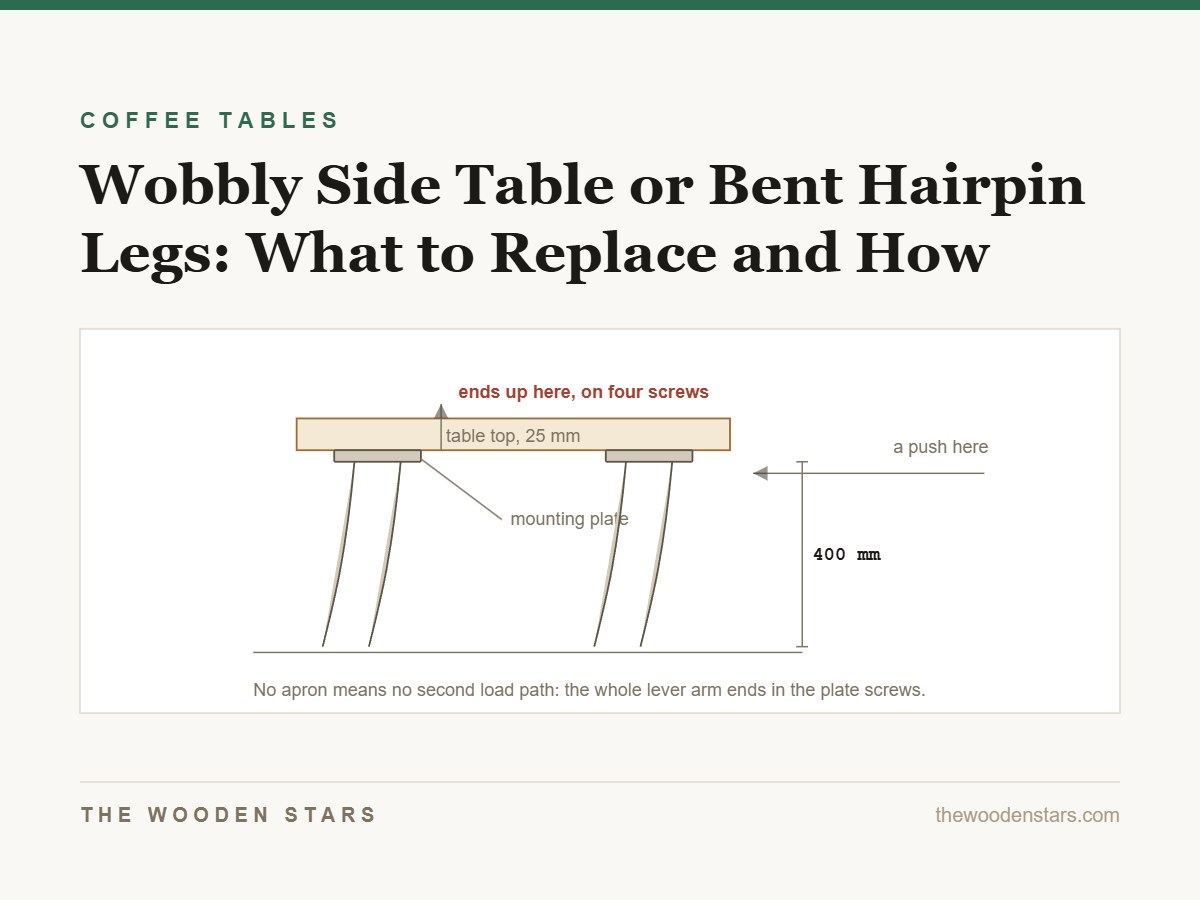
Side tables and coffee tables fail differently from every other piece of furniture in the house, and for a structural reason: most of them have no apron. There is a top, and there are legs bolted to the underside of it, and nothing else. Every sideways push you apply — dragging the table across a rug, knocking it with a foot — lands entirely on a small group of screws.
Which is why the two most common faults on a low table are a wobbling leg fixing and a bent hairpin leg, and both are among the cheapest repairs in furniture.
A wobbling side table is almost always the leg mounting plate: the screws have loosened or the holes have stripped. Tighten them; if they spin, plug the holes with glued dowel and re-drill. Bent hairpin legs cannot be straightened reliably — they are sprung steel and they take a permanent set — so replace the set. And always lift a hairpin-legged table, never slide it.
Start here: a set of four 16 in hairpins is the coffee-table height, and legs are always replaced as a set, never one at a time.

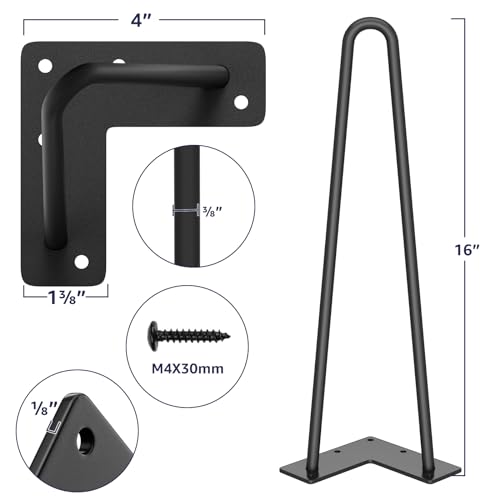
Prime SMARTSTANDARD 16" Hairpin Furniture Legs, Black 4PCS




Why the fixing loosens
Consider the geometry. A 16 in hairpin leg gives a 400 mm lever arm. A modest sideways push at the top of the leg becomes a large force trying to lever the mounting plate off the underside of the table, and it is resisted by four screws into perhaps 20 mm of wood.
Two consequences follow, and they explain almost every low-table complaint:
- Wood compresses under the plate. The plate beds in slightly, the screws lose their preload, and the leg develops a small amount of play. That play then multiplies the wear.
- Sliding is much worse than lifting. Dragging the table sideways applies exactly the load the fixing is least able to resist, and it is what bends hairpins.
Diagnose in two minutes
| Symptom | Cause | Fix |
|---|---|---|
| Wobble that disappears when you hold the leg | Loose mounting plate screws | Tighten; plug and re-drill if stripped |
| Wobble with the plate tight | Bent leg, or splayed hairpin | Replace the legs |
| Table rocks on the floor | Uneven leg length or a missing pad | Felt pads, or levelling glides |
| Screws spin without tightening | Stripped holes | Glued hardwood dowel, then re-drill |
| Plate has torn out of the top | Screws too short, or the top is thin | Longer screws with a larger plate, or through-bolts |
| Leg not perpendicular | Plate fitted crooked, or a bent leg | Re-fit; check with a square |
| Squeak when weight shifts | Metal on wood at the plate | A felt or rubber washer under the plate |
Fixing a stripped screw hole properly
Not with a longer screw and not with a matchstick. Both are temporary, and the second is a woodworking joke that people take seriously.
- Drill the stripped hole out to suit a hardwood dowel — 6 or 8 mm is usual.
- Glue a length of dowel in with PVA, grain running the same way as the surrounding wood, and let it cure fully. Overnight, not an hour.
- Trim flush and drill a fresh pilot hole into the dowel.
- Refit with the correct screw length: long enough to hold, short enough not to break through the top. On a 25 mm top, 16 to 19 mm.
This gives you a fixing that is stronger than the original, because you are now screwing into hardwood end grain rather than into whatever the top happens to be. For a top that has torn out entirely, or a thin top, the honest answer is through-bolts with a washer and nut on top — visible, and unbreakable.
Hairpin legs: sizing and replacing
Hairpin legs are the most-retrofitted furniture part there is, and the sizing is simple once you know the convention: they are sold by height, and the height quoted is the leg, not the finished table.
| Table | Leg height | Finished height with a 25 mm top |
|---|---|---|
| Coffee table | 16 in / 400 mm | about 425 mm |
| Side table | 22 in / 560 mm | about 585 mm |
| Console / sofa table | 28 in / 710 mm | about 735 mm |
| Dining table or desk | 28 in / 710 mm | about 735 mm |
| Bench | 16–18 in / 400–450 mm | about 425–475 mm |
| Bar height | 40 in / 1,000 mm | about 1,025 mm |
Two further specifications matter:
- Rod diameter. 10 mm (3/8 in) for light tables; 12 mm (1/2 in) for anything carrying weight or over 22 in tall. Thin rods on a tall leg are the usual reason a set feels springy.
- Number of rods. Two-rod legs are the classic look and are less stable; three-rod legs are noticeably stiffer, especially at desk and dining heights.
On the coffee-table side there is also a proportion question that matters more than the hardware: a coffee table should sit within an inch or two of the sofa’s seat height, and about two-thirds of its length. The full set of relationships is on our coffee and side tables hub.
Why you cannot straighten a bent hairpin
Hairpin legs work because the steel flexes — that is the design. Sprung steel returns to shape within its elastic range and takes a permanent set beyond it. Once a leg has splayed, the metal has yielded, and bending it back puts a second yield in the opposite direction at the same point. It will look nearly right and be measurably weaker, and it will bend again at that spot.
Replace the set — all four, not one, because a new leg among three tired ones gives you a table that rocks.
Fitting new legs squarely
- Set the legs in from the corners, typically 40 to 60 mm. Right at the corner gives the screws end grain and no surrounding material; too far in makes the table tippy.
- Mark all four positions from the same two edges so they are symmetrical. Measuring each leg from its nearest corner accumulates error.
- Pilot-drill everything, especially in oak, maple and beech, which split around a dry screw.
- Check perpendicular with a square before final tightening — hairpin legs are usually meant to splay slightly outward, so match all four rather than aiming for vertical.
- Add felt pads to the feet, and re-tighten after a month once the wood has bedded in.
What you need
- Hairpin legs, 16 in, set of 4 Coffee table height; replace as a set On Amazon →
- Hairpin table legs, 16 in, heavy duty Higher load rating for a thicker top On Amazon →
- Leg mounting plates The part that actually fails when a leg loosens On Amazon →
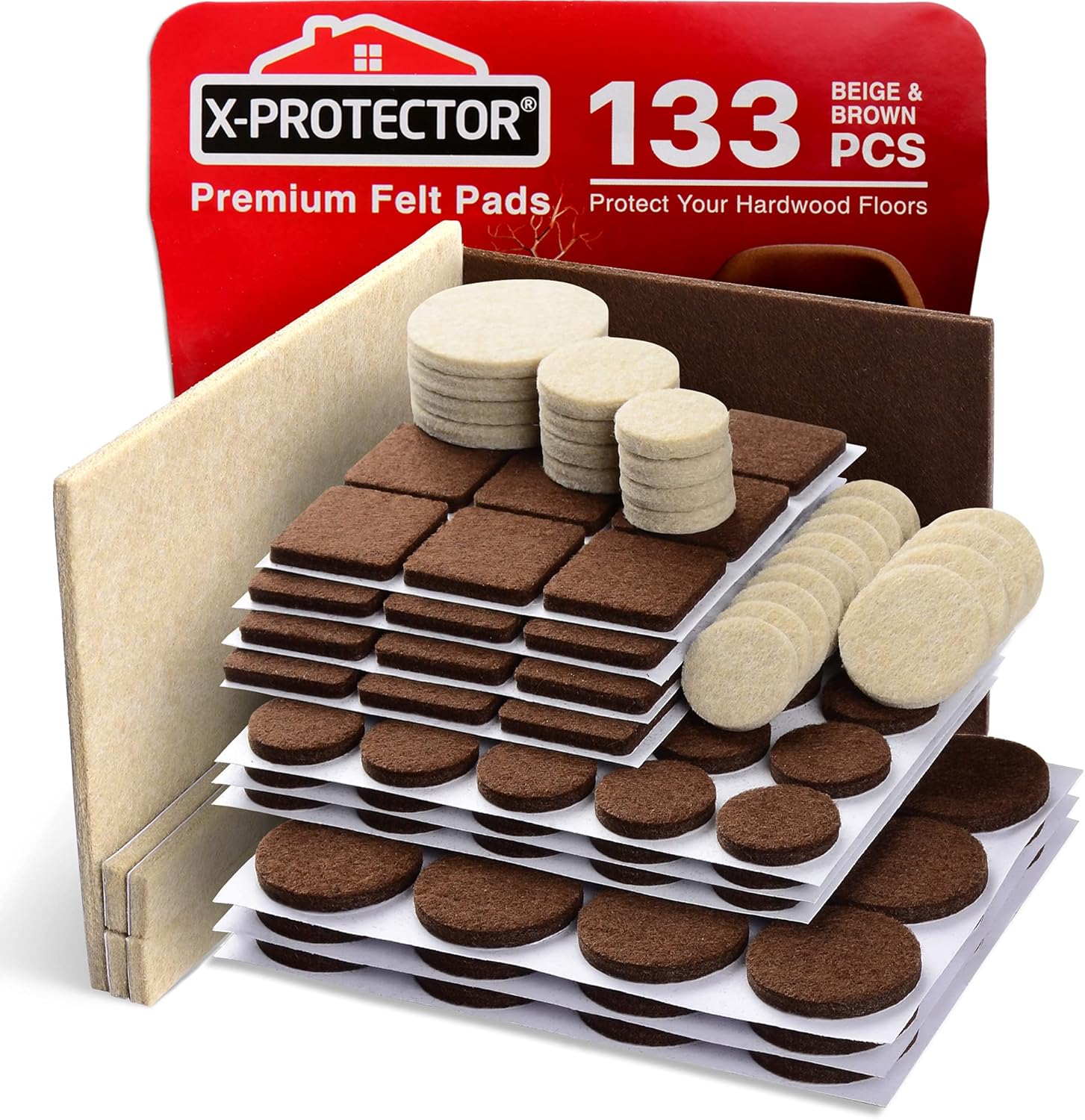
- Felt furniture pads Protect the floor and stop the temptation to slide On Amazon →
- Hardwood dowel and PVA The proper repair for a stripped screw hole
What to buy
Sixteen inches for a coffee table, and buy plates too if your legs currently sit on a single central screw.


The other low-table injury: white rings
Coffee tables meet standing water more than any surface in the house except a kitchen counter — glasses without coasters, condensation, wet bottles. The result is a white ring, and it is almost always in the finish rather than in the wood, which means it is usually reversible in minutes. Our guide to removing water rings covers the ladder, starting with a dry iron and a cotton cloth.
On a veneered top the same water has a second consequence: it swells the core at the edge and lifts the veneer. That one is a glue-and-clamp repair, and it is only fixable while it is early.
Questions we get asked
Can I fit hairpin legs to any table top?
Almost. The constraints are thickness — you need at least 19 mm for screws to hold, and 25 mm is comfortable — and material. Solid wood and plywood hold screws well; MDF holds them poorly and particleboard barely at all. On board material, use through-bolts rather than screws.
Do hairpin legs need a cross brace?
At coffee-table height, no. At 28 in and above, a three-rod leg or a brace between legs makes a real difference — that is the height at which two-rod hairpins start to feel lively under a desk. If the table will take a load, choose 12 mm rod.
Why does my side table wobble only on the rug?
Because a rug is compressible and unevenly so. Small tables with narrow feet sink into pile by different amounts, and the table effectively has four different leg lengths. Wider feet or a pad under each leg spreads the load; levelling glides let you dial it out.
Are mounting plates worth fitting if my legs screw in directly?
Yes, if the leg has a single central bolt or screw. One fixing means the leg can pivot, and the pivoting is what strips the hole. A plate turns one fixing into four or more and spreads the leverage over a larger area of the top.
Should I glue the mounting plate as well as screwing it?
No. You want to be able to remove it — for a house move, for a repair, for a change of legs — and glue on the underside of a finished top will pull finish off when it comes away. Screws with a washer, correctly sized, re-tightened once after bedding in, is the right specification.