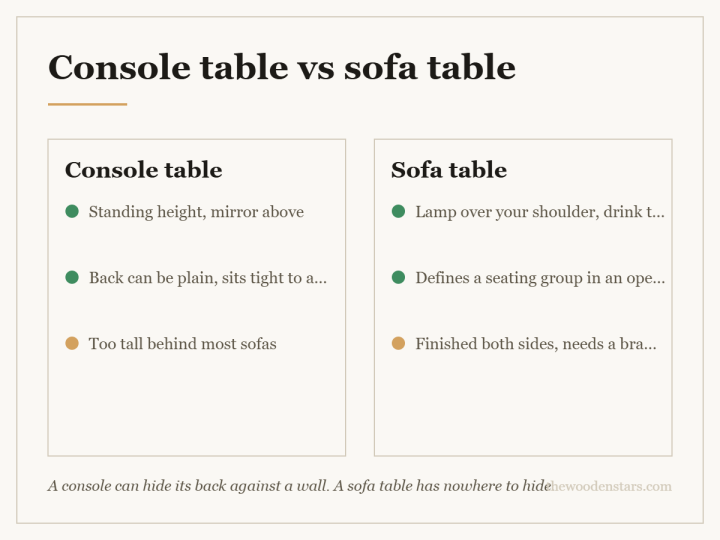
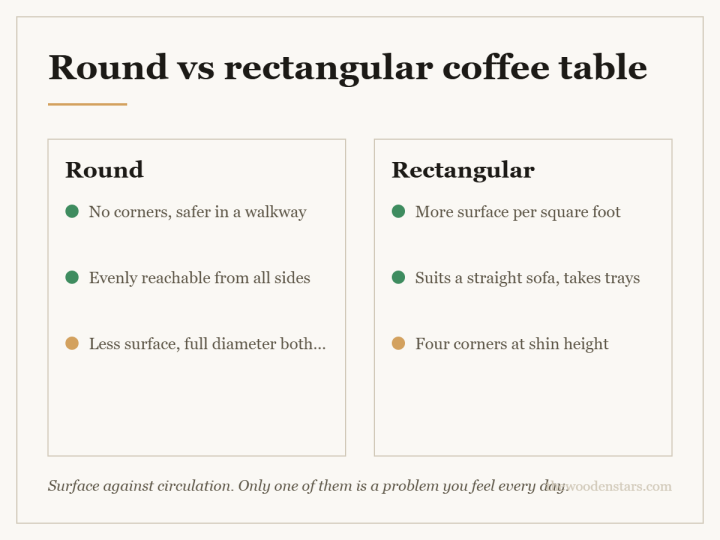
Coffee table with storage vs without — What it costs
The Wooden Stars is a participant in the Amazon Services LLC Associates Program. We may earn a commission when you buy through links on our site, at no extra cost to you.
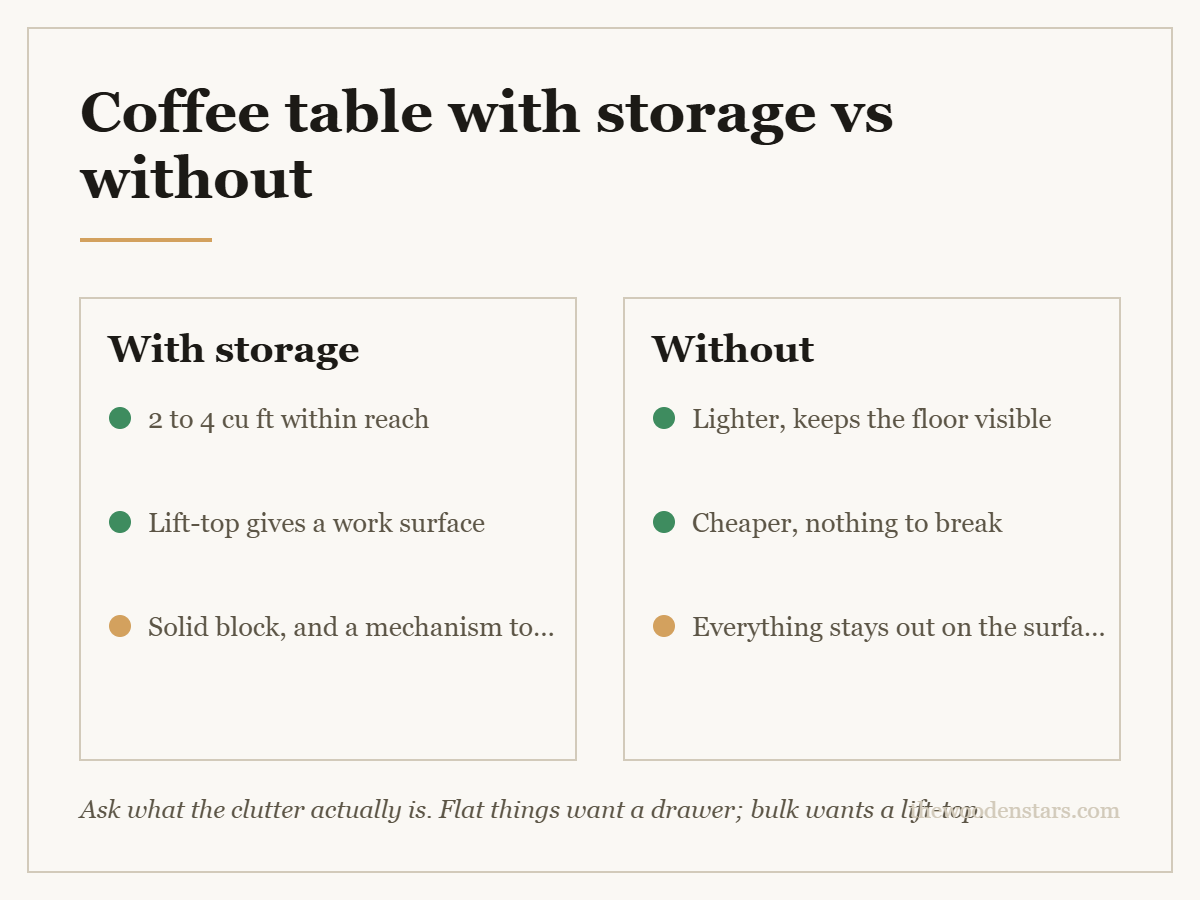
Coffee table with storage vs without is a trade of height and lightness for about 2 to 4 cubic feet of space you can reach from the sofa.
Whether that is a good deal depends almost entirely on whether the storage is the right shape for what actually accumulates in your living room.
A storage coffee table — drawers, a lower shelf or a lift-top — holds 2 to 4 cubic feet: remotes, chargers, board games, throws, magazines. It costs visual lightness (a closed box instead of a frame), sometimes 2 to 3 inches of height, and on drawer models it needs clearance to pull out. A table without storage reads lighter, makes a small room feel bigger, costs less and has nothing to fail. The deciding question is not whether you want storage — it is whether the clutter you want to hide is flat. Drawers take flat things; only a lift-top or an open shelf takes bulk.
Coffee table with storage vs without: the three kinds
“Storage” covers three quite different things, and they are not interchangeable.
Drawers. Typically 3 to 4 inches deep inside, running from one or both sides. Excellent for remotes, coasters, chargers, playing cards and paperwork. Useless for anything bulky. Detail in coffee tables with drawers.
An open lower shelf. The cheapest and most common. Takes books, baskets and a tray — and displays everything on it, so it is storage only in the sense that the floor is storage. It also makes vacuuming harder.
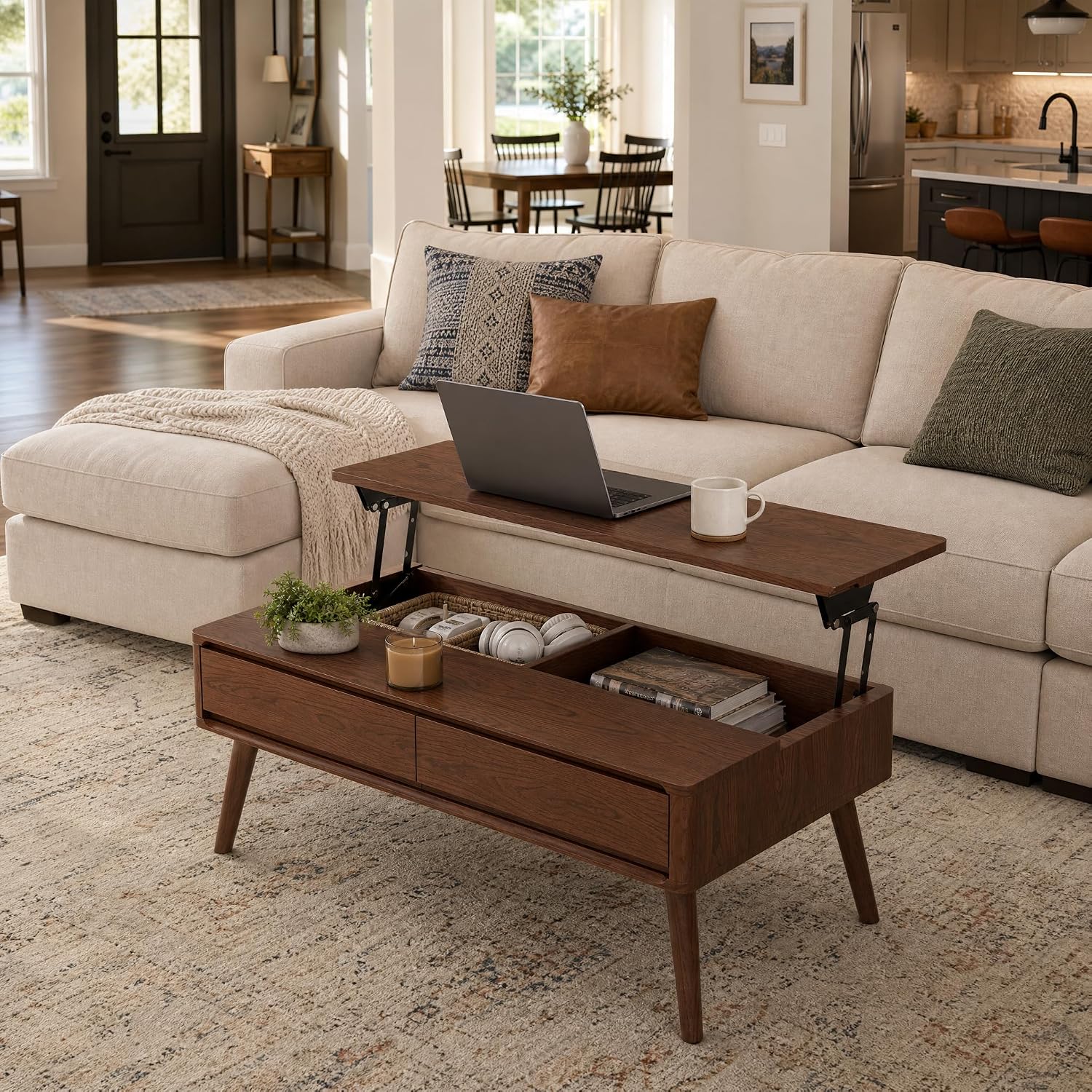
A lift-top. The whole surface hinges up and forward, revealing a deep well and giving you a work surface at laptop height. Holds the most — 3 to 4 cubic feet — and is the only version that takes bulky things like throws and games. See lift-top coffee tables.
| Type | Capacity | Takes | Costs |
|---|---|---|---|
| No storage | — | — | Nothing |
| Open shelf | 1 to 2 cu ft | Books, baskets, a tray | Everything is on show |
| Drawers | 0.5 to 1 cu ft | Remotes, chargers, cards | Clearance to pull out |
| Lift-top | 3 to 4 cu ft | Throws, games, laptops | Height, weight, a mechanism |
What storage costs the room
Visual weight. A coffee table with a closed base is a solid block in the middle of the floor. An open-framed table lets you see the rug underneath, and in a small room that difference is real — it is the same reason people choose leggy sofas.
Height, on lift-tops. The mechanism needs somewhere to live, so lift-tops often sit at 18 to 20 inches rather than 16 to 18. That can put the table above the sofa seat, which is the one height rule that matters — see coffee table dimensions.
Clearance, on drawers. A drawer needs its own depth of floor to open, and a coffee table sits in the middle of a walkway. If the drawer opens towards the sofa, the 14 to 18 inch gap to the sofa has to absorb it.
A mechanism. Lift-top hinges are the part that fails. Gas struts sag, and the cheap scissor versions develop play and then wobble under a laptop. A table with no storage has nothing that can break.
Where storage earns it
A living room that is also something else. A room used for work, homework or by children generates things that need to disappear before the evening. This is the strongest case, and it is a lift-top case specifically.
Small flats with no other storage. Three cubic feet is not nothing when there is nowhere else.
Remotes and chargers. Genuinely improved by one shallow drawer. This alone justifies a drawer model for many people, and it is the cheapest form of storage to buy.
Throws and blankets. Bulky, used daily, and nowhere obvious to live. Lift-top or a large open shelf with baskets.
What to check on a lift-top specifically
This is the version with something to go wrong, so it is worth the inspection.
- The mechanism should hold at any height, not just fully up and fully down. A top that drops halfway is one that will pinch fingers.
- No lateral play. Push the raised top sideways. Movement now becomes a wobble under a laptop within a year.
- The top should come forward as well as up — that is what brings it over your knees. A top that only rises is much less useful.
- Height when raised: 26 to 30 inches, which is desk height from a sofa. Lower and you stoop.
- Weight rating. A raised top carrying a laptop and a plate is 15 to 20 lb on a cantilever.
The middle answer
An open lower shelf plus two baskets gets you most of the capacity of a closed base, keeps the table visually light, costs the least, and has nothing to fail. The baskets hide what needs hiding and can be removed when you want the room to look larger.
It is the answer for most living rooms, and it is rarely what gets sold, because it is the cheapest configuration.
Shape interacts with this too: drawers and lift-tops want a rectangle, while a round table usually offers only a shelf — round against rectangular coffee tables.
And whatever the base does, the top takes the abuse. Finish and durability are in hardwood coffee table durability and removing water rings.
Either way
- Storage baskets Turns an open lower shelf into hidden storage for a fraction of the price
- Serving tray with handles Clears the top in one move, storage or not
- Felt floor glides Coffee tables get pushed about more than any other piece
- Cable organiser box What a shallow drawer is genuinely best at hiding
What to buy
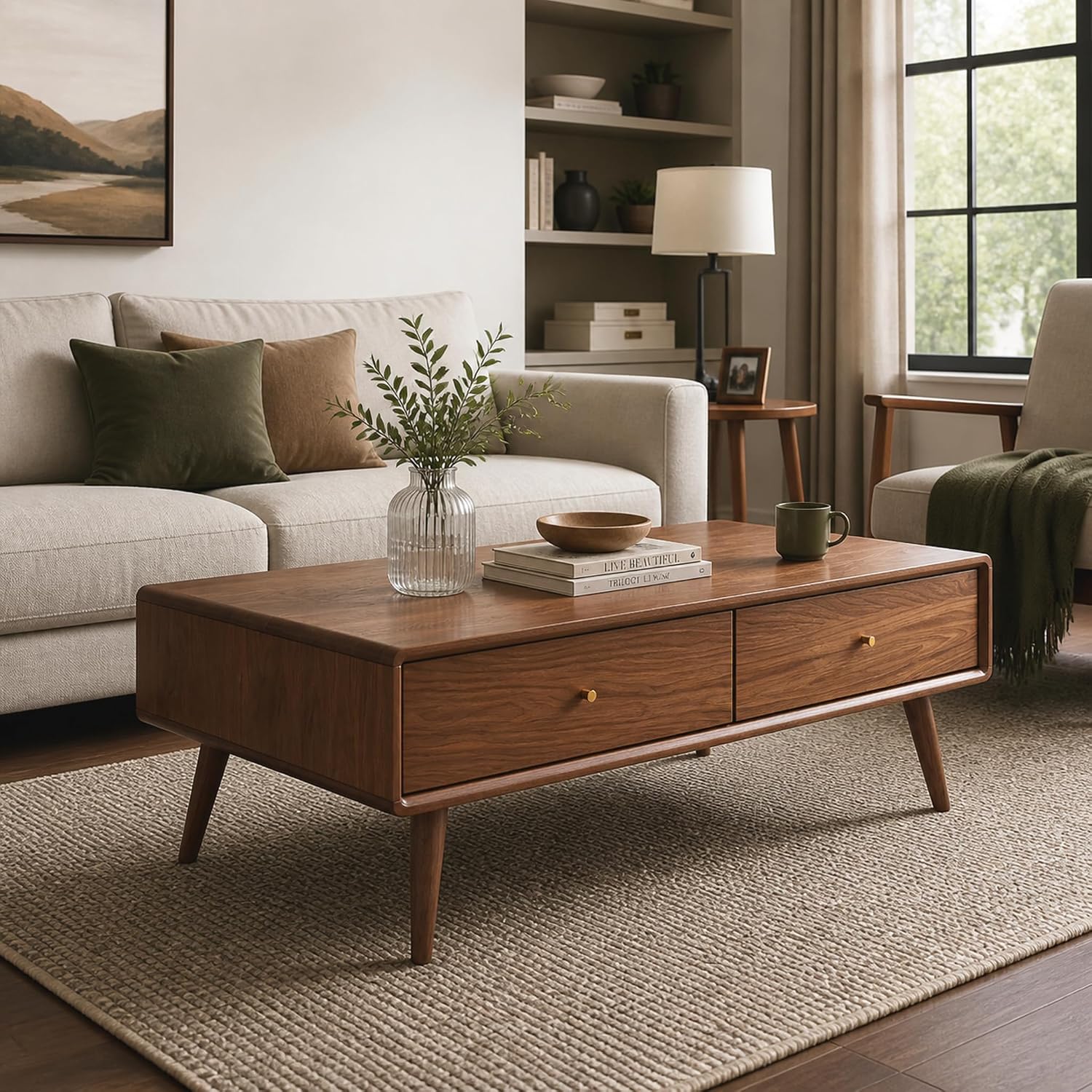


For the storage versions, see coffee tables with drawers and lift-top coffee tables. For sizing, coffee table dimensions and round against rectangular. For the round option, round wood coffee tables. For durability, hardwood coffee table durability.
Questions we get asked
Is a coffee table with storage worth it?
If the clutter you want to hide is flat — remotes, chargers, cards — a drawer is worth it cheaply. For bulk like throws and games you need a lift-top.
How much does a storage coffee table hold?
Two to 4 cubic feet. Drawers give half a cubic foot, an open shelf one to two, a lift-top three to four.
What does storage cost?
Visual lightness, sometimes 2 to 3 inches of height, floor to open drawers, and on lift-tops a mechanism that can fail.
Do lift-tops sit too high?
Often. They run 18 to 20 inches against 16 to 18, which can put the table above the sofa seat. Check against your sofa.
What should I look for on a lift-top mechanism?
It should hold at any height, have no sideways play, and bring the top forward as well as up.
Is there a cheaper middle option?
An open lower shelf with two baskets. Most of the capacity, none of the mechanism, and the table still looks light.