Console table vs sofa table — One word, two heights
The Wooden Stars is a participant in the Amazon Services LLC Associates Program. We may earn a commission when you buy through links on our site, at no extra cost to you.
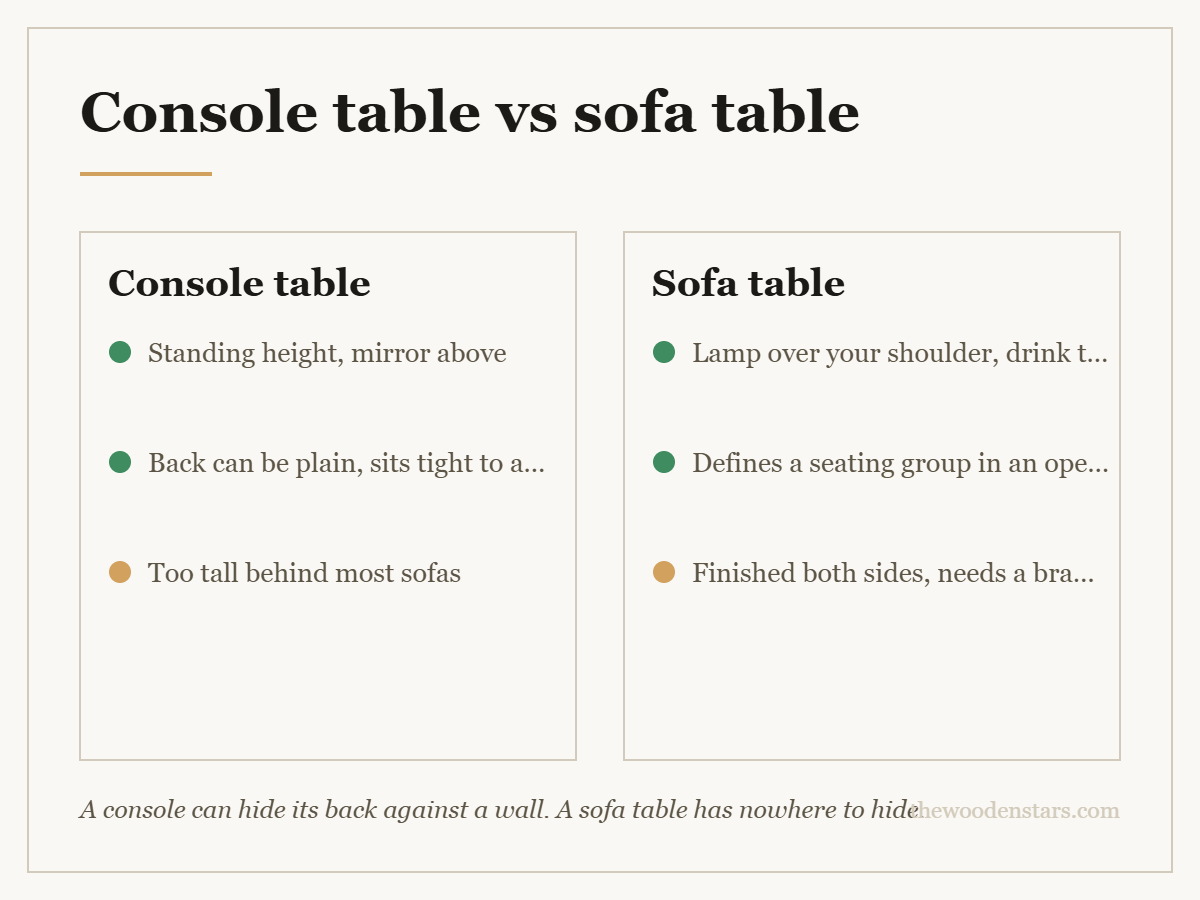
Console table vs sofa table is largely one object with two jobs. The same narrow table becomes a console against a wall and a sofa table behind a sofa — and the job changes the height you need.
Retailers use the words interchangeably, so buying on the name gets you nowhere. Buy on height and length instead.
Both are long, narrow tables 10 to 18 inches deep. A console table stands against a wall — in a hall, behind a door, under a mirror — at 30 to 34 inches, which is worktop height and suits standing. A sofa table stands behind a sofa and should be level with or 1 inch below the sofa back, usually 26 to 32 inches. Get that wrong and the table either disappears behind the sofa or stands proud of it. Length should be two-thirds to three-quarters of the sofa, and both want the same depth limit: anything over 18 inches becomes an obstruction.
Console table vs sofa table: the height is the whole decision
A sofa table is measured from the sofa back. Level, or up to an inch below. That way a lamp on it lights over your shoulder, a drink sits within reach from the seat, and the table reads as part of the sofa rather than a separate object behind it.
Sofa backs run 26 to 34 inches depending on the style, so there is no single correct table height — a low mid-century sofa at 27 inches and a high-backed one at 34 want different tables.
A console table is measured from the human. Standing height, 30 to 34 inches, so you can drop keys on it without stooping and a mirror above it sits at face height.
The overlap — 30 to 32 inches — is why one table often does both jobs. Outside that band, it does not.
| Measure | Console table | Sofa table |
|---|---|---|
| Height | 30 to 34 in | 26 to 32 in |
| Measured from | Standing use | The sofa back |
| Depth | 10 to 16 in | 12 to 18 in |
| Length | Half to two-thirds the wall | Two-thirds to three-quarters the sofa |
| Stands | Against a wall | Behind a sofa, in the room |
| Needs a wall | Yes | No, it is seen from both sides |
| Anchoring | Advisable if tall and narrow | Not usually |
Depth, which is where both go wrong
These are narrow tables on purpose. Ten to 18 inches is the range, and each end has a reason.
Under 10 inches and the top holds nothing useful — a lamp base alone is 6 to 10 inches across.
Over 18 inches and it stops being a console. In a hall, 18 inches of depth against a wall leaves a 36-inch corridor at 54; anything deeper and people turn sideways. Behind a sofa, a deep table pushes the whole seating group into the room.
Twelve to 14 inches is the sweet spot for a hall. Fourteen to 16 behind a sofa, where a drink needs to sit without being knocked by a head.
The deeper cousin of the same shape is a credenza, and the depth distinction is worked through in credenza against console table.
The sofa table’s other requirement: it is seen from both sides
A console goes against a wall, so its back can be plain, unfinished, or a stretcher rail.
A sofa table stands in the room. Whoever walks in sees the side you were not thinking about. That means:
- A finished back, or no back at all — an open frame reads correctly from either side.
- No exposed cable route. If a lamp stands on it, the flex runs down a leg in full view, so plan where the socket is.
- Drawers that are not obviously one-sided, or accept that the handles face the sofa.
It also has to be stable from a shove, because people lean on the back of a sofa. A table on four slim legs with no stretcher racks; look for a lower shelf or a cross brace.
Length, and the mistake people make
Behind a sofa, the table should be two-thirds to three-quarters of the sofa’s length, centred. An 84-inch sofa wants a 56 to 63-inch table.
A table the same length as the sofa looks like a shelf bolted on. A table half the length looks lost. The margin at each end is the point — it lets the sofa read as the larger object.
Against a wall, the rule is softer: half to two-thirds of the wall, and whatever hangs above it should be narrower than the table, not wider. A mirror wider than its console is the most common styling error in a hallway.
Storage versions are in entryway console tables with drawers.
What to check on either
- Measure the reference first — sofa back height, or the wall run including the skirting and any radiator.
- Racking. A long, narrow, four-legged table is the shape most prone to wobbling diagonally. A lower shelf, stretchers or corner blocks fix it — how to fix a wobbly table applies equally here.
- Top thickness. At 50 inches of span a thin top with no apron bows under a stack of books. Three-quarters of an inch minimum in solid timber.
- Tipping. A tall, narrow console with a drawer is easy to pull over. If there are children, strap it — the reasoning is the same as anti-tip kits for dressers.
- Feet. Both get pushed and dragged; felt glides save the floor — levelling feet and glides.
Material terms are in what engineered wood actually is, and finishing in the best finish for a solid wood top.
For either table
- Furniture anti-tip strap A tall narrow console with a drawer pulls over easily
- Felt floor glides Both get dragged, and both stand on the floor you care about
- Cable management clips A sofa table’s lamp flex is visible from the room side
- Levelling shims A long narrow table shows a floor dip more than any other shape
What to buy


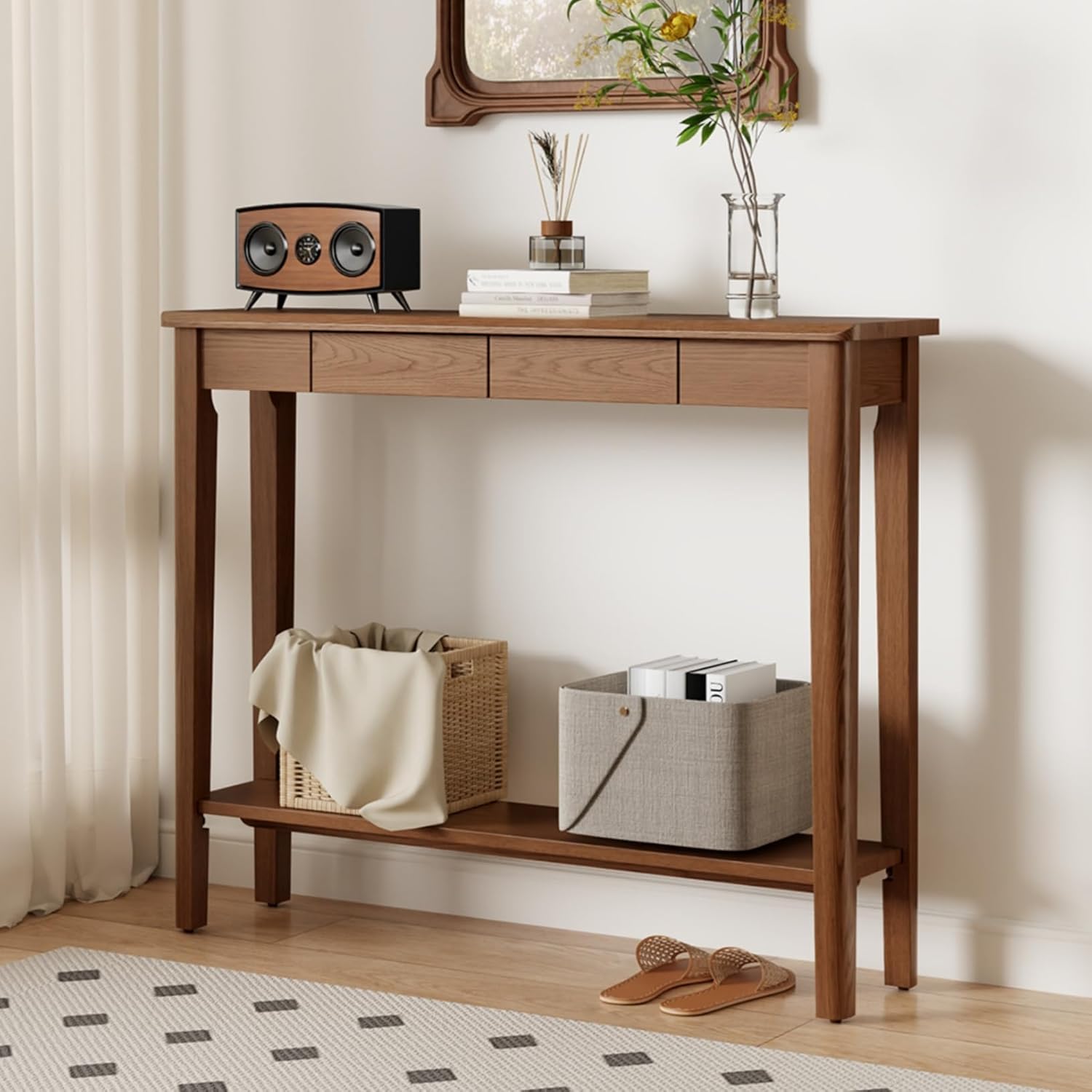
For the hallway version, see entryway console tables with drawers. For the deeper cousin, credenza against console table and sideboards with storage. For the low table in front, coffee table dimensions. For the bedroom equivalent, nightstand against side table.
Questions we get asked
What is the difference between a console table and a sofa table?
Placement, and therefore height. A console stands against a wall at 30 to 34 inches; a sofa table stands behind a sofa at 26 to 32, level with its back.
Can one table do both jobs?
If it falls in the 30 to 32-inch overlap and your sofa back is that height, yes. Outside that band, no.
How tall should a sofa table be?
Level with the sofa back or 1 inch below. Measure the sofa — backs run 26 to 34 inches.
How long should it be?
Two-thirds to three-quarters of the sofa, centred. An 84-inch sofa wants 56 to 63 inches.
How deep should a console table be?
Ten to 16 inches in a hall, 14 to 16 behind a sofa. Over 18 and it becomes an obstruction.
Does a sofa table need a finished back?
Yes, or an open frame. It stands in the room, so the side facing away from the sofa is the side people see first.