Ladder shelf vs bookcase — Lean or stand
The Wooden Stars is a participant in the Amazon Services LLC Associates Program. We may earn a commission when you buy through links on our site, at no extra cost to you.
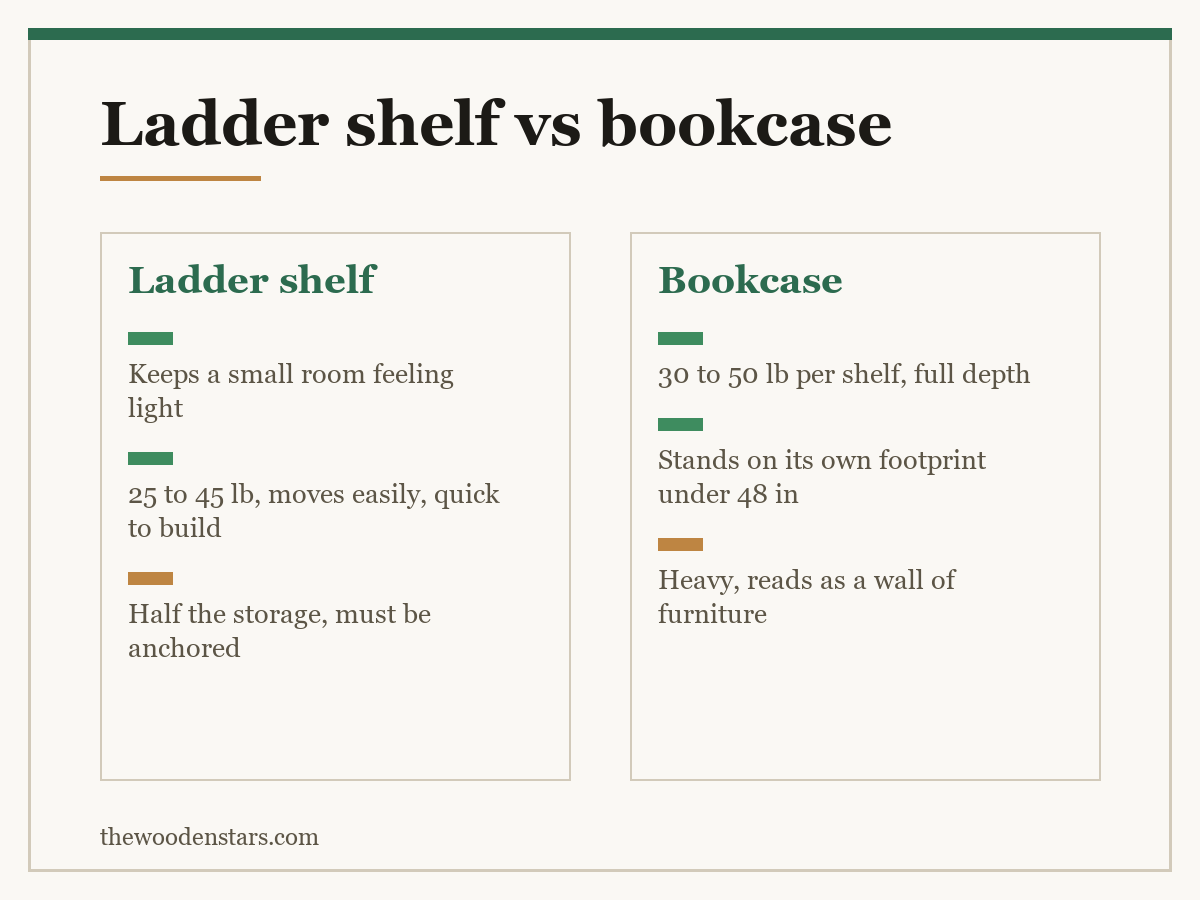
Ladder shelf vs bookcase is a trade of storage for lightness. A ladder shelf leans on the wall and tapers as it rises, so it holds perhaps half what a bookcase of the same height holds.
What it buys is a piece that does not read as a wall of furniture.
A ladder shelf leans against the wall at 10 to 15°, with shelves that taper from 12 to 14 inches at the bottom to 6 to 8 at the top. It weighs 25 to 45 lb, assembles in minutes, and its top shelves hold ornaments rather than books. A bookcase is vertical, full depth throughout, holds 30 to 50 lb per shelf and stores roughly twice as much. The ladder’s leaning geometry means it must be anchored — it is held up by friction and angle, both of which fail when someone pulls on it. Ladder for display in a light room; bookcase for books.
Ladder shelf vs bookcase: what the lean costs
- Depth tapers. Bottom shelf 12 to 14 inches, top shelf 6 to 8. A bookcase is full depth on every shelf.
- Storage. Roughly half, for the same height and footprint.
- Load per shelf. 10 to 25 lb against 30 to 50.
- Weight. 25 to 45 lb against 60 to 120, which is why a ladder shelf moves easily.
- Floor footprint. The base sits 6 to 10 inches out from the wall, so it occupies more floor than its shelves suggest.
The top shelf is the giveaway: at 6 to 8 inches it will not take a hardback front-on. It takes a photograph, a small plant, a candle. That is the piece’s actual job — how deep a bookshelf should be explains why 10 inches is the practical floor for books.
| Measure | Ladder shelf | Bookcase |
|---|---|---|
| Shelf depth | 6 to 14 in, tapered | 10 to 13 in throughout |
| Load per shelf | 10 to 25 lb | 30 to 50 lb |
| Total storage | About half | Baseline |
| Weight | 25 to 45 lb | 60 to 120 lb |
| Floor used | Base 6 to 10 in out | Flush to the wall |
| Assembly | Minutes | Longer |
| Must be anchored | Yes, always | Past 48 in |
The anchoring point, which is not a footnote
A leaning shelf is held up by two things: the friction of its feet on the floor and the angle it makes with the wall. Both fail the moment someone pulls a shelf towards them, and children pull on shelves.
So a ladder shelf must be fixed to the wall at the top, every time, at any height. Most ship with a small bracket and screws for exactly this, and the bracket is the part people leave in the bag.
Two details specific to the format:
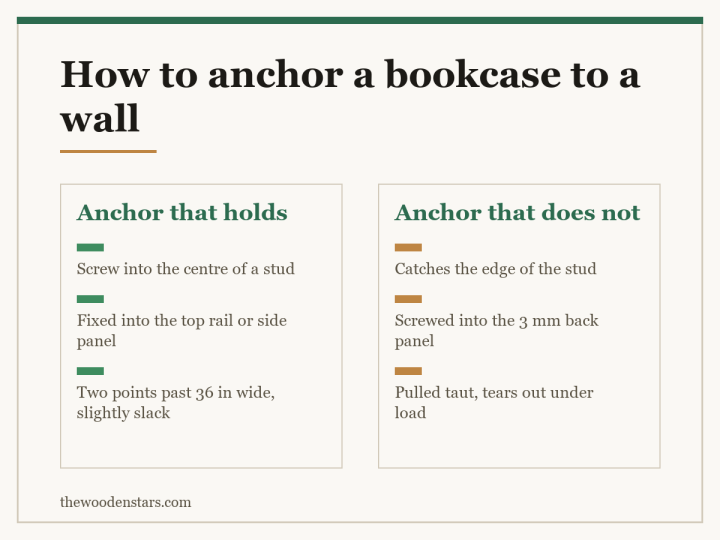
The fixing has to reach a stud. The whole load transfers to one or two points at the top, so a plasterboard plug is not enough — the method is in how to anchor a bookcase to a wall.
Hard floors reduce the friction. On tile or polished timber the base slides out under load, which increases the lean angle and makes it worse. Felt or rubber feet help; the wall fixing is what actually holds it.
A vertical bookcase is stable on its own footprint up to about 48 inches and then needs the same treatment — how tall a bookcase should be.
Where the ladder shelf genuinely wins
It does not block light or sightlines. Open sides, open back, tapering away from you. In a small or dark room a 72-inch ladder reads far lighter than a 72-inch bookcase of the same height.
It suits display. Tapering shelves naturally sort objects by size — big things low, small things high — which is how people arrange ornaments anyway.
It moves. Thirty pounds, no fixings beyond one bracket, carried by one person. For renters and for rooms that get rearranged, that matters.
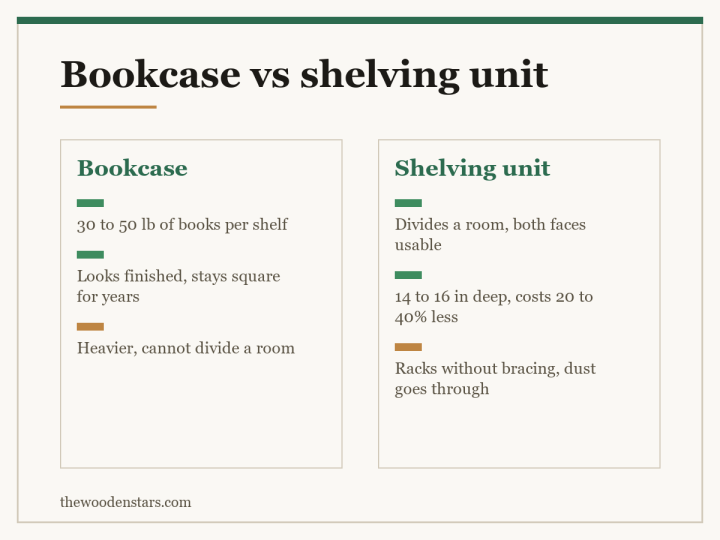
It costs less and assembles in minutes, because there is no carcass and no back panel to square up — the structural difference set out in bookcase against shelving unit.
It works beside a desk or a sofa where a full bookcase would crowd. The base sits out but the top pulls away, so it takes less visual room at head height.
Which to buy
Buy the ladder shelf if the contents are plants, photographs, small baskets and a handful of books; the room is small or dark; you rent or rearrange often; or the piece sits beside something else and a full bookcase would crowd it.
Buy the bookcase if you own books in quantity. A run of hardbacks is 30 to 40 lb per foot, which is past what most ladder shelves are rated for, and the top half of a ladder cannot take them at any weight because the shelves are too shallow.
The honest middle: a low bookcase at 36 inches for the books, with a ladder shelf elsewhere for display. Two pieces doing one job each, rather than one piece doing both badly.
Whichever way, check the shelf span stays under about 32 inches unsupported — how to fix a sagging bookshelf — that the material is what the listing claims, per engineered wood against hardwood, and the height against bookcase dimensions.
Either piece
- Anti-tip furniture straps A leaning shelf needs this at any height, not just tall ones
- Stud finder A ladder’s whole load goes through one or two top fixings
- Felt or rubber feet Stops the base sliding out on tile or polished timber
- Storage baskets What makes a shallow tapered top shelf hold anything useful
What to buy


For sizing, see how tall a bookcase should be and how deep a bookshelf should be. For the other formats, bookcase against shelving unit and space saving bookshelf.
Questions we get asked
What is the difference between a ladder shelf and a bookcase?
A ladder shelf leans and tapers, holding about half as much. A bookcase is vertical and full depth on every shelf.
Can a ladder shelf hold books?
On the bottom two shelves, yes. The top shelves are 6 to 8 inches deep and will not take a hardback front-on.
Does a ladder shelf have to be anchored?
Yes, always. It is held up by friction and angle, and both fail when someone pulls on a shelf.
How much does each hold per shelf?
Ten to 25 lb on a ladder shelf, 30 to 50 on a bookcase.
Why does my ladder shelf slide?
Hard floors reduce the friction at the base. Felt or rubber feet help; the wall fixing is what actually holds it.
Which suits a small room?
The ladder shelf, because it tapers away and does not block light — provided you do not need the storage.