Space saving bookshelves — Height, depth and the wall
The Wooden Stars is a participant in the Amazon Services LLC Associates Program. We may earn a commission when you buy through links on our site, at no extra cost to you.

Books are dense, and a book collection grows faster than the floor it sits on. In a small room the answer is almost never a bigger bookcase — it is a shallower one, a taller one, or one that is not on the floor at all.
Three dimensions, and the one most people cut is the one that costs the most capacity.
Three ways to save space, in order of how little they cost you. Go shallower — 6 to 8 inches instead of 11 to 12 — which suits paperbacks perfectly and halves the floor depth. Go taller — up to the ceiling, because the top two feet of a wall are almost always empty. Go off the floor — wall-mounted shelves have no footprint at all, but they must go into studs, because a metre of books is 30 to 40 kg. What not to cut is shelf span: a long shelf sags permanently, and the fix costs more than the saving.
Shallow is the best first move
A standard bookcase is 10 to 12 inches deep. Most books do not need that.
| Contents | Depth needed | Floor saved vs 12 in |
|---|---|---|
| Mass-market paperbacks | About 7 in | 5 in per run |
| Trade paperbacks | 8 to 9 in | 3 to 4 in |
| Standard hardbacks | 9 to 10 in | 2 to 3 in |
| Large-format books | 12 to 14 in | None; you need the depth |
| Display only | 4 to 6 in | 6 to 8 in |
Across a 10-foot wall, going from 12 inches deep to 8 gives back over three square feet of floor. In a small room that is a chair.
Deeper is not better, and it has a hidden cost: any shelf with spare depth behind the books acquires a second row within a year, and those books become invisible. The full sizing is in how deep a bookshelf should be.
Tall, because the top of the wall is empty
Most rooms use the bottom five feet of wall and ignore the rest. A bookcase that runs to the ceiling costs no extra floor at all and can add half its capacity again.
Three things to plan:
Reach. Anything above about 72 inches needs a step. Put the books you rarely open up there and the ones you use at eye level.
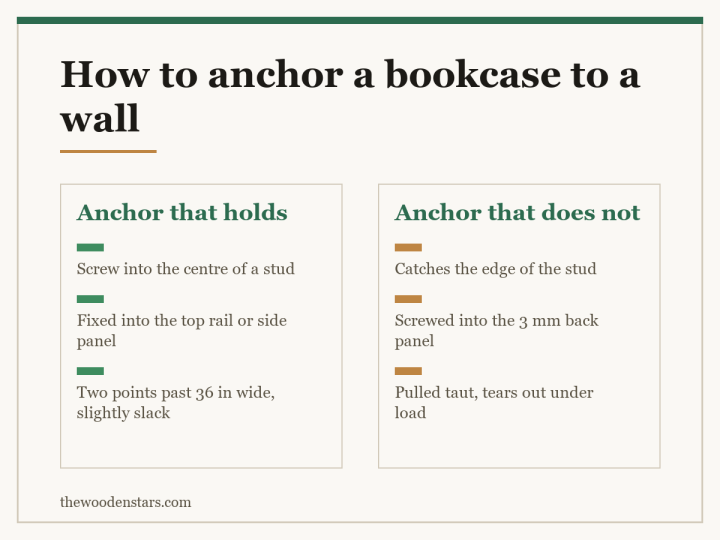
Anchoring. Not optional. A tall loaded bookcase with a child climbing it is a documented tip-over risk. Into a stud, with a strap, on assembly day.
Getting it upright. A unit taller than your ceiling height minus a few inches cannot be tilted up in the room once assembled. Check the diagonal, or buy one that assembles in place.
Off the floor entirely
Wall-mounted shelving has no footprint, which in a genuinely tight room beats every other option.
The requirement is fixings. A metre of shelf full of books is 30 to 40 kg, and that is a pulling load on the wall. Plasterboard anchors alone are not adequate, whatever the packaging says.
- Find the studs and put a bracket on each one you cross, with a bracket near each end of the run rather than only in the middle.
- Bracket length should be at least two thirds of the shelf depth. A 10-inch shelf on 6-inch brackets has four inches of unsupported overhang exactly where the books lean.
- Floating shelves carry the least — the hidden rod is the real limit. Fine for a row of paperbacks, wrong for hardbacks.
The options are in bookshelf brackets and brackets for floating shelves.
Places a bookcase fits that you have not considered
Above a door. A shelf across the top of a doorway is dead space in every room.
In the alcoves beside a chimney breast. Purpose-shaped, and usually wasted.
Under a window, up to sill height. A low run of shelving doubles as a surface.
Along a hallway. A 6 to 8-inch shelf in a 44-inch hallway still leaves the 36 inches of walking width a corridor needs.
Under the stairs, where shelves can follow the rake.
Corner units. A corner is the least useful part of any room and a corner bookcase turns it into storage.
The one thing not to economise on: span
Sag rises with the cube of span. Double the shelf length and the same load bends it roughly eight times as far — and timber and panel both take a permanent set, so a bowed shelf never recovers.
Practical limits with books on them:
- 3/4 inch particleboard or MDF: under about 30 inches.
- 3/4 inch plywood or solid timber: up to about 36 inches.
- 1 inch solid timber: up to about 42 inches.
A tall narrow bookcase with short shelves is structurally better than a wide low one with long shelves, and it saves floor at the same time. If a shelf has already bowed, see how to fix a sagging bookshelf.
Shelf spacing, which is free capacity
Fixed shelves spaced for hardbacks waste two inches above every row of paperbacks. Across six shelves that is a whole extra shelf’s worth of height thrown away.
Adjustable shelves on pins let you space to the books you actually own — and their presence tells you the sides are substantial enough to drill a column of holes. Spacing guide: 8 to 9 inches for paperbacks, 10 to 12 for hardbacks, 13 to 15 for large formats.
For a small room
- Stud finder Wall-mounted shelving carries real weight; studs are not optional
- Furniture anti-tip kit Mandatory on a tall bookcase, into a stud
- Shelf pins Spares let you re-space to the books you own and gain a shelf
- Bookends A half-full shelf leans, and leaning books bend the board
What to buy


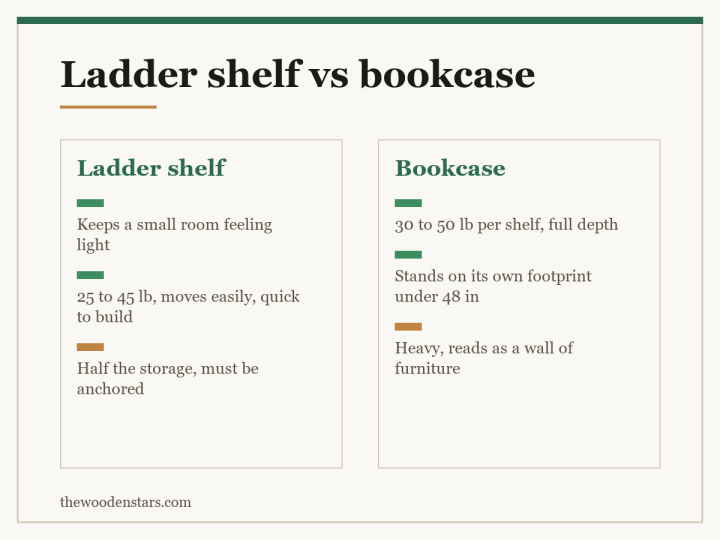
For depth specifically, see how deep a bookshelf should be; for the freestanding-against-wall-mounted question, bookcase or bookshelf; and for standard sizes, bookcase dimensions.
Questions we get asked
How do I fit more books into a small room?
Go shallower first — 8 inches suits most paperbacks — then taller, up to the ceiling. Wall-mounted shelving removes the footprint entirely.
How deep should a space saving bookshelf be?
Six to eight inches for paperbacks. Only go to 12 if you own large-format books, because spare depth collects an invisible second row.
Are floating shelves good for books?
For paperbacks, yes. The hidden rod limits capacity, so a run of hardbacks needs proper brackets into studs.
How long can a shelf be before it sags?
About 30 inches in 3/4 inch panel, 36 in plywood or solid timber, 42 in one-inch solid. Longer needs support or a stiffening front edge.
Does a tall bookcase need anchoring?
Yes, into a stud. A loaded tall case is one of the higher tip-over risks in a home.
Where can I put shelves that I have not thought of?
Above a door, in chimney alcoves, under a window, along a hallway, under the stairs, and in corners.