Bookcase or bookshelf — The words, and what changes structurally
The Wooden Stars is a participant in the Amazon Services LLC Associates Program. We may earn a commission when you buy through links on our site, at no extra cost to you.

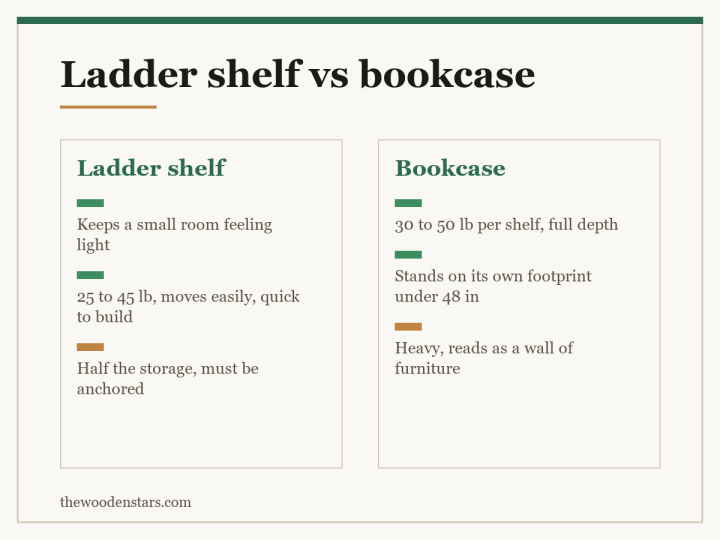
Most people use bookcase and bookshelf to mean the same thing, and in ordinary speech that is fine. But there is a real distinction underneath, and it maps onto a structural difference that decides whether the thing can stand on its own.
Once you know it, the two words stop being interchangeable and start telling you what you are buying.
A bookcase is a freestanding case — sides, top, bottom and usually a back — that stands on the floor by itself. A bookshelf is, strictly, a single shelf, and in listings it has come to mean anything shelf-like including wall-mounted units with no case around them. The structural consequence: a bookcase has a back panel and a base, which stop it racking; a wall-mounted shelf relies entirely on the wall and its fixings. So the word tells you where the load goes — into the floor, or into your studs.
The distinction, and why it is structural
Bookcase
A case: two sides, a top, a bottom, shelves between them, usually a thin back panel. The whole thing is a box, and a box resists twisting. Load goes down through the sides into the floor.
It stands unaided — though it still wants anchoring to a wall so it cannot tip, which is a different problem from standing up.
Bookshelf, wall-mounted
Shelves carried on brackets, cleats or hidden fixings, with no case. Everything the shelf holds goes through the fixings into the wall.
No floor contact means no footprint, which is the whole appeal in a small room. The cost is that your wall becomes a structural component, and a plasterboard wall without studs behind it is not one.
Bookshelf, freestanding
Sold under the same word but structurally a bookcase — often an open frame with no back. Without a back panel it racks more easily, so it depends more on being anchored and on having well-fitted shelves.
| Feature | Bookcase | Wall-mounted shelf |
|---|---|---|
| Load path | Down through the sides to the floor | Into the wall fixings |
| Needs studs | No, but anchor it anyway | Yes, absolutely |
| Footprint | 10 to 14 in of floor depth | None |
| Racking resistance | Back panel and base | The wall |
| Moves house easily | Yes | Leaves holes |
| Capacity | High, limited by shelf thickness | Limited by the fixings |
| Best for | Any room with floor to spare | Small rooms, above furniture |
The number that governs both: shelf span
Whatever it is called, the thing that fails is the shelf, and it fails by sagging.
Sag rises steeply with span. A shelf twice as long as another bends roughly eight times as far under the same load per inch. That is why a 24-inch shelf in ordinary panel is fine and a 48-inch one in the same material bows within a couple of years — permanently, because timber and panel both take a set.
Practical limits for books, which are heavy:
- 3/4 inch particleboard or MDF: keep spans under about 30 inches.
- 3/4 inch plywood or solid timber: up to about 36 inches.
- 1 inch solid timber: up to about 42 inches.
- Anything longer needs a centre support, a thicker shelf, or a stiffening strip glued along the front edge.
A front edge strip is the cheap fix and it works remarkably well, because stiffness rises with the cube of depth and the strip adds depth exactly where the bending is.
Depth: what you actually store
Bookcases are commonly 10 to 12 inches deep, which suits most books with room to spare. Deeper is not better — it just invites two rows of books, and the back row becomes invisible.
Paperbacks need about 7 inches, standard hardbacks 9 to 10, and large-format art and cookery books 12 to 14. If the collection is mostly paperbacks, a shallow unit holds the same books in less floor. The full sizing is in how deep a bookshelf should be, and standard case dimensions in bookcase dimensions.
Fixing a wall-mounted shelf properly
This is where wall-mounted units fail, and it is entirely avoidable.
- Find the studs. Books are dense — a metre of shelf can hold 30 to 40 kg. Plasterboard anchors alone are not adequate for that, whatever the packaging claims.
- Use at least two fixing points per bracket run, and put a bracket within a few inches of each end rather than only in the middle.
- Check the bracket depth against the shelf depth. A 10-inch shelf on 6-inch brackets has four inches of unsupported overhang at the front, which is where the load sits.
- Floating shelves have a hidden rod system, and the rod length is the real capacity limit. They look best and carry least — fine for a row of paperbacks, wrong for a run of hardbacks.
The bracket options are covered in bookshelf brackets and brackets for floating shelves.
Anchor a bookcase too
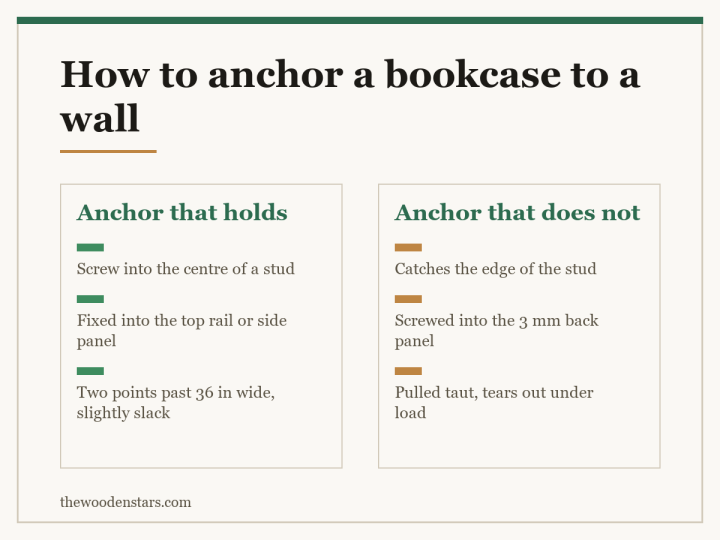
A tall bookcase loaded top-heavy, with a child climbing it, is the same tip-over risk as a tall chest of drawers. Anchor it into a stud with a strap on the day it goes up.
This is not about whether it stands — it does. It is about what happens when somebody pulls on it. The same argument applies to tall wood dressers.
Material, where it counts
For a bookcase: the shelves (span and thickness, above) and the back panel, which should be fixed all the way round rather than tacked at the corners. A proper back is most of a case’s resistance to twisting.
Adjustable shelves on pins are a good sign, because they mean the sides are substantial enough to drill a column of holes. The material vocabulary is in what engineered wood actually is, and repairing a shelf that has already bowed is in how to fix a sagging bookshelf.
For either kind
- Stud finder Mandatory for wall-mounted shelves; books are heavier than they look
- Furniture anti-tip kit A loaded bookcase is a tipping risk even though it stands alone
- Shelf pins Spares let you re-space shelves to the books you actually own
- Spirit level A shelf out of level shows against every book on it
What to buy


For depth specifically, see how deep a bookshelf should be; for standard sizes, bookcase dimensions. In a tight room, space saving bookshelves, and for fixings, bookshelf brackets.
Questions we get asked
What is the difference between a bookcase and a bookshelf?
A bookcase is a freestanding case with sides, top, bottom and usually a back. A bookshelf strictly means a single shelf, and in listings covers wall-mounted units with no case.
Is a bookcase stronger than a wall shelf?
It carries its load to the floor rather than into your wall, so capacity is limited by the shelves rather than by fixings. A well-fixed wall shelf into studs is still strong.
How long can a bookshelf span without sagging?
About 30 inches in 3/4 inch panel, 36 in plywood or solid timber, 42 in 1-inch solid. Longer spans need support or a stiffening front edge.
Do wall-mounted shelves need to go into studs?
For books, yes. A metre of shelving can hold 30 to 40 kg, which plasterboard anchors alone will not carry reliably.
How deep should a bookcase be?
Ten to twelve inches suits most books. Paperbacks need about 7; large-format books need 12 to 14.
Does a freestanding bookcase need anchoring?
Yes. It stands unaided, but a loaded tall case tips if someone pulls or climbs on it.