How deep a bookshelf should be — By what you actually store
The Wooden Stars is a participant in the Amazon Services LLC Associates Program. We may earn a commission when you buy through links on our site, at no extra cost to you.

Bookshelf depth gets chosen by whatever the shop had, and then lived with for years. It is worth thirty seconds of thought, because too deep is a worse problem than too shallow — a deep shelf invites a second row of books, and the back row becomes invisible storage you will never use.
The right depth comes from what you actually put on the shelf, and books are more standardised than they look.
For books alone, 10 to 12 inches is the standard and it suits almost everything. Paperbacks need about 7 inches, standard hardbacks 9 to 10, and large-format art, photography and cookery books 12 to 14. Go shallower — 6 to 8 inches — in a hallway or a narrow room where floor depth is precious; a shallow shelf holds the same paperbacks in half the footprint. Go deeper only if you genuinely own oversized books, because a deep shelf otherwise just collects a hidden second row.
What each kind of book needs
| Contents | Depth needed | Notes |
|---|---|---|
| Mass-market paperbacks | About 7 in | A 6 in shelf works with a slight overhang |
| Trade paperbacks | 8 to 9 in | The most common modern format |
| Standard hardbacks | 9 to 10 in | Novels, biography, most non-fiction |
| Textbooks and reference | 11 to 12 in | Also the heaviest, so check the span |
| Art, photography, cookery | 12 to 14 in | Often landscape format and very heavy |
| Records (12 in LPs) | 13 to 14 in | Plus a stiff shelf; records are dense |
| Box files and A4 folders | 12 to 13 in | Depth for the file plus finger room |
| Decorative objects only | 6 to 10 in | Depth is about proportion, not capacity |
Add about half an inch to any of these so you can get your fingers behind a book to pull it out. A shelf sized exactly to the book means hooking the top of the spine, which is how spines get torn.
Why deeper is not better
Three real costs to buying deeper than you need.
Floor space. A 14-inch bookcase against a wall in a 10-foot room takes 12 per cent of the room’s depth. A 9-inch one takes 8 per cent. Across a long wall that difference is a walkway.
The second row. Any shelf with spare depth behind the books will acquire a second row within a year. Those books are then invisible and effectively lost. If you want double-depth storage, that is a decision to make deliberately, not one to drift into.
Sag. A deeper shelf is a heavier shelf, and it holds more weight, so it bends further across the same span. Depth and span interact, which is the next section.
Depth, span and sag together
A shelf bends according to how far it spans, not how deep it is — but depth decides how much weight sits on it.
Sag rises with the cube of span. Double the length and the same load per inch bends it roughly eight times as far. And because timber and panel both take a permanent set, a shelf that bows does not recover.
Practical limits for a shelf full of books:
- 3/4 inch particleboard or MDF: under about 30 inches between supports.
- 3/4 inch plywood or solid timber: up to about 36 inches.
- 1 inch solid timber: up to about 42 inches.
- Longer than that needs a centre support, a thicker shelf, or a stiffening strip glued along the front edge.
The front-edge strip is the cheapest fix and works unreasonably well, because stiffness rises with the cube of depth and the strip adds depth exactly where the bending happens. If a shelf has already bowed, see how to fix a sagging bookshelf.
Shallow shelves, where they win
A 6 to 8-inch shelf is genuinely useful and under-used.
Hallways and landings. A corridor needs about 36 inches of walking width. An 8-inch shelf in a 44-inch hallway leaves that; a 12-inch one does not.
Above a desk or a bed. Shallow means less overhead presence and less to hit your head on.
Paperback collections. If most of what you own is paperbacks, a shallow shelf holds them all with nothing wasted and nothing hidden.
Display. Single-row picture-ledge shelves are 4 to 5 inches and exist to show covers rather than spines.
Shallow units for tight rooms are covered in space saving bookshelves.
Height between shelves
Depth is only half the sizing question. Vertical spacing matters as much, and adjustable shelves are worth paying for because book collections change.
- Paperbacks: 8 to 9 inches of clear height.
- Standard hardbacks: 10 to 12 inches.
- Large-format books: 13 to 15 inches.
- Records: 13 inches, and they must stand vertically — stacked flat they warp.
Adjustable shelves sit on pins in a drilled column, which also tells you the sides are substantial enough to drill. Standard case sizes are in bookcase dimensions, and pin sizes in shelf pins and supports.
Wall-mounted shelves: depth against bracket length
One extra check if the shelf is on brackets rather than in a case.
The bracket should support at least two thirds of the shelf depth. A 12-inch shelf on 6-inch brackets has half its depth unsupported at the front — which is exactly where the load sits when books lean forward.
Floating shelves have hidden rods, and the rod length is the real limit. They look best and carry least: fine for paperbacks, wrong for a run of hardbacks. The options are in bookshelf brackets and brackets for floating shelves.
Before you order
- Tape measure Measure your deepest book, then add half an inch for finger room
- Shelf pins Spares let you re-space to the books you actually own
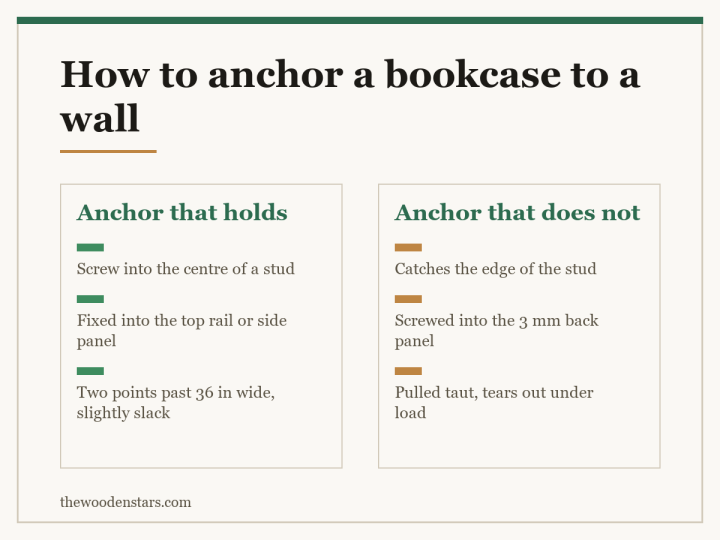
- Stud finder Wall-mounted shelves carry real weight and need studs
- Bookends A half-full shelf leans, and leaning books bend their own boards
What to buy


For standard case sizes, see bookcase dimensions; for the freestanding-against-wall-mounted question, bookcase or bookshelf. In a tight room, space saving bookshelves.
Questions we get asked
How deep should a bookshelf be?
Ten to twelve inches suits most books. Paperbacks need about 7; large-format art and cookery books need 12 to 14.
Is a 12-inch bookshelf too deep?
Only if your books are smaller than that. Spare depth collects an invisible second row and costs floor space.
How deep does a shelf need to be for records?
Thirteen to fourteen inches, and the shelf must be stiff — records are dense, so keep the span short.
How much space should there be between shelves?
Eight to nine inches for paperbacks, 10 to 12 for hardbacks, 13 to 15 for large formats. Adjustable shelves are worth paying for.
Can a shelf be too shallow?
A slight overhang at the front is fine and common. Below about 6 inches, standard books start to overbalance forward.
How long can a shelf be before it sags?
About 30 inches in 3/4 inch panel, 36 in plywood or solid timber, 42 in one-inch solid. A stiffening strip on the front edge extends all of those.